Last week, the NLL held a dispersal draft for the Panther City Lacrosse Club, where each of the other 14 teams selected players from the PCLC roster (or list of draft picks). This was the first dispersal draft in the NLL since 2011, but for a while before that, they were a regular thing as teams came and went all over the place.
In the early 2000’s, the league expanded a bunch of times, moved teams around a lot, and contracted teams a lot. For a while, it was the wild west. It seemed that for every Calgary or Colorado that stuck around for a long time, there were a half-dozen Orlandos and Portlands and Chicagos that were there for a couple of years at most and then vanished. It became clear that if you could come up with the entrance fee ($1 million or $2 million at the time, later up to $5 million), the league would toss a franchise your way, no questions asked. More often than not, the team would draw poorly, leaving the owner short on funds. The Washington Power once earned a home playoff game but chose to play on the road because they’d lose less money. One team (I can’t remember which but it might have been the same Washington Power) couldn’t pay its players at one point. The owner could try to sell the franchise but more likely they’d have to cut their losses and poof! Another dispersal draft.
And when I say they contracted teams a lot, I mean a lot. There were dispersal drafts every year from 2002 to 2011 with the exception of 2006. One of those drafts (just before the 2008 season) dispersed the players from two teams at once. A year later, there were two separate dispersal drafts in one off-season. In those two years, the same players from the same team were dispersed twice, but that’s another story altogether.
The dispersal drafts had a huge effect on the league, usually more so than the entry drafts. Obviously adding a promising rookie like Josh Byrne, Lyle Thompson, or Mark Matthews can have a big impact on a team, but in a dispersal draft, you’re drafting from among players who have already played in the league, sometimes for years. Imagine drafting Dan Dawson (who went first overall in three different dispersal drafts), Casey Powell, or Brodie Merrill in their primes. In the Orlando dispersal draft, Colorado picked up Matt Vinc, who had just won his first Goaltender of the Year award, and flipped him to the Knighthawks for John Grant, Jr.
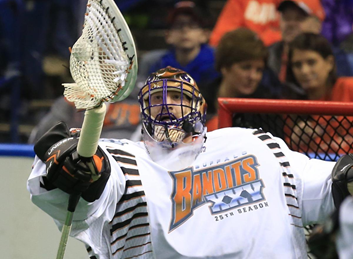 First overall picks in dispersal drafts include Dan Dawson (2007, 2008, 2011), Tracey Kelusky (2002), Anthony Cosmo (2008, pictured at right), Brodie Merrill (2009), and Matt Vinc (2010).
Then in 2013, the unthinkable happened. A second straight NLL season began with the same teams in the same locations. No new teams, no contraction, no relocation. The last time before this that a season had begun with exactly the same teams as the previous season was 1993. But after twenty years of constant team changes, things started to stabilize. There was still some team movement: Washington, Philadelphia, Edmonton, Minnesota, and Rochester changed locations, and we had new teams like the new Wings and Knighthawks as well as the Riptide, Seals, and Desert Dogs. But for every location that failed, a new location was found so no teams were contracted. As mentioned above, the Panther City dispersal draft is the first one in 13 years.
Every new team wants to be the next Buffalo or Calgary, pulling in 10+ thousand people per game, but the unfortunate fact is that you’re more likely to be gone in a few years. There have been 50 different teams in NLL history. 24 of them (almost half) lasted less than five years before vanishing or being moved, while only 7 have lasted 15 or more years. I hate to say it, but it’s not unlikely that we’ll have more dispersal drafts in the future. Let’s just hope that they’re few and far between like the last 13 years, and not an annual event like the previous decade.
 NLL Chatter