Many NLL fans these days have heard the story that the Buffalo Bandits had a long winning streak back in the early 90’s that lasted an entire season. It’s true, but there’s more to it than just that. Let’s have a look the facts of this amazing streak.
Category Archives: History
Stats Central: Elite scorer vs. committee
From 2018–2020, I wrote a weekly article for IL Indoor called Stats Central. Every week I’d look at various statistics and see what kind of insight we can get from them. All of those articles are listed here.
In 2019, I wrote the article below, where I looked into whether it’s generally better to build your team’s offense around a single superstar player, or to have a more “scoring-by-committee” approach. The conclusion was less than compelling, and so I wrote a different article for that week and shelved this one. I’ve blown the dust off of it, rewritten a bit, and updated the numbers to include the seasons since then.
Here, for your viewing pleasure, is the Lost Stats Central Article.
The History of the NLL Dispersal Draft
Last week, the NLL held a dispersal draft for the Panther City Lacrosse Club, where each of the other 14 teams selected players from the PCLC roster (or list of draft picks). This was the first dispersal draft in the NLL since 2011, but for a while before that, they were a regular thing as teams came and went all over the place.
He played where? Players and their forgotten teams
Every now and again, I see a stat or an old NLL boxscore that surprises me, because it shows a player playing for a team that I’d forgotten he ever played for. What, Jimmy Quinlan wasn’t always with the Rush? Mark Steenhuis wasn’t a Bandit his whole career? Callum Crawford has played in lots of places but… Calgary?
Then recently, someone on an NLL podcast (I think it was Pat Gregoire but if it wasn’t, my apologies to whoever it was) said something about this very thing. He even called me out by name, suggesting that I write about it. All right then. Challenge accepted.
Here are a bunch of players who had long stints for one or two teams (or many, if you’re Callum Crawford or Ryan Benesch), and potentially forgotten shorter stints for other teams. We’ll start with active players and while there are dozens of inactive players I could list, I’ll only list the inactive ones that surprised me the most.
Memories of my first season as an NLL fan
I grew up in southern Ontario. Other than a year and a half in Ottawa and a four month work term in Redmond, Washington, I have lived my entire life within a two-hour drive of Toronto. That area is home to about 60% of NLL players. But unlike them, my first exposure* to the sport of lacrosse came when I was twenty-one. My university roommate Steve bought himself a lacrosse stick. He didn’t know anyone else who had one, so he played a lot of wall ball. The extent of my lacrosse experience at that time consisted of tossing a ball straight up a few times, not much further than a foot or two. I usually caught it.
After that semester, lacrosse left my mind once again and stayed out until almost ten years later. On April 1, 2000, I went with some friends to a Wings/Bandits game in Buffalo. That’s the day I fell in love with lacrosse. I immediately became a Rock season ticket holder and in December of that year, I went to my first ever Toronto Rock game, a 17-7 win over the Ottawa Rebel. Here are some of my memories and impressions about the team and the league from that year.
Watson vs Eliuk vs Vinc
For many years, the question of “best goaltender in NLL history” has had two answers: Bob “Whipper” Watson and Dallas Eliuk. Some say Dallas, some say Whipper, some can’t decide between the two. It’s rare that you hear someone other than one of those two described as the best ever. But the question of Whipper vs. Dallas as the best ever may soon become outdated. Nothing’s being clarified, however; the waters are getting even muddier.
I don’t think it’s a stretch to say that Matt Vinc has been the best goaltender in the NLL over the past decade. The awards and numbers certainly back that up:
- Five Goaltender of the Year awards in six years
- Three Championships plus two other trips to the finals
- Led the league in GAA in 2013, finished in the top three four other times
- Holds three of the top ten spots in the “Best GAA in a Season” list (see weird aside below)
- Has the second-lowest career GAA among starters in NLL history
- Second in NLL history in career saves; will overtake Anthony Cosmo in game two or three next season (he’s 104 behind)
- Second in NLL history in career minutes; will overtake Anthony Cosmo in game four or five next season (he’s 221 behind)
- Third in NLL history in career playoff GAA
- First in NLL history in career playoff minutes and saves, ahead of second place by over 300 minutes and 170 saves
Weird aside: Here’s an odd one for @NLLFactOfTheDay: A starting goalie has finished a season with a sub-10.00 GAA only 17 times in NLL history. Matt Vinc has done it four times. Nobody else has done it more than twice. Yet Vinc didn’t lead the league in GAA in any of those four seasons. And here’s the craziest part: in 2010, Vinc finished with a GAA of 9.51, the seventh best of all-time, but he finished fourth in GAA that season.
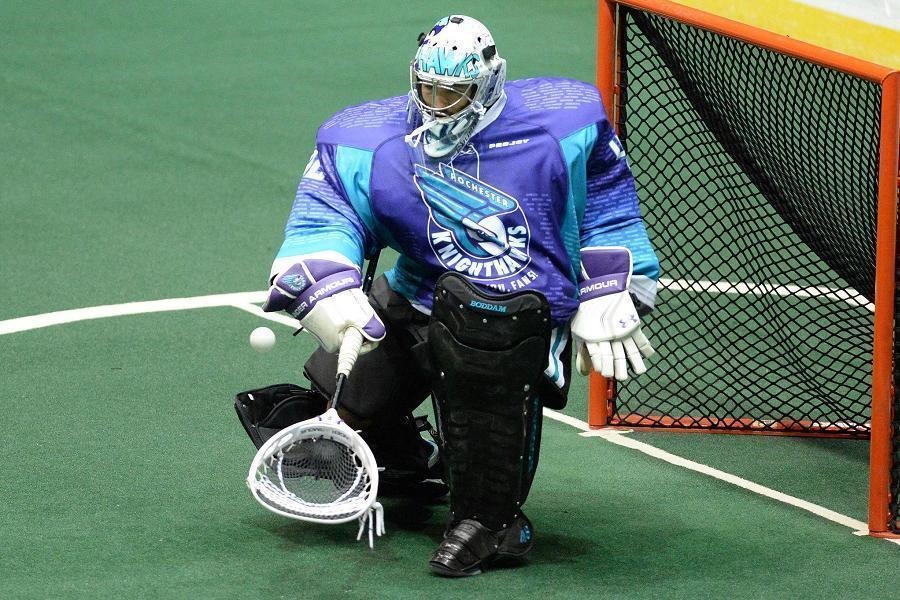
Vinc has won five Goaltender of the Year awards, while Watson won only two and Eliuk never won any. This is, of course, meaningless since the award didn’t exist before 2001. Eliuk’s career was more than half over by the time the award came into being and from 2002 until the end of his career, his teams were generally pretty lousy. (His 2008 LumberJax made the finals, but Eliuk was the backup goalie by then.) Having said that, Watson won the 2008 Goaltender of the Year award on a sub-.500 team that missed the playoffs.
When comparing players’ careers, I never compare the number of Championships they won. That is entirely a team statistic and has no bearing on whether one individual player was better than another. Brodie Merrill has never won an NLL title but he’s arguably better than an awful lot of players who have. But if you must know, Eliuk won six with the Wings, Watson six with the Rock, and Vinc three with the Knighthawks.
If we’re going to compare these three goalies, shouldn’t we just compare their stats directly? Let’s try. Vinc has a lifetime GAA of 10.88. Watson’s was 11.14, while Eliuk was 12.24. So Vinc’s GAA is 0.26 lower than Watson and 1.36 lower than Eliuk. Pretty clear that he’s the best of the three, right? Actually, no.
During Dallas Eliuk’s career spanning 1992-2008, the average number of goals scored in an NLL game was 25.66. During Bob Watson’s career from 1998-2011, the average dropped to 24.82, and during the Matt Vinc years from 2006-2018, the average was only 23.41. Eliuk had a higher GAA because more goals were scored in general during his career (2.25 more per game) than during Vinc’s. Thus you’d expect Eliuk’s GAA to be higher than Vinc’s. If you assign half the difference in goals scored to each goalie, Eliuk would have a sort of “handicap” of 1.13 over Vinc, so the 1.36 difference in their GAAs is really only about 0.23. Similarly, Watson’s adjusted GAA is actually lower than Vinc’s.
I don’t have numbers for shots faced before 2005, so I can’t compare their career save percentages. But from 2005-2018, Vinc has a save percentage of 78.2%, third behind Steve Dietrich and Ken Montour (and a handful of others with just a couple of games played). Watson is only three players back of Vinc at 77.4% while Eliuk is a fair ways back at 75.9%. Again though, that only covers the last three years of Eliuk’s career, not his prime.
Not that this is news, but there’s no really good way to compare players who played in different eras. Eliuk’s career and Vinc’s only overlapped by three years, but Eliuk was past his prime by then and Vinc wasn’t yet the standout goalie he would become. The game was different enough during the years before and the years after that statistics can’t be directly compared. Watson’s career overlapped both for a longer period of time but there is a twelve-year age difference between Watson and Vinc (and six years between Watson and Eliuk) so comparisons are still difficult.
So which of the three is the best ever? There’s no correct answer – arguments can be made for any of the three. Maybe we have to say Eliuk is the best of the 1990’s, Watson the best of the 2000’s, and Vinc the best of the 2010’s, and leave it at that. The only thing we can definitively say is that this is no longer a two-horse race.
The Blazers and the Sting: It’s drafty in here
The mid-to-late 2000’s were a tumultuous time in the NLL. Teams were popping up, moving, and vanishing all over the place. This all reached “peak weird” in about 2007-2008 and if you are new to the NLL, you might not know about all of these strange goings-on. Even if you’ve been following the league since then, some of this is still hard to believe.
Deconstructing the 2008 Minnesota Swarm
While searching for facts for @NLLFactOfTheDay, I stumbled upon a couple of crazy games by the Swarm in 2008. That made me look over the 2008 season for the Swarm in a little more detail, and I found some more fun little tidbits. The 2008 season was long enough ago that there are lots of familiar names involved in these games but not always on the teams you might expect. But it was also recent enough that I remember some of these things happening.
So here’s a summary of the 2008 Swarm season. If you like this idea, maybe I’ll deconstruct some other memorable seasons, perhaps the 2007 Knighthawks or 2005 Rock. But like the ’08 Swarm, it doesn’t have to be Championship teams; it might also be fun to look at the 1-15 2006 Rush. Send in your suggestions! But note that I only have detailed information going back to 2005. Before that I can only talk about wins/losses, final scores, attendance, and season scoring stats.
Five players you didn’t know played somewhere else
Everyone knows that John Tavares played his entire career with the Bandits. Similarly, Blaine Manning played with nobody but the Rock, Andrew McBride with the Roughnecks, and there are a few others.
And then there are a number of other players who you might think are in the same boat because they’ve played so long with one team that you can’t think of them playing anywhere else. But they did. If you’re a long-time fan of the league, you may know all of these but I’d guess that for many of you, at least one of these will be a surprise. The first one was for me and led me to look around for more.
These are in no particular order.
Jeff Shattler
Can you imagine Shattler in any jersey other than the Roughnecks? How about Bandit orange? Shattler played a single game with the Buffalo Bandits in 2006, where he picked up one assist and three loose balls. He was then traded to the Roughnecks along with a second round draft pick for Kevin Dostie. Shattler’s now in his eleventh season with Calgary, having played over 190 games and amassed over 700 points. He also won the Transition Player of the Year and MVP awards in 2011. Dostie picked up 157 points in 53 games over four seasons in Buffalo so it’s not like the Bandits got nothing back, but I’m going to call Calgary the winner on that one.
Incidentally, that second round pick that Calgary also picked up? They used it to draft Jamie Lincoln, who never played for Calgary but did see time with the Mammoth, Stealth, and Black Wolves.
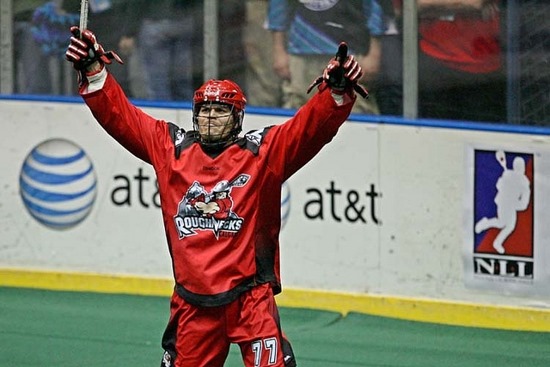
Mark Steenhuis
Steenhuis has been a Bandit his whole life, right? Wrong. He actually played a full season with the Columbus Landsharks in 2002, picking up 30 points in 12 games. He’s since played 233 games as a Bandit.
Bob Watson
Watson actually played for two different teams before the Rock, but one was the Ontario Raiders (who turned into the Rock after one season in Hamilton) so that doesn’t really count. But Whipper also played 268 minutes for the Baltimore Thunder in 1996, where he had a very un-Whipper-like 17.24 GAA. He took 1997 off entirely and returned to the NLL with the Raiders in 1998 and then played 13 seasons with the Rock, where he only had two seasons with a GAA above 12 (and one of them was 12.04). Oh, and two Goaltender of the Year awards, two NLL Championship Game MVP awards, six championships, and a Hall of Fame induction.
Jimmy Quinlan
Quinlan became the face of the Edmonton Rush from 2006-2013, playing over 125 games, many of them as captain. He then became an assistant coach with the team, where he remains. Many Rush fans can’t imagine the team without Jimmy Quinlan. But Quinlan picked up 10 points in 8 games, and a Championship ring, with the Toronto Rock in 2005.
Scott Ranger
Ranger was drafted by the San Jose Stealth and actually played parts of two seasons (11 points in 9 games in 2004 and 2005) there before heading to Calgary where he picked up more than 450 points in 137 regular season and playoff games over 8 years.
Six degrees of Bob Watson
I realized the other day that a large number of goaltenders in the NLL have played with Anthony Cosmo. This is not surprising seeing as how he’s been around so long. Then I realized that both he and Mike Poulin are the only goaltenders left in the league who played alongside the great Bob Watson, so it turned into a little game – how many steps is each goalie from Bob Watson?
I’ve gone through the current goaltenders in the league and assigned them a “Whipper number”, defined thusly:
- Bob Watson has a Whipper number of 0.
- Anyone else has a Whipper number one greater than the lowest Whipper number of anyone they played with.
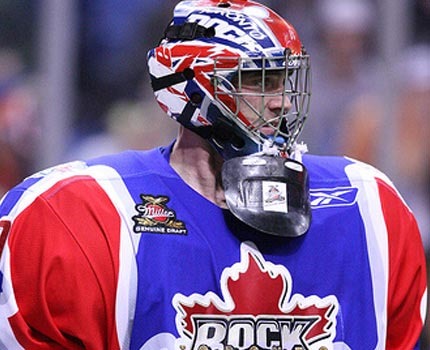 So if you played on a team at the same time as Watson, your Whipper number is 1. If you didn’t but played with someone with a Whipper number of 1, your Whipper number is 2, and so on. If you are familiar the “Six Degrees of Kevin Bacon” game or Erdős numbers in mathematics, it’s the same idea.
I decided to limit it to just goaltenders, so Tyler Richards playing with Colin Doyle who played with Whipper doesn’t count.
1
Anthony Cosmo played with Whipper on the Rock 2001-2004, and Mike Poulin did from 2007-2008.
2
Christian Del Bianco played with Mike Poulin in 2016, while Frank Scigliano did from 2012-2016. Davide DiRuscio played with Cosmo in 2016. Brodie MacDonald plays with Poulin in Georgia now (2017). Matt Vinc played with Cosmo in San Jose in 2006. Angus Goodleaf played with Cosmo in Buffalo from 2010-2012. Aaron Bold played with Cosmo on San Jose from 2007-2008, and Brandon Miller did from 2005-2006. Nick Rose played with Cosmo on Boston in 2010-2011 and also played with Poulin in Calgary for part of 2012.
3
Tyler Carlson has played with Aaron Bold on the Rush since 2015. Tyler Richards played with Bold on the San Jose Stealth in 2009. Evan Kirk played with Brandon Miller on the Wings in 2014. Steve Fryer played with Miller on the Wings in 2012 and the Rock in 2014 and 2016.
4
Tye Belanger played with Evan Kirk on the Black Wolves in 2015-2016. Doug Jamieson plays with Kirk on the Black Wolves now (2017).
5
Dillon Ward played with Tye Belanger in Colorado in 2014.
6
Alexis Buque has played with Ward in Colorado since 2015.
So 11 of the 18 goalies in the league (61%) either played with Whipper or played with someone who did. Like I said, this isn’t really surprising, since Watson has only been retired for 5 seasons and both Cosmo and Poulin have each been around for 10+ years and have played in a number of cities.
Next project: six degrees of Mat Giles. Giles played for 12 different teams in 15 seasons and retired in 2013 so I suspect 80% of the league has a Giles number of at most 2.
 NLL Chatter