Help the Iroquois get back in the blue

This is not an issue affecting the National Lacrosse League, which is what I usually write about. But this is an important issue for lacrosse in general and your help is needed.

In 2010, the World Lacrosse Championships (field lacrosse) were held in England. A controversy erupted when the UK refused to allow the Iroquois Nationals team into the country. The Iroquois team is entirely separate from the Canadian and US teams and is one of the top teams in the world. The team uses passports issued by the sovereign Haudenosaunee nation*. Citizens of the Haudenosaunee consider themselves neither American nor Canadian, and have their own passports which, I believe, are accepted in Canada and the US and recognized by the UN.

* – Haudenosaunee is the native word for the Iroquois people, which consists of six Native American tribes (known as the “six nations”) banded together in New York and southern Ontario.

Iroquois players

Originally, the UK refused to grant visas to the players because there was no guarantee that the US would allow the players back into the country. US Secretary of State Hillary Clinton got personally involved and offered to grant US passports to everyone on the team but they were determined to travel using their own passports. Clinton then granted the team a waiver that effectively constituted the guarantee the UK was looking for, but they refused to change their minds. As a result, the team missed the entire tournament.

The tournament is held every four years, and the next one will be held in Denver in July of 2014. While travelling to the tournament will not be a problem this time around, the FIL (Federation of International Lacrosse) has decided that since the Iroquois did not compete in the last tournament, they will be seeded 30th. This puts them well out of the Blue division, which traditionally represents the top six teams from the previous tournament. Many lacrosse people, Iroquois and otherwise, are protesting this decision. There is only one reason why the Iroquois team was not in the top six, and that reason had nothing to do with lacrosse – it was entirely political. Punishing the team for decisions that were not only unfair but beyond their control only serves to legitimize the UK’s decision.

It’s not just the Iroquois team that would be affected by this decision. Lacrosse is hundreds of years old in North America, but it’s quite new in a number of countries that are participating for the first time. Consider the countries that are just good enough to make it to this competition (think the German or Latvian Olympic hockey teams in 2010) and then find out that they are in the same group as the Iroquois team. If your position in the next tournament depends on how you do in this one, do you want to be disadvantaged by having one of the strongest teams in the entire tournament in your division when they really should be a few levels up?

The game of lacrosse was invented by Native American people many hundreds of years ago in eastern North America. The Iroquois people are directly descended from those people – in a nutshell, this is their game. Should the Iroquois team automatically be put into the top division just because of that? Honestly, no. But it does earn them some respect from the lacrosse community. That in addition to their play in other competitions should earn them some flexibility on the part of the FIL.

The Iroquois have earned their place among the best lacrosse teams in the world. They should not be punished because of a purely political incident.

Iroquois_thumb1

An online petition has been created to attempt to convince the FIL to reverse this decision and allow the Iroquois team to play in the top division, where they belong. I am asking my readers to please sign this petition and help restore the Nationals’ rightful standing as one of the top lacrosse teams in the world.

Update: The FIL has voted and decided that the Iroquois will be in the Blue division in 2014. I don’t know whether or not the petition had anything to do with the decision, but it’s not unlikely that the outcry from the lacrosse community was a factor. Thanks to everyone who signed the petition!

How do we avoid moving the Championship game? And should we avoid it?

Yesterday, we talked about the 2013 NLL Championship game being held in Langley, BC because of scheduling issues at Comcast Arena. But could this have been avoided? Yes. How?

Money.

It would have been relatively easy to avoid, actually, though pricey. When the regular season schedule was being made, the NLL would have figured out when the final week of the season was going to be. Each team would then book the Saturday night of the next weekend for the Division Semi-Finals, the Saturday night of the following weekend for the Division Finals, and the Saturday night of the next weekend for the Finals. If they wanted to be really thorough, they would have booked Friday night, Saturday, and Sunday of all three weekends. Then there’s no chance that the arena would be booked for the playoffs, and everything’s good. Right?

Well, yes, except that for most teams, booking their arena for three entire weekends in a row during the NHL playoffs is completely impossible. Every NLL team except Washington and Rochester has an NHL team playing in the same arena. In every one of those cases (even the ones where the NHL team doesn’t own the building), I’ll give you one guess which team would get priority during those weekends. Hint: the answer rhymes with NOT LACROSSE.

So let’s say we decide that some playoff games are going to be Friday night, some Saturday night, and some Sunday afternoon, and the building owners all agree with the dates. Now the team owners have to pay for those dates, and I don’t imagine that paying to rent the ACC or Rexall Place is overly cheap. In fact, since there are only 8 home games (for now) and you just added three more, you’ve increased your arena costs by 37.5%. Sure, most teams will be able to cancel one or all of those dates eventually and presumably get some of their money back, but (a) you might not be able to cancel the dates until a week before, and b) there will very likely be a steep financial penalty (even more so because of the late notice). The non-hockey-team NLL owners (Toronto, Washington, Edmonton, Philadelphia, Rochester) are used to putting down their own money knowing they’re unlikely to get it all back, but they’re only so altruistic, and frankly I think it’s unfair to expect the owners to pay that out of their own pockets. The franchises or the league would have to foot the bill, and I’m pretty sure there just isn’t that much money floating around the NLL’s bank accounts.

Is every ticket-buying fan in the league interested in bumping ticket prices across the board to avoid the exceptionally slim possibility of both (a) their team making it to the finals and (b) the arena not being available? Some might, others won’t. It wasn’t the case this year with the parity we currently have, but some years it’s obvious from the start that one or more teams are just not good enough to make the finals. Would fans of those teams want an increase in ticket prices so they could book their arena for a Championship game that they have almost no chance of hosting?

I would think that if such a decision had to be made, pissing off a few fans in one city by moving the Championship game is the lesser of two evils when compared with pissing off more fans in all the NLL cities.

So yes, it could have been avoided. But the only real way to do it is by spending money that the league doesn’t have. Maybe when negotiating the TV deal for next season, the league could try and squeeze a few more bucks out of it, and then use that extra to book the arenas. But with all due respect to Stealth fans, in my opinion it really isn’t a big enough or frequent enough problem to warrant spending bucketloads of money on solving.

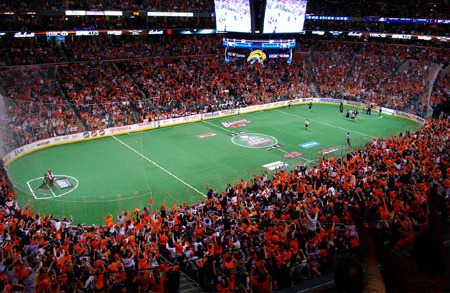
Langley hosts the NLL Championship

The NLL Championship game in 2013 will, for the first time, be held in a neutral site arena, kind of: the Langley Events Centre in Langley, BC. Langley is about 90 miles north of Everett and is the closest arena that the Stealth could find to host the game. Comcast Arena, the normal home of the Stealth, is booked this Saturday for a Christian music concert. The Key Arena in Seattle, a much closer alternative, is also booked with roller derby, and thanks to the CBS Sports TV contract, changing the date was not an option, so the Stealth were forced to either go to Langley or give up the game and allow the Knighthawks to host.

This would have been more than a little ironic, since a similar thing happened in 2007 when the Knighthawks were unable to host the Championship game because of a circus booked at the Blue Cross Arena. The Knighthawks had to win their first Championship in ten years in front of the fans of their opponents, the Arizona Sting.

The Langley Events Centre

There’s been a lot of talk on twitter and on the IL Indoor forums about this, most of which is negative, and phrases like “unprofessional” and even “bush league” have been thrown around. So I asked on twitter “How would you have solved the problem? Here are some of the responses:

@Amypriddy12: put the game in Rochester where they could sell out the arena…

@bradmacarthur: hold it in Rochester? ’07 games was moved to AZ when BCA wasn’t available.

@tfernaays: The same way the did in 2007: give the other team the game.

@RichCumpston: Just play it in Rochester, like they did in 2007 when Arizona couldn’t host it.

Is it just me, or is there a trend here? Yes, the option to move the game to Rochester was likely the next step if Langley was unavailable. The difference between this case and 2007 is that in Rochester’s case, there was no alternative. Presumably there are other arenas in the Rochester area, but if it’s too small, the league won’t want to hold the game there. If you think moving the final game to another arena is bush league, try televising a national championship on CBS Sports from a dinky little arena that holds 300 people. Any other arenas that might have been even close to the BCA in terms of capacity were booked, and the Board of Governors nixed an idea to hold the game in Buffalo. The only option at that point was to move it to Arizona.

In this case, there is another option available, and that’s Langley. Yes, the fans will have to drive a couple of hours north and cross the Canadian border, but if it’s either that or watch it on TV from Rochester, I imagine most Stealth fans will make the drive – or at least they’ll be happy that they have that decision to make.

I did get one other suggestion:

@GlenMcDole: I believe in the early 90s, highest attendance city held it. Denver would be a good place this year

On the surface, this seems like a decent idea – this way, you’re rewarding the city that has the most fans, and making fans happy is certainly good for the league. But first off, it means that most years, the Championship game is in a neutral site unless the team with the highest attendance also happens to make the finals. This is fine for the Super Bowl, where a city needs to prepare for a year just to host the game, but that’s not the case in the NLL.

Secondly, it would mean that the NLL would have the Championship in Colorado or Buffalo every year. Could this increase attendance in the other cities, with fans trying to get the Championship there? That seems like the goal, but I honestly doubt it would have any impact on attendance. Even if it does, it wouldn’t help the fans in small arenas (ironically, I believe Rochester and Washington are the two smallest). Buffalo’s First Niagara Centre can hold over 19,000, and the Bandits had that many out to their final game. But most of the other arenas just plain can’t hold that many people. Everyone in the entire City of Rochester could be lining up for Knighthawks tickets, but only 11k of them can fit in the arena, and so without building a new 20,000-seat arena, Rochester would have no chance of ever hosting a final. That’s unfair to them.

The league could make provisions, saying no team can host twice in a row, or that they alternate between the top three, or base it on the average percentage of capacity, but quite honestly, these schemes are starting to sound hokey to me.

Personally, I think the highest-seeded team that makes the final has earned the right to host it, and so that’s where it should be held. If that’s not possible, as is the case this year and was in 2007, the home team should be allowed to attempt to find an alternate location for the game, within reason. If the Stealth had said “Yes, the arena we used to use in San Jose is available, we’ll play there”, that’s no good since they’re well over 800 miles apart. Asking fans to travel that far is silly, though I understand the complaints about having to cross the border.

Does this suck for Stealth fans? Of course it does. But could it have been avoided? Check back tomorrow for the answer.

2013 NLL Award winners

Every year the IL Indoor writing staff submit their picks for the annual NLL awards, and here are mine. Note that these are not picks for who I think will win, they’re picks for who I think should win.

Offensive player of the year – Shawn Evans

Runners-up: Garrett Billings, Rhys Duch, Callum Crawford

Billings had almost as great a season in 2013 as he did in 2012, and Duch set personal records in both goals (leading the league) and assists. Crawford only had 4 games (out of 14) with less than 6 points – none of them after March 3 – and had six straight games of 8+ points. But Evans had them all beat before he even began his final game. Evans had five games with 10+ points, more than John Grant had during his record-setting 2012 season, while only Crawford and Dan Dawson even had two.

Transition player of the year – Jesse Gamble

Runners-up: Geoff Snider, Jeremy Thompson, Brad Self

Is this a bit of a homer pick? Possibly, but I really thought Gamble had a hell of a year. He played strong defense, ran like the wind, scored a bunch of goals (including two on the power-play), and led the team in loose balls.

I thought about picking Jordan MacIntosh, who will probably win the award, but decided against it for the same reason I didn’t think Jeff Shattler should have won this award two years ago – he’s not really a transition player. He’s an excellent player, no question, and as good as he was, he even stepped up his game when Andrew Suitor went down with a season-ending injury. But he played a lot more shifts on offense than he did defense. In the division semi-final game, MacIntosh played as much offense as Benesch or Crawford did. Gamble is a true transition player.

Defensive player of the year  – Kyle Rubisch

Runners-up: Chris Corbeil, Scott Self

It sounds like Kyle Rubisch might be the winner of this award every year for the foreseeable future. The word I hear most often to describe his play is “beast”.

Goaltender of the year – Matt Vinc

Runners-up: Brandon Miller, Tyler Richards, Nick Rose

If not for Matt Vinc, the Knighthawks might have been hitting the links early, not the Bandits. To have a goalie with the best GAA and the best save percentage in the league and still finish at .500 tells you how bad their offense was. Similarly, as one Wings fan put it, the Wings would be 1-15 without Brandon Miller. I’m not sure it would have been that bad but the Wings had a similar problem to the Knighthawks – outstanding goaltending, but almost no offense to speak of.

Rookie of the year – Mark Matthews

Runners-up: Kiel Matisz, Shayne Jackson, Dhane Smith, Curtis Knight

From a stats point of view, it was closer than you might have thought. Matthews had 4.31 points per game, while Jackson and Matisz had 4.00 and 3.94 respectively. But Matthews turned the Rush’s mediocre offense from last year into the third highest-scoring in the league, and that’s after losing Aaron Wilson, Scott Evans, and Shawn Williams. Obviously Matthews himself didn’t make up the difference entirely, but he forced opposing defenses to focus on him. This opened things up for Ryan Ward, Corey Small, and Zack Greer, all of whom increased their point totals over 2012.

Unsung player of the year – Cory Vitarelli

Runners-up: Kasey Beirnes, Jay Thorimbert, Brodie MacDonald

When you think of the offensive stars on the Knighthawks, you think Jamieson, Dawson, Powless, Accursi, Point, even Keogh, but Vitarelli doesn’t always spring to mind. But he was third in team scoring, put up at least a point in every game he played this year, and scored some of the prettiest goals we saw all season. Beirnes has gotten more recognition in the last year or two for his hard work playing behind big-name guys like Doyle, Billings, and Sanderson, but he’s been doing that for years. Jay Thorimbert had almost identical face-off numbers to Bob Snider, which is impressive in itself. Thorimbert split face-off duties in 2012 with Brandon Francis and Jeremy Thompson, but became the Bandits’ only face-off man this year – and increased their team face-off win percentage from 48.3% to 59.7%. Brodie MacDonald only played in three games this year, but put in at least 20 minutes in each, and finished with a GAA of around 8 and a save percentage of 80%. Having that kind of backup goalie behind you has to be a great confidence boost for both Aaron Bold and Derek Keenan.

Coach of the year – Troy Cordingley

Runners-up: Chris Hall, Derek Keenan

The Rock were the most consistent team this year, in a league where many teams looked unstoppable one week and terrible the next. Chris Hall showed how important he is to the Stealth, bringing them back from their brutal 2012 season, much of which was played without him, to second place in the West.

GM of the year – Derek Keenan

Runners-up: John Arlotta, Curt Styres

Drafting Mark Matthews wasn’t the master stroke – every GM would have done that. But in the off-season, Keenan retooled the offense, turning them from the worst in the league to the third-highest scoring – and managed to do this despite losing Shawn Williams, Aaron Wilson, and Scott Evans. Keenan also turned Paul Rabil, a player who never played for him and wasn’t going to, into Jarrett Davis.

MVP – Shawn Evans

Shawn EvansRunners-up: Garrett Billings, Callum Crawford, Matt Vinc

Evans had an outstanding year. He led the league in both assists and points, almost setting records in both, and beat his next closest teammate by almost fifty points. He had almost exactly the season Garrett Billings had a year ago, and Billings was my choice for MVP then. How close were their seasons?

G A Pts PPG LB Shots SOG
Billings 2012 32 82 114 10 74 195 131
Evans 2013 32 80 112 12 69 186 139

Evans had the same number of goals as he did last season but picked up 33 more assists. Just to cap it all off, Evans scored the overtime winner in the last game of the season to clinch the Western division for the Roughnecks.

When it comes to the playoffs, less is more

Understatement of the week: The fact that eight of the nine NLL teams make the playoffs has caused some controversy. Judging by the talk on twitter and the IL Indoor forums over the last year or two, many fans don’t like it. They feel it cheapens the regular season, making most of the games meaningless. As someone put it, they play 72 games to eliminate 1 team, then 7 games to eliminate 7 teams.

When there were six or seven teams in each division, this format made some sense, but now that there’s only nine teams, I’m not sure it still does. I don’t think I’ve seen the NLL actually state their reasons for making the decision not to change the playoff format , but there are advantages along with the disadvantages. Here are the top few of each:

Pros

  1. The more teams make the playoffs, the more fans get to watch playoff games, and who doesn’t want to watch their team in playoff games?
  2. More teams in the playoffs means more playoff games. More playoff games means more revenue. Now that the NLL is actually receiving money from a TV deal (CBS Sports), this is a good thing for the league.
  3. Unless a team has a really lousy season, every team is still in the playoff hunt until close to the end of the season, arguably making more games meaningful, not fewer. This year, with only four games left in the regular season, we only know the final seeding of one team, and three teams are still fighting for two remaining playoff spots.

Cons

  1. If you’re a good team and you’re confident you won’t finish last, you could mail in the first half of the season, knowing you’d still make the playoffs anyway. As long as you don’t finish last, the regular season is basically a warm-up for the playoffs.
  2. If two teams have a really lousy season, you could have a 5-11 team make the playoffs. And we have. For comparison, this is equivalent to 51 points in a full NHL season. The fewest points by a playoff team since the 2004-05 lockout was 88 by both Philadelphia and Montreal in 2009-10 – and many think the NHL also allows too many teams into the playoffs.

Con #2 is certainly an issue that I agree with. No team with a record that bad should be making the playoffs. But I’m not sure I buy Con #1. First off, if you make the playoffs but don’t finish first or second, you may not get a home playoff game, and I assume teams generally want to play playoff games at home. So simply making the playoffs isn’t enough. Also, if you mail in the first half and then screw up the second half and do miss the playoffs, you’re going to look pretty stupid. A stupid move like that is likely to cost you (as a coach or GM) your job, and in this league, it could cost you your fan base and ultimately your franchise. No executive is going to take that chance.

The NLL will be adding two more games to the 2014 schedule, but haven’t announced any changes to the playoff format. While I applaud the schedule expansion (two more games per team means 9 more lacrosse games to watch next year!), I’m wondering if the schedule change announcement would have been the right time to scale back the playoffs a bit. There are lots of ways to do this, but here are what I think are the best two:

  1. Nuke the divisional format and just have nine teams, ranked 1-9. Top six make the playoffs. In the first round, the top 2 teams get a bye, 3 plays 6 and 4 plays 5. Then 1 plays lowest seeded winner and 2 plays higher seeded winner. Winners of those games play for the Cup.
  2. If we must have divisions, then the top 3 from each division make the playoffs. No crossover. Top two get a bye, 2 and 3 in each division play. 1 plays winner, division winners play for the Cup.

Either way, we have five playoff games instead of seven, so the league may not like that. But the drama this weekend notwithstanding, it would make the regular season in general more meaningful, and reduces the possibility of a crappy team making the playoffs only because another team is crappier.

Of course, to go along with this would be a balanced schedule – but that’s a whole ‘nother topic for another day.

Careers cut short

Again this year, the NLL has been hit by the worst kind of injury bug – the one that takes a player out of the league permanently. It’s been almost two months since Knighthawks defender Ryan Cousins was forced to retire due to persistent injuries. Cousins is a former two-time Defender of the Year and was captain of the Minnesota Swarm for seven years. Now, he also played in the league for eleven seasons so it’s not like his career was cut short after only a few years, but at 31, he could easily have played 5 or 6 more years and possibly more than that.

As an aside, while looking for details on Cousins’ retirement, I came across this article by Rochester fan (and NLL employee) Alex Hinkley and was stunned to read that Hinkley believes Cousins should not have retired. Cousins makes what is likely one of the most difficult decisions of his life and Hinkley has the gall to say he shouldn’t have retired? Yes, he was injured last year and came back to play, but he says himself that he had yet another injury before this season began. Normally when a player retires due to injury, it’s not because he can’t be bothered to do the work required to get back in shape, it’s because their doctor has told them that any further injuries could do irreparable damage. Cousins might have decided that playing one more year of lacrosse wasn’t worth spending the rest of his life walking with a cane. It’s possible, even likely, that Cousins may come to regret retiring. But I think it’s more likely that Cousins, along with his family and doctor, decided that he’d much rather retire and wish he hadn’t than not retire and wish he had.

Ryan CousinsCousins wasn’t the only player who retired this season because of injury. Dan Carey, also 31, announced his retirement just before the season began after suffering a concussion near the end of the 2012 season. Carey also missed half of 2009 and all of 2010 due to concussion. Phil Sanderson, another concussion victim on the Rock, hasn’t officially retired, but he missed the last two games of 2012 plus the playoffs and has yet to play in 2013.

If you go over the list of NLL players who have had to retire early due to injuries, a few pretty big names show up:

  • Merrick Thomson accumulated 124 points in two seasons with the Wings (and was an MLL star as well) before concussions ended his very promising career in 2011 at the age of only 27.
  • Ken Montour, the 2009 NLL goaltender of the year, experienced a concussion during a game in 2010 (also at age 31) and never played again. Montour (as well as Thomson and Tracey Kelusky) talks about his experiences in a must-read interview with IL Indoor’s Stephen Stamp from back in 2011.
  • Paul Gait retired after the 2002 season (during which he scored 114 points, the third highest total ever) at the age of 35 due to knee injuries. We’ll ignore the four games he played with the Mammoth in 2005. His twin brother Gary played 3 more full seasons with the Mammoth before retiring, and then unretired in 2009, played 24 more games with the Knighthawks, then retired again.
  • Mark Miyashita was the first overall draft pick of the Vancouver Ravens in 2003 but only played 46 games over 5 seasons with Vancouver, Colorado, and Minnesota before multiple ACL injuries forced him to retire.

The quintessential example of an athlete forced to retire early because of injuries is Bobby Orr. Orr, considered by some as a better hockey player than Wayne Gretzky, played nine full seasons in the NHL and then parts of three more before retiring at age 30 because of repeated damage to his knees. Now Sidney Crosby is in danger of being added to this list, having missed much of the last couple of seasons due to a couple of serious concussions. Last week, he was hit in the head with a puck, breaking his jaw. He’s reporting no concussion symptoms from that, but we all know that if he suffers one more concussion, his career is likely over. Crosby won’t even be 26 until this summer.

There has been a lot of research and a lot more discussion on head injuries in sports in recent years, which will hopefully reduce the number of concussions and early retirements. But due to the nature of sports, particularly contact sports like football, hockey, and lacrosse, you will never completely eliminate the possibility. It’s something the athletes know and a risk they’ve accepted. When you see a freak accident like the one that ended Andrew Suitor’s 2013 season, you start to appreciate the ability of players like Colin Doyle, Shawn Williams, and John Tavares to be able to play for so long. How do they do it? There’s some conditioning involved – being in top physical shape can help you avoid some injuries and recover more easily from others. Being a smart player, and therefore being able to avoid situations that could result in injury, is another advantage these guys have. But Suitor is also a professional athlete, in top shape, and is unquestionably a smart lacrosse player.

Sometimes, as they say, shit happens. Part of the “secret” to a long playing career is just to be lucky.


Have you done the NLL Chatter survey yet? If not, I’d greatly appreciate a minute or two of your time. Please head over here, answer a few questions, and help me make NLL Chatter even better. Thanks for your help!

The Casey Powell trade: Good or bad for the Mammoth?

Considering I’ve only known about the Casey Powell trade for about twelve hours, I’ve changed my mind about it a surprising number of times. First it was great because it shakes up both offenses. Then it was dumb because Casey Powell is old. Then it was smart because he’s not that old. Then it was dumb because even if he’s not that old, he’s unlikely to play for long, making this a rental move. Now I’m back to good.

The offense for both teams did need a shake-up, and this deal will certainly provide that. Casey Powell wasn’t having an outstanding season – 22 points in 7 games, which would be a 50 point season over 16 games. This is far from terrible, but it would be his lowest point total since 2000. The Knighthawks offense was getting a little crowded, with Powell, Dan Dawson, Cody Jamieson, Mike Accursi, Johnny Powless, Cory Vitarelli, Stephen Keogh, and Craig Point. This move takes Powell out of the mix, giving the rest of them a little more floor time, which if nothing else changes the dynamic. It might allow the Knighthawks to see a little more of the 8-10 point Dan Dawson and less of the 2-3 point Dan Dawson. If the Knighthawks offensive problems were a case of too many cooks, this may help the broth turn out a little better. Hopefully better than that metaphor just did.

Casey Powell

In the case of the Mammoth, John Grant is having a very good season, a little down from last year’s outstanding season, but that’s to be expected. Unfortunately, pretty much everyone else in the offense is down from last year as well. Adding Casey Powell to that mix will have the opposite effect than in Rochester. Rather than having too many people to pass to, the Mammoth only had one, and I’ve heard a lot of Mammoth fans talk about how all their offense flows through Grant. I’ve even heard suggestions that maybe sitting Grant for a game might be a good idea, just to let the offense know that it’s possible to take a shot yourself, even if Grant is on the floor. Adding Powell will change their dynamic as well, allowing them to not put Grant out there on every shift if they don’t want to. This also reduces the possibility of Grant being what we in the computer industry call a “single point of failure” – if Grant gets injured, the Mammoth offense might have fallen apart. With Powell in the lineup, they should be able to adapt a little easier. In fact, there is talk that Gavin Prout is injured and may miss the remainder of the season, in which case Powell simply replaces Prout.

There’s also the mentoring aspect – if you’re a young offensive player, particularly an American, it’s hard to imagine not being excited to have arguably the greatest American lacrosse player in history playing beside you.

The reason I thought this was a bad idea for a little while was based on an assumption that I do not know to be true – the assumption that Casey Powell will retire at the end of this season, or maybe next season at the latest. He just turned 37 and missed all of last season due to injury, so it stands to reason that he may not play much longer. If that’s true, then the Mammoth have given up Jon Sullivan (from a defense that could really use him) and a pick for at most a season and a half of Powell. Is he enough to turn the team around and make them contenders? If not, the deal makes no sense. They didn’t get Powell so they could be contenders for the next five years, this is a move for right now, and the Mammoth are in last place so there may not even be a “right now”.

But there are two reasons I changed my mind on this. First, 37 isn’t that old (right, John Tavares?). In fact, Powell is a year and four months younger than John Grant. Powell has retired from the MLL but he could play another few years if he can stay healthy. It’s a bit of a risk to assume that though.

The other reason is that in the current NLL, as long as you don’t finish dead last, you’re in the playoffs. And as Edmonton showed us last year (and several years ago in the NHL as well, now that I think about it), once you’re in the playoffs anything can happen. If Grant and Powell have a couple of very good games, Lewis and Belanger don’t have to be outstanding. If they’re just “good enough”, we could be talking about the 2013 Champion Colorado Mammoth. Weirder things have happened though admittedly, not many.

It’s likely that Powell is a rental player and will retire after this season. If the Mammoth get a Championship out of it, obviously it’s a good deal for them. Even if they just make the playoffs, you could argue it’s a good deal considering that they’re the team on the outside looking in at this point. If the Mammoth get a second season out of Powell, so much the better for them. It’s really only if he doesn’t play (or tanks) and they miss the playoffs that this doesn’t work out as as even a small win for the Mammoth.

As for the Knighthawks, the offense gets better through addition by subtraction, and they pick up a good experienced defender and a draft pick, so it’s a win for them as well.

Veterans and goal reviews and Dave Pym is a smart guy

There have been a few things I’ve wanted to write about but they weren’t really enough for a whole post. So I came up with the completely original idea of combining them all into one post. I know, right? Brilliant!


What is a veteran?

I recently got into a conversation over Twitter with @IKnowLax (and he does know lax) after a blog posting he made where he referenced Rock forward Garrett Billings as a veteran. I said that Billings hadn’t been in the league long enough yet to qualify as a veteran, and he disagreed. So I asked my twitter followers what they thought – how do you define “veteran” in the context of the NLL? Is it strictly time played in the league, and how long? Does the player’s impact on the league change things? I used an example: Cody Jamieson is in his third season but has already led his team to a Championship – is he a veteran? I got a few varied responses:

  • IKnowLax – “a person who has had a long experience in a particular field” I’d say 2 years. You’re not considered new at a job after that. …a guy like Cody Jamieson I would consider a vet.
  • TimNThen – I’d say it’s more based on playing time and impact combined
  • HindaCozaCulp – time in the league
  • banditfan11 – I don’t think he [Billings] should be called a veteran just yet
  • StealthDragon – I think years. If you make it to your 3rd year you’re a veteran [He clarified later to say that he meant once you’ve finished 3 years, so you’re a vet in your fourth]
  • apmckay – To me a veteran is someone who’s been through enough he can guide others through it too.

I also asked on the IL Indoor forums and got a few more responses there:

  • Wings-4-Life – My cutoff is 5 full years. I do not consider Jammer or Billings to be veterans.
  • Laxwizz – I’d say 50+ games in the league. If you’ve been able to stick with the league that long you deserve to be called a vet. [50 games is a little over 3 seasons.]
  • Hollywood42 – 5 or more years IMO
  • @podcasterryan – For me it’s 3 full seasons. In your fourth year you are a vet.
  • poskid – I like four years. Might be because the Swarm are so young and lasting four years here means something.
  • swami24 broke it down even further: You are a veteran at the start of your third full year. You are a seasoned veteran in your 6th season and a grizzled veteran in your 10th.

So we don’t have a real consensus, but it looks like most people would consider a player a veteran after they had finished 3-4 years. Personally, I’d give it a couple more years – after five full years I’d probably use the term veteran. I might drop it to four if the player had had a significant impact, so I might give Jamieson that honour next year.


The magic number

Former Roughnecks coach and current Toronto Rock scout Dave Pym tweeted recently:

Unlike Spinal Tap the magic number is not 11. It is 12. If you can pop 12 then your winning % will be 75% and better. Probably a lot higher.

Of course, that made me curious, and I jumped into action. It’s not that I was trying to prove Pym right or wrong, I was just curious as to how true that was. It shouldn’t really be that surprising that Pym’s impressions after all of his years in lacrosse were pretty accurate.

Over the history of the NLL (not including any games from the 2013 season), the the average losing score was 10.6 (the average winning score was 14.4 in case you’re wondering). The median losing score is 10, so if you want to give yourself a >50% chance of winning, scoring 11 would do it, but just barely. Scoring 11 goals would have won you 51.6% of all NLL games. Scoring 12 would give you a much higher 64.6% winning percentage, and if you wanted to hit the 75% mark, you’d need to score 13 (which would actually give you 76%).


Automatic goal reviews

While watching the Calgary / Edmonton game a couple of weeks ago (not last week’s 9-8 nailbiter, but the 18-15 goal-o-rama game the week before), I thought I was watching a basketball game: there was lots of scoring and the last few minutes of the game took forever. I wasn’t the only one either; lots of people on twitter felt the same way. The reason for the frustration was the fact that there were three goals scored within the last two minutes of the fourth quarter, the time during which no goal challenges are allowed. Instead, the referees will automatically review every goal during those two minutes. This apparently includes included empty-net goals.

I get the idea of this rule. If a coach challenges a goal and the challenge is overturned, his team loses a timeout. If they don’t have a timeout remaining, they get a bench minor penalty. But if there aren’t two minutes left in the 4th quarter, the team can’t serve the whole two minutes, so there’s less of a risk to calling for a challenge. To avoid frivolous “nothing to lose” challenges near the end of a game, they simply take away that possibility and review every goal, negating the need for a challenge. But I expected that the rule was written to say that all goals in the last two minutes of the 4th were reviewed if necessary. If there is no question that the shooter was outside the crease, none of his teammates are near the crease, and the ball went in before the whistle, shot clock expiry or final buzzer, there’s no need to review it, right? Apparently not. Even worse, both of the empty-net goals were reviewed.

The fact that these goals were reviewed at all is frustrating enough. But when the reviews take two minutes or more, we start to get into “ridiculous” territory. They showed the replay from a couple of different angles during the telecast, and there was no question that the goals were good. There’s no reason those reviews should have taken more than about fifteen seconds. I have no idea why they took so long. The fans watching on twitter, those in the stands at the game, and even the announcers calling the game were similarly stumped.

Some of the suggestions I saw on twitter were to limit the time that a review could take (i.e. if the ref can’t figure it out within 30 or 60 seconds, the call on the floor stands), or allowing the coach of the team who was scored on to waive the review. The problem with the second option is that if the losing team is gaining momentum in the last two minutes, the scored-on coach would not waive the review because he wants to kill any momentum the scoring team might have had. But momentum is being killed anyway, so they need to do something.

Thankfully the NLL announced a couple of days later that empty-net goals in the final two minutes of the fourth (or OT) are no longer required to be reviewed. While this is a great addition, I would have preferred the rule be changed to give the referees the ability to decide for themselves whether a review is necessary. A lot of people complain about the refs in the NLL, but the league has to show enough confidence in them to allow them to see a goal and make a judgment call as to whether it needs reviewing. Maybe they can err on the side of caution and say “If it’s close at all, review it”.

Either way though, kudos to the NLL for addressing this issue quickly.


Colorado’s goalies

Last year, I seem to remember some trepidation about Chris Levis being the Mammoth’s starting goalie. Was he up to the task? By the end of the year, however, there were no doubts, and Levis placed third in IL Indoor’s Goaltender of the Year race (even getting one first-place vote). It seemed that many people forgot about this over the summer, though, since I saw a lot of people remarking at the beginning of this season that Colorado’s biggest question mark was goaltending. Now maybe Levis had a bad summer in the MSL or WLA, or got injured while windsurfing or something, and I didn’t hear about it. But it seemed to me that if Levis was one of the best goaltenders in 2012, there shouldn’t be much of a question about him in 2013 before any games have been played.

Sure enough though, Levis didn’t have a great start to the season and was released. Matt Roik, who had been brought in during the off-season as Levis’ backup, was given the starting job. But when the Mammoth signed Dan Lewis to back up Roik, I saw tweets from people talking about how the Mammoth had solved their goaltending problems. Really? Dan Lewis is the answer? Nothing against Lewis, about whom I know very little, but his entire NLL career consists of nine minutes during which he allowed 4 goals and made 10 saves. That’s not much to go on.

That said, as of now Lewis has played 8 minutes. He’s got a 9.25 GAA and 87.5% save percentage. Not bad at all.

Hyperbole

As they say, hyperbole is just the worst.

Over the 12 years I’ve been “involved” with lacrosse (involved is in quotes since I don’t play or coach – my sole involvement is watching it and writing about it), I’ve heard a lot of claims about the sport and the league. Some are true and some are not, but many are opinions presented as fact. Let’s take a look at some of them and see which ones actually stand up.


Bring someone to a lacrosse game once and they’ll come back again and again.

Truth: Nope. If that were true, attendance would continually be increasing. NLL attendance goes up and down just like every other sport, depending on the team’s success, the economy, other sports and entertainment offerings in the city, and a bunch of other factors. The Wings and Rock are drawing far less than they used to. Buffalo had huge crowds, then they dropped off significantly, and now they’re back up. This year, Washington’s first home game had an attendance of 7,023. About 2,000 of those were Native Americans for whom Rochester owner Curt Styres bought tickets. Washington’s second home game was seen by 3,766, a drop of almost 50%.

Some people see a lacrosse game for the first time and are immediately hooked, myself included. Many others are not.


Lacrosse players play for the love of the game and not for money, unlike greedy NHL/MLB/every-other-sport players.

Truth: Tough one. Yes and no. It’s definitely true that lacrosse players make far less money than in the NBA, NHL, MLB, or NFL. While we see NHL players flying first class and staying in 5-star hotels and fighting for $8 million per season instead of a measly $7½ million (and baseball players fighting over double that amount), lacrosse players seem happy to take vacation days from their real jobs to fly coach (or take buses), play a game, and then travel home again before going back to work, all for an average of less than $15,000 per year.

At the same time, it’s not like there have been no labour issues in the NLL:

  • The 2005 season was almost cancelled because of labour difficulties, and last-minute negotiations resulted in a deal that saved the season.
  • The 2008 season was cancelled because of a players strike (not a lockout) over money. Again, some last-minute heroics saved the season.
  • That 2008 strike cost the league the Arizona Sting.
  • They are playing the 2013 season under the previous (expired) CBA because they couldn’t negotiate a new one in time for the season to start. Kudos to both the league and the PLPA for agreeing to do this.

It sounds like more hyperbole, but because of that strike in 2008 we almost lost the season and I’m not sure the league as a whole could have survived it. This was pre-Twitter, but those of us on the NLL message boards were quite convinced that we’d seen the last of the NLL. That event really soured me on the whole “players play for love of the game” thing, and whenever I hear someone say that, I immediately think “well mostly, but…..”


NLL teams that play games on back-to-back nights do better in the second game.

Truth: Nope. Last season, I looked at the back-to-back game stats over the history of the league (up to 2011 since 2012 was in progress at the time) and did the math. The numbers tell us that there is no pattern – playing two games on consecutive nights is no different from playing two games a week apart.

I think the confusion here is that it seems like common sense that a team playing on back-to-back nights would be tired on the second night and so one might expect that they lose those games more often. Since teams don’t have a terrible record in those games (on average, their records in those games aren’t any better or worse than their records in any other games), people think “they win more often than they should”, and that ends up translating to “they win more often than they lose”.


Lacrosse is the fastest-growing sport in North America.

Truth: Yes and no. I’ve been hearing this claim for ten years, and if lacrosse had been the fastest growing sport every year for 10 years, it’d be freakin’ huge by now. And I was right, sort of. Lacrosse has not been the fastest-growing sport in each of the last ten years; between 2007 and 2009 it was rugby.  But over the last ten years as a whole, lacrosse is indeed the fastest-growing sport in the US. From that article, “Lacrosse participation is up 218.1 percent over the last 10 years.

Note that all the stats I could find were American, and were likely talking about field lacrosse.


Offense wins games, defense wins championships.

Truth: Mainly false. Again, I’ve done the math and if we look at all of the champions in the 25-year history of the NLL, more often than not they’ve ranked higher in the league on offense than they did on defense. The Les Bartley era in Toronto (1998-2003) was a six-year anomaly.


Do you know of other similar statements about lacrosse? Want to know if they’re true? Post a comment and let me know.

The Lou Marsh committee snubs John Grant – and lacrosse

Christine Sinclair, captain of Canada’s national women’s soccer team, was named the winner of the 2012 Lou Marsh award this past Monday. This award is given to Canada’s outstanding athlete of the year, as chosen by a group of sports reporters and broadcasters. Sinclair had an outstanding year, breaking her own record for goals (23), setting an Olympic record with 6 goals, and factoring in on over 65% of her team’s scoring. Without question, she is deserving of the award.

John Grant

Also deserving, in my opinion, is the Colorado Mammoth’s John Grant. Grant set a new NLL record for points in a season and was named league MVP. Then his Chesapeake Bayhawks won the MLL championship, and to cap it all off his Peterborough Lakers won the Mann Cup. Not a bad year for one of the best lacrosse players in history. But how much consideration was he given for the Lou Marsh? None, apparently, as National Post writer, Lou Marsh committee member, and twitter aficionado Bruce Arthur revealed to me in an exclusive interview. OK, I’ll put “interview” in quotes. In actual fact, we had a short twitter exchange:

@GraemePerrow: @bruce_arthur Were you on the Lou Marsh committee? Was John Grant (lacrosse player) given any consideration?

@bruce_arthur: @GraemePerrow he wasn’t, to be honest.

@GraemePerrow: @bruce_arthur Too bad. One of the best lacrosse players ever with one of his best seasons ever, 3* years after life-threatening surgery

@bruce_arthur: @GraemePerrow I’ll look him up. Thanks.

* – it was actually four years. I misspoke.

I’ll look him up.” Not only was Grant not given any consideration at the meetings, but Arthur has never heard of him.

I wish I could say that this reflects badly on Arthur or the Canadian sports media in general, but unfortunately for the lacrosse community, it’s par for the course. I’m sure this is frustrating for fans of a lot of sports – who was Canada’s best rugby player in 2012? Did he deserve to be mentioned? I have no idea, but rugby isn’t Canada’s national summer sport. Lacrosse is.

Should Grant have won the award over Sinclair? There’s certainly an argument to be made for it. More non-soccer fans heard about Sinclair this year than non-lacrosse fans heard about Grant, thanks to the Olympics. That said, it doesn’t seem fair to punish Grant for having an outstanding year in a “fringe” sport.

But I think it’s more than fair to say that Grant deserved to be in the conversation. Someone in that room should have said “Hey what about this John Grant guy? Won championships in two different leagues and was MVP of a third.” With a little research, they could have discovered that Grant had had knee surgery in 2008, which was not just career-threatening but life-threatening. There was talk of amputation, and Grant was told he’d never play again. Four years later, he’s the best player in the NLL. Again.

If someone in the room had brought that up and after some thought, it was decided to give Sinclair the award, I’d be fine with that and this article would never have been written. I might disagree with their decision, but they have their opinion and I have mine. But not to have Grant’s name even mentioned is a travesty.

Unbelievably, 2012 wasn’t even Grant’s best year. In 2007, he won the NLL Championship and the Mann Cup. He was named MVP of the NLL, the NLL Champions Cup game, the MLL, and the Mann Cup, and was also Offensive Player of the Year in the MLL. And since that wasn’t enough, he also won the World Indoor Lacrosse Championship as part of Team Canada. But did he get any consideration for the Lou Marsh award that year either? As far as I can tell, nope.

The Lou Marsh trophy was first awarded in 1936. Since then, 12 hockey players have won it along with 9 figure skaters. There have been runners, skiers, baseball players, golfers, swimmers, and now a soccer player. There have even been two wheelchair racers. But in 76 years, zero lacrosse players. Lacrosse has been one of Canada’s national sports since 1994 and was Canada’s only national sport for well over a hundred years before that, but the best lacrosse players in the world don’t seem to be considered for this award. This needs to change, but if John Grant can have the seasons he had in 2007 and 2012 and not even get mentioned, it doesn’t look like it will.