The top 10 one-team NLL players

Last week, Down Goes Brown did a post (actually on Grantland.com) called The 10 Greatest One-Team NHL Players. Since DGB is unlikely to cover lacrosse anytime soon, I decided to do it myself. Given that there are fewer teams in the NLL, the history is much shorter, and there has been far more team movement than the NHL, there really aren’t all that many such players. If we restrict ourselves to players with more than 50 games in their NLL careers, all with a single team, we find that there are only 54 of them. But there are still some pretty good names on this list.

Incidentally, DGB is one of the funniest sports blogs anywhere. If you’re a hockey fan, I strongly recommend it.

So without further ado, here are the top 10 players who spent their entire NLL careers with one team. The number of games listed includes playoff games. I’m restricting the number of games played to 100 or more, since it’s not quite fair to put people like Cody Jamieson (54 games) or Garrett Billings (72 games) on this list so early in their careers.

10. Jeremy Hollenbeck, Rochester Knighthawks (127 games)

Jeremy Hollenbeck

Hollenbeck played ten seasons with the Knighthawks, winning a Championship in 1997. In 2011, he was inducted into the Rochester Knighthawks Hall of Fame.

9. Dan Ladouceur, Toronto Rock (150 games)

Dan Ladouceur

In the early 2000’s, Laddy was one of the anchors of the best defense in the NLL, along with guys like Jim Veltman, Glenn Clark, Terry Bullen, and Pat Coyle. He even scored a goal or two here and there (I distinctly remember a breakaway where he ran up the floor frantically looking around for someone to pass to, then buried it himself), including one in the 2002 Championship game. At about 6’6″ he was an imposing figure and a good fighter too (see above, having a chat with Shawn Evans), though I did once see him dropped with one punch. In a 2002 fight in Toronto, Matt Green hit him with a shot to the jaw that knocked him unconscious.

I have heard rumours that the Rock were not allowed to trade Ladouceur because of his job as a Durham Regional police officer (I believe he’s on the SWAT team), but I confirmed with Laddy himself that it’s not true. He said they could have traded him at any time but they were a classy organization and worked with him.

8. Peter Jacobs, Philadelphia Wings (158 games)

Peter Jacobs

As good a face-off guy as Geoff Snider is, he’s only matched Peter Jacobs’ high of 318 face-off wins in a season once. (The all-time record is 319 by Bob Snider in 2012.) Jacobs is also the only person not named Snider to ever have a face-off percentage above 70% for a season. Jacobs played 12 seasons for the Wings, winning just shy of 60% of almost 3,000 face-offs. He didn’t finish a single one of those seasons with a percentage below 50%.

7. Jake Bergey, Philadelphia Wings (142 games)

Jake Bergey

Bergey played ten seasons in Philly and won two Championships. He scored 50+ points six times, including 86 in 14 games in 2001. He’s currently second all-time in Wings goals, assists, and points.

In the 2007 expansion draft, he was chosen by the Boston Blazers, but was traded back to Philly before the season started. Then the Blazers sat out the 2008 season so there was another expansion draft. Bergey was chosen by Boston again, and again was traded back to the Wings. He has to be one of the few players who played for a single team his entire career and yet was traded twice.

6. Andrew McBride, Calgary Roughnecks (185 games)

Andrew McBride

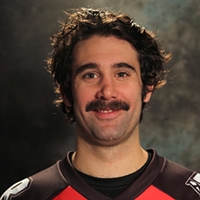
McBride has played 11 seasons in Calgary, and has been the captain since Tracey Kelusky was traded after the 2010 season. He’s a defender, transition player, a fighter, an outstanding team leader, and you’ll never hear a more well-spoken guy during an interview. And when is Movember time of year, he is look like Borat.

5. Rich Kilgour, Buffalo Bandits (225 games)

Rich Kilgour

Darris’ big brother was captain of the Bandits for 12 years, won four championships, had his number retired by the Bandits and is in the NLL Hall of Fame. Only one player personifies the Bandits better than Richie Kilgour and, well, we’ll get to him later.

4. Regy Thorpe, Rochester Knighthawks (217 games)

Regy Thorpe

Regy Thorpe was a big tough defender who played an amazing fifteen seasons with the Knighthawks, beginning in 1995, the team’s first season in the league. He won two Championships and was captain of the 2007 Championship team. But most interestingly, he was the first player-GM in NLL history when he took the reins of the team and played in the 2009 season. His tenure as a GM only lasted one season before owner Curt Styres took over, but much to the chagrin of NLL scorers, Thorpe played one more season before retiring in 2010.

3. Blaine Manning, Toronto Rock (199 games)

Blaine Manning

Blaine Manning had a pretty successful start to his NLL career, winning championships in 3 of his first 4 seasons (2002, 2003, 2005) with the Toronto Rock. It kind of went downhill after that for a couple of years, but after The Rock GM Who Must Not Be Named was fired and Terry Sanderson was brought back, Manning was a big part of the rebuilding process that resulted in the 2011 NLL Championship. Long before Dan Dawson arrived in Boston, Manning was one of the original Big Three along with Colin Doyle and Josh Sanderson in Toronto. They peaked in 2005 when Doyle finished first overall in scoring, Manning tied with John Grant for second, and Sanderson tied with John Tavares for third – and all five of them finished with over 100 points.

I went on and on about Manning in an article right after he retired, so I won’t rehash all his stats here. Suffice it to say that Manning should be a lock for the NLL Hall of Fame once he is eligible.

2. Tom Marechek, Philadelphia Wings (161 games)

Tom Marechek

Tom “Hollywood” Marechek won four championships in 12 NLL seasons and was inducted into the NLL Hall of Fame in 2007. Marechek is the all-time Wings leader in both goals and assists, and is 8th all-time in the league in goals. But of the top goal-scorers in league history, only one player in the top 10 (and two in the top 25) have played fewer games than Marechek. The only players who averaged more goals per game than Marechek are Gary Gait, Paul Gait, John Grant, and John Tavares. Not bad company.

Hard to believe he’s only the third-best lacrosse player from Victoria, BC.

1. John Tavares, Buffalo Bandits (313 games)

John Tavares

No-brainer. Tavares is one of the best players ever to play in the NLL (many argue he is the best), and after 22 seasons with the Buffalo Bandits, there’s no argument who’s at the top of this list. Or most lists, for that matter.

Tavares owns pretty much every offensive NLL record, most of them by a mile. As of the end of the 2013 season, he has 778 career goals, ahead of second-place Gary Gait by 130 and ahead of third-place (and the closest still active player) John Grant by over 200. He has 887 assists, 108 more than Colin Doyle. He has 1665 points; if he retired today, second place Doyle couldn’t catch him even with four more 100 point seasons. He’s scored an amazing 5.95 points per game over his career, second only to John Grant’s 6.37. (Technically he’s also behind a guy named Gary Edmands with a career average of 6 – he scored 6 points in his only NLL game with the Bandits in 1996.)

Since Tavares is still active, the amazing numbers will just continue to climb.

Honourable mentions

  • Billy Dee Smith, Buffalo Bandits, 149 games
  • Pat McCabe, New York Saints, 119 games
  • Mike Carnegie, Calgary Roughnecks, 105 games
  • Kyle Sorensen, San Jose / Washington Stealth, 105 games (I know, two different teams but they’re the same franchise so it counts.)

Just under the radar

These guys didn’t quite make the 100 game limit, but I wanted to acknowledge them anyway.

  • Devan Wray, Calgary Roughnecks, 99 games
  • Jeff Zywicki, San Jose / Washington Stealth, 99 games
  • Sal LoCascio, New York Saints, 95 games

The end of the Blaine Manning era

I remember it like it was twelve years ago.

Young lacrosse star Kaleb Toth, who scored the last-second goal to give the Toronto Rock the 2000 NLL Championship, was traded to the brand-new Calgary Roughnecks for a player with no NLL experience and a draft pick. As a Rock fan, was I outraged? Did I feel ripped off? Not really. First off, I knew that Toth was an Alberta boy and being the first home-town player for this brand new team was likely a huge deal for him as well as for the Roughnecks. Secondly, the player we got back was the second overall pick in the previous draft, a strong forward named Blaine Manning. A second overall pick plus a first rounder should be enough of a return for Toth, shouldn’t it? Still, we’ve all seen first round draft picks that just didn’t work out; would Manning turn into one of those?

Blaine ManningObviously he didn’t, and the rest is history. Manning scored 71 points (21+50) in his first season plus another 12 (4+8) in the playoffs (including the double-overtime winner in the semi-finals against the Washington Power) as the Rock won their third Championship. He was named Rookie of the Week five times, Rookie of the Month for March, and finally Rookie of the Year. Toth, for his part, racked up 79 points in his first of eight straight 50+ point seasons, became the face of the Roughnecks for a decade, and on his retirement became the first inductee into the “Forever A Roughneck” program. If there was ever a trade that worked out better for both teams, I’m not sure what it was.

Manning scored 60+ points in ten straight seasons, and 70+ in all but one of those. His best season was 2005 when he scored 105 points, tied with John Grant for second in the league after Colin Doyle’s 111. Josh Sanderson was third with 102, making 2005 the only season in NLL history that three teammates scored over 100 points. At their prime, Doyle, Manning, and Sanderson formed what might be the most potent top three on any team in NLL history.

Manning was not just a strong scorer who could pick corners as well as anyone. He could shoot from outside, could drive to the net through as many defenders as necessary and liked to dive through the crease as well. But there are two specific things about Manning’s play that I will remember: first, he would frequently switch hands. If there was no room to shoot right-handed or he was on the wrong side of the net, he’d flip his stick around and shoot as a lefty. I honestly don’t know how effective this was and I assume it was less accurate than his right-handed shot, but he scored numerous goals this way, catching the goalie off-guard, and I’ve rarely seen other players do it. Second, he was almost untouchable on the penalty kill. If you needed to kill some time on the shot clock, give the ball to Manning and he’d simply hold it for 20-30 seconds, regardless of the number of people pounding (or sometimes piling) on him. Mark Steenhuis is also very skilled at this but for many years, Manning was the best.

Manning played in every Rock game for ten full seasons – 2002 to 2011 – but two games into the 2012 season, his consecutive game streak was halted at 162 (177 including playoff games) when he broke his collarbone. That streak was good for third place all-time after Doyle and Steve Toll, though all three have since been eclipsed by Shawn Williams. He returned in April, having missed ten games, but only recorded 9 points in his 6 games that year. Last season Manning was given a different role and was more of a “grinder”, the guy that gets in the defender’s way and thereby gives better looks to guys like Doyle, Billings, and Leblanc. But there were times where he tried to be the Manning of old and wasn’t able to. The frustration on his face was obvious, which is why this announcement was surprising to me but not shocking. Evidently the toll on his body over the last couple of years was too much, and he decided that this was the end for his playing days.

Over the years of his career (2002-2013), only eight people have more points than Blaine Manning. Only one player (Bob Watson) has played more games in a Rock uniform, though Doyle will pass him this coming season. He is second in Rock history after Doyle in goals, assists, and points (both regular season and playoffs), and second after Jim Veltman in loose balls. He led the team in scoring twice and won four Championships with the Rock. Manning is certainly one of the greats in Rock and league history and should get serious consideration for the NLL Hall of Fame once he is eligible. He is one of my all-time favourite players and I wish him well in the next phase of his lacrosse career.

Two of the best

Coach of the Year? Sorry, not good enough.

Earlier this year the NLL had a GM trading for himself, in what was likely a first in pro sports. In what might be another first, we now have the reigning Coach of the Year being fired by his team. Make no mistake: Troy Cordingley did not retire from coaching, he did not leave to take a different job or pursue other interests, it didn’t even sound like “a mutual decision for the benefit of the club”. He was fired.

Although this is the first time in league history that the Les Bartley Award winner was fired, it will be the fourth time the Coach of the Year does not begin the next season with the same team. The first time was in 2001, the first year the award was presented. The inaugural winner was Philadelphia Wings head coach Tony Resch. Resch had just coached the Wings to their 6th Championship, and the retired from coaching a couple of months after receiving the award, and was replaced by Adam Mueller.

Seven years later, Mueller won the award (which had been renamed the Les Bartley Award in 2004) with the New York Titans, and then he retired from coaching. The next time it happened, it was none other than Troy Cordingley at the other end of his Toronto Rock career. Cordingley won the Bartley award with the Calgary Roughnecks after leading them to the NLL Championship in 2009, and then left the Roughnecks in the offseason to join the Toronto Rock.

John LovellSo this is the first time this has happened in the NLL. But has it happened anywhere else? The only other similar situation I could find was in 2010, when the University of Maryland fired their football coach Ralph Friedgen after he won the Atlantic Coast Conference’s Coach of the Year award. As far as I could see, it has never happened in the NFL, NBA, NHL, or MLB.

Update: It has happened before in a pro sport. Ted Nolan was fired as head coach of the Buffalo Sabres after winning the Jack Adams trophy for the 1996-1997 season. Thanks to @GlenMcDole for the correction.

Anyway, enough history, back to the Rock. I have been called a Rock apologist and fanboy, and have been told that this blog focuses too much on the Rock, and perhaps that’s somewhat true. (Of course I’ve also been told that I’m not a real Rock fan because I said something negative about them, or picked them to lose a game, or something like that. I can’t win.) Well, I have no explanation for this particular move. Cordingley took the Rock to the Championship game in 2010, won it all in 2011, finished first in the division in 2012, and finished first overall in 2013. That sounds like four pretty successful seasons to me. Yes, the goal of every team is to win the Championship and they did that only once in that time. But they were a legitimate contender for the Championship in each of those seasons. Maybe that’s the problem – they were contenders every year but only won it all once.

Perhaps I’m enough of a Toronto sports fan that I consider simply not sucking as a successful season, since that’s been true for the Leafs, Raptors, and Blue Jays for the last 20 years. But for Jamie Dawick and the rest of the Rock management, winning the Championship is the only measure of success – anything less is failure. Perhaps they looked at the last few years in a slightly different way – 2011: Championship. 2012: Lost in second round. 2013: Lost in first round. It’s obviously a small sample size, but they got booted from the playoffs earlier in each of the last two seasons. Something similar happened to Dave Pym (now a Rock scout) a couple of years ago. He coached the Roughnecks to three straight seasons of 10+ wins, finishing first overall in two of them, but because of their lack of post-season success (did not reach the finals in any of those years), Pym was fired. Pym’s regular season record as Roughnecks coach was 33-15, but the record that got him fired was the 1-3 in the post-season. Perhaps the Rock thought the same way – finishing first overall is great and all, but if you don’t win in the playoffs, it doesn’t matter.

Personally, I am unconvinced that the two most recent post-season losses were enough to fire Cordingley. I’ve seen people calling it a stupid move and the dumbest move the Rock have made in years. That may be a bit strong, but if the entire decision rested on the loss to the Knighthawks in the 2nd round last year and the loss to the Swarm this year, I don’t think that’s enough. I’m not as angry as some others, but I am confused. Perhaps there’s more to this than has been announced. Interestingly, Terry Sanderson also “fired” himself as defensive coach.

Is John Lovell as good a head coach as Troy Cordingley? Maybe, there’s no way to know yet. He has tons of lacrosse coaching experience, though none as a head coach at the NLL level. But he’s won Championships as an assistant coach, the players know him, and he’s well respected in the lacrosse community. But the team is replacing a man who’s won two Championships as a head coach and is one of only two men to win multiple Les Bartley Awards. And if a guy like that can’t keep his job after getting to the finals twice, winning once, and finishing first the other two years, Lovell’s got some awfully big shoes to fill.

2013 NLL season wrap-up

Well, that’s it for one of the most exciting and entertaining NLL seasons ever, thanks in part to the parity in the league. Almost every game was unpredictable, and there wasn’t a single game all year where anyone would have been honestly shocked if the losing team had won. Incidentally, that’s my excuse for finishing below .500 in my predictions.

A lot of interesting things happened in the 2013 season, some of which were expected, some of which were not. Let’s take a look at a few of each.

Five things we expected

  1. Parity. As I mentioned above, the parity in the league is unprecedented. The Bandits only won 6 games, but four of them came against the Champions, the Championship runners-up, and the Rock, who had the best record. The team with the best record was ahead of the team with the worst record by only 4 wins (10-6 vs. 6-10), the smallest that number has been since Detroit finished 6-2 and four teams were 3-5 back in 1992.
  2. The Stealth didn’t suck. Nobody expected their 2012 season to be as bad as it was, but I’m pretty sure that nobody realistically expected it to happen again.
  3. Garrett Billings cemented himself as one of the top offensive players in the NLL with his second-straight 100-point season.
  4. After one of the best offensive seasons ever, John Grant returned to earth with a pedestrian (for him) 91 points. Matt Vinc
  5. Matt Vinc won his third Goaltender of the Year award. Another few years of this type of performance, and the “best of all time” argument between Watson and Eliuk will become a three-way conversation. In fact, it’s almost there now.

Five things we didn’t expect

  1. Sophomore slump? Never heard of it. If you look at the top rookies of 2012 – Kevin Crowley, Adam Jones, Jordan MacIntosh, Tyler Carlson, Evan Kirk, Johnny Powless – only Kirk dropped off significantly from his rookie performance. Powless dropped from 50 points to 40, but he had to start sharing the ball with the likes of Dan Dawson and Casey Powell. The rest all stayed about the same or got better.
  2. Getting rid of Casey Powell won’t hurt your offense. The Knighthawks averaged 11.1 goals per game before the trade, 11.3 after. Cody Jamieson and Dan Dawson both saw their points/game averages go up to make up for the loss of Powell, Dawson from 4.2 to 5.1, and Jamieson from 5 to 6.3.
  3. Mike Poulin had a distinctly un-Poulin-esque season. His 12.70 GAA was the highest of his career, almost 2.5 points higher than 2012. The only starters who finished with higher GAAs were Evan Kirk and Anthony Cosmo. But his performance in the Roughnecks’ 12-11 OT victory over Edmonton at the end of the season was outstanding, and he played well against both the Mammoth and the Stealth in the playoffs. Shawn Evans
  4. Shawn Evans has been a very good player for years, and taking his game to the next level wasn’t wholly unexpected. But this year, Evans jumped the next level and went to the one after that. He bested his career high in points by 33 and won the scoring title by 12. His 112 points is tied for the 5th best season ever, putting Evans among the Gaits, Grants, and Tavares’.
  5. The Knighthawks started the year 0-3, were never above .500 at any point, and only two teams scored fewer goals. But they are the Champions. Actually, we should have expected it, since it’s almost what they did last year.

So there’ll be no more NLL games until at least December when training camps open. Don’t worry folks, it’s only… um… seven months. (sigh) Until then, we still have the MLL for outdoorsy types, and the MSL and WLA for people who like sweating in arenas in July. There may or may not be other American indoor leagues as well, such as NALL, PLL, MILA, and possibly others; so many of them started up so fast I kind of lost track of which ones still exist.

So enjoy your summer and fall, whether it’s filled with lacrosse or not! NLL Chatter will be more or less quiet over the summer, but we’ll publish the odd story as things unfold: the new CBA, trades, the entry draft, rule changes, the 2014 schedule, things like that. And we’ll be back next season with the usual mix of relevance and irreverence. See you then!

Game Report: Minnesota 20 @ Toronto 11

With no traffic, I can drive from my house to the ACC in about 45 minutes. Because this is Toronto and traffic is unpredictable, I normally leave for a game at least an hour and a half before game time. On Sunday, I left home at 1:10pm for a 3:00pm start. We arrived at our seats just before half-time. The last hour and a half of the drive took place within 5 km of the ACC. By the time we got to the game, it was almost three hours after we left home. But once I got there and started watching the game, I realized that being stuck in traffic wasn’t all that bad compared to what was going on down on the floor.

Anyone who thinks I’m a total Rock homer or that the Rock pay me to write positive Rock articles while pretending to be impartial (hey Jamie, great idea, huh? Whaddaya think?), read on.

I thought about skipping this whole article and just doing my game report as a tweet:

Minnesota @ Toronto game report: Wow, did that ever suck.

That pretty much sums it up. The Rock offense was terrible. It looked like the first game of the season – balls were dropped, passes were missed, shots missed the net by a foot or two or hit the goalie full in the chest, rebounds were given up on, it was bad. Colin Doyle was working his ass off, but nobody else seemed to be. Leblanc was invisible. Manning looked old. I don’t even remember seeing Beirnes, who’s one of my favourite players. I do remember seeing Sanderson digging around in the corners once or twice but other times he was invisible too. Even Billings looked like he didn’t know what to do, so he just kept shooting from bad angles or with a defender right in front of him.

Most of the Swarm defense is freaking huge – and even the ones that aren’t huge seemed to be. They had the Rock completely covered all game long, and I’m sure there were Rock players who didn’t know who was in net for Minnesota since they could never see him, let alone the net itself. To those Rock players: it was Tyler Carlson, who was amazing.

Toronto’s transition has been much better this year than previous years, but they were making some bad decisions as well. The transition player would speed up the floor with the ball, and regardless of whether he had a lane to the net, he’d go in anyway and take a low-percentage shot instead of circling around and waiting for the forwards to come out. If he did wait for the forwards, it took so long to get set up that by the time there were five forwards on the floor, there were only 10 seconds left on the shot clock.

Nick Rose wasn’t terrible, despite what the final score might tell you. He wasn’t great, make no mistake, I wouldn’t even say he was good. But as bad as the Rock offense was, the defense was worse. Swarm forwards seemed able to just run around defenders at will, and get a few seconds all by themselves to decide where to shoot on Rose. Sometimes it almost looked like the Rock defenders got out of the way of the Swarm forwards.

Of course, the fact that they were killing penalties for most of the second half certainly didn’t help. The Rock were so undisciplined out there that I thought we were watching the Bandits. (Too soon, Bandits fans? Sorry.) The worst one came early in the fourth quarter. Someone (don’t know who) hit Patrick Merrill with what seemed to me to be a completely legal, if bone-crunching, hit. Scott Evans took exception to the hit and went after the offender, while Jesse Gamble went after someone else at the same time. Gamble was given two for facemasking (though I think he was just trying to get the guy’s helmet off so he could fight him) and two for roughing. Evans was given two for checking from behind, two for instigating, five for fighting, and a game misconduct. When all was said and done, the Rock were on a nine-minute penalty kill, two minutes of which was 5-on-3. Luckily Minnesota took a penalty shortly afterwards to even it up a little, but still – all four goals the Swarm scored after that were on the power play.

This is the second straight year I’ve had to write about a stupid penalty that handcuffed the Rock during a playoff game. The score at this point was 16-8. The comeback was definitely a long shot, but they had almost an entire quarter to do it. Now we’re down one forward and are killing penalties for 2/3 of the rest of the game. Why? Partially to get revenge for a legal hit, but mainly because the Rock were frustrated. Frustrated that their offense couldn’t get anything going, frustrated that when they did get a decent shot Carlson was there to stop it, and frustrated that the Swarm forwards were running roughshod over the Rock defense.

I don’t want to take anything away from the Swarm by implying that they won because the Rock played badly. Not true – the Swarm won because they played very well. Five different Swarm players had hat-tricks, and Tyler Carlson was almost unbeatable. I’m not a big believer in the whole “they wanted it more” thing, but that’s really what it looked like. In the fourth quarter, the Rock players looked like they just wanted it to be over ASAP. And you can’t really blame them.

So the Rock are done for the year, the Raptors are out of the playoffs, the Blue Jays aren’t nearly what everyone thought they were going to be (though it’s still pretty early in the season), and the Argo season doesn’t start for six weeks. It’s come to this. Toronto sports fans now have to hang their hopes on the Maple Leafs.

God help us.

2013 NLL Award winners

Every year the IL Indoor writing staff submit their picks for the annual NLL awards, and here are mine. Note that these are not picks for who I think will win, they’re picks for who I think should win.

Offensive player of the year – Shawn Evans

Runners-up: Garrett Billings, Rhys Duch, Callum Crawford

Billings had almost as great a season in 2013 as he did in 2012, and Duch set personal records in both goals (leading the league) and assists. Crawford only had 4 games (out of 14) with less than 6 points – none of them after March 3 – and had six straight games of 8+ points. But Evans had them all beat before he even began his final game. Evans had five games with 10+ points, more than John Grant had during his record-setting 2012 season, while only Crawford and Dan Dawson even had two.

Transition player of the year – Jesse Gamble

Runners-up: Geoff Snider, Jeremy Thompson, Brad Self

Is this a bit of a homer pick? Possibly, but I really thought Gamble had a hell of a year. He played strong defense, ran like the wind, scored a bunch of goals (including two on the power-play), and led the team in loose balls.

I thought about picking Jordan MacIntosh, who will probably win the award, but decided against it for the same reason I didn’t think Jeff Shattler should have won this award two years ago – he’s not really a transition player. He’s an excellent player, no question, and as good as he was, he even stepped up his game when Andrew Suitor went down with a season-ending injury. But he played a lot more shifts on offense than he did defense. In the division semi-final game, MacIntosh played as much offense as Benesch or Crawford did. Gamble is a true transition player.

Defensive player of the year  – Kyle Rubisch

Runners-up: Chris Corbeil, Scott Self

It sounds like Kyle Rubisch might be the winner of this award every year for the foreseeable future. The word I hear most often to describe his play is “beast”.

Goaltender of the year – Matt Vinc

Runners-up: Brandon Miller, Tyler Richards, Nick Rose

If not for Matt Vinc, the Knighthawks might have been hitting the links early, not the Bandits. To have a goalie with the best GAA and the best save percentage in the league and still finish at .500 tells you how bad their offense was. Similarly, as one Wings fan put it, the Wings would be 1-15 without Brandon Miller. I’m not sure it would have been that bad but the Wings had a similar problem to the Knighthawks – outstanding goaltending, but almost no offense to speak of.

Rookie of the year – Mark Matthews

Runners-up: Kiel Matisz, Shayne Jackson, Dhane Smith, Curtis Knight

From a stats point of view, it was closer than you might have thought. Matthews had 4.31 points per game, while Jackson and Matisz had 4.00 and 3.94 respectively. But Matthews turned the Rush’s mediocre offense from last year into the third highest-scoring in the league, and that’s after losing Aaron Wilson, Scott Evans, and Shawn Williams. Obviously Matthews himself didn’t make up the difference entirely, but he forced opposing defenses to focus on him. This opened things up for Ryan Ward, Corey Small, and Zack Greer, all of whom increased their point totals over 2012.

Unsung player of the year – Cory Vitarelli

Runners-up: Kasey Beirnes, Jay Thorimbert, Brodie MacDonald

When you think of the offensive stars on the Knighthawks, you think Jamieson, Dawson, Powless, Accursi, Point, even Keogh, but Vitarelli doesn’t always spring to mind. But he was third in team scoring, put up at least a point in every game he played this year, and scored some of the prettiest goals we saw all season. Beirnes has gotten more recognition in the last year or two for his hard work playing behind big-name guys like Doyle, Billings, and Sanderson, but he’s been doing that for years. Jay Thorimbert had almost identical face-off numbers to Bob Snider, which is impressive in itself. Thorimbert split face-off duties in 2012 with Brandon Francis and Jeremy Thompson, but became the Bandits’ only face-off man this year – and increased their team face-off win percentage from 48.3% to 59.7%. Brodie MacDonald only played in three games this year, but put in at least 20 minutes in each, and finished with a GAA of around 8 and a save percentage of 80%. Having that kind of backup goalie behind you has to be a great confidence boost for both Aaron Bold and Derek Keenan.

Coach of the year – Troy Cordingley

Runners-up: Chris Hall, Derek Keenan

The Rock were the most consistent team this year, in a league where many teams looked unstoppable one week and terrible the next. Chris Hall showed how important he is to the Stealth, bringing them back from their brutal 2012 season, much of which was played without him, to second place in the West.

GM of the year – Derek Keenan

Runners-up: John Arlotta, Curt Styres

Drafting Mark Matthews wasn’t the master stroke – every GM would have done that. But in the off-season, Keenan retooled the offense, turning them from the worst in the league to the third-highest scoring – and managed to do this despite losing Shawn Williams, Aaron Wilson, and Scott Evans. Keenan also turned Paul Rabil, a player who never played for him and wasn’t going to, into Jarrett Davis.

MVP – Shawn Evans

Shawn EvansRunners-up: Garrett Billings, Callum Crawford, Matt Vinc

Evans had an outstanding year. He led the league in both assists and points, almost setting records in both, and beat his next closest teammate by almost fifty points. He had almost exactly the season Garrett Billings had a year ago, and Billings was my choice for MVP then. How close were their seasons?

G A Pts PPG LB Shots SOG
Billings 2012 32 82 114 10 74 195 131
Evans 2013 32 80 112 12 69 186 139

Evans had the same number of goals as he did last season but picked up 33 more assists. Just to cap it all off, Evans scored the overtime winner in the last game of the season to clinch the Western division for the Roughnecks.

Division semi-final picks

I went 2-2 in the final week of the season, bringing me to 33-39. Not bad, better than last year, but still not up to the level of my IL Indoor colleagues, all but one of whom finished at or above .500. Only Ty Pilson finished with a losing record, and he was still two games ahead of me. I will need to step up my “make wild guesses” game.

What better way to do that than with four games that could easily go either way? I really should be used to that since that’s been the case in the NLL pretty much all season long.

Regular season record: 33-39 (.458)
Playoff record: 0-0 (.000)

Game

Comments

Pick

PHI @ ROC Which Rochester team shows up? The one that scored 20 against Philly and then 15 against Buffalo the next night, or the one that 14 total against Buffalo and Philly over the next two weeks? I’m gonna say neither since I don’t see this being a high-scoring game, but I think Rochester will win it. The Knighthawks offense started to play better once they traded Casey Powell and while both goalies can steal a game, Vinc is my choice for Goaltender of the Year. Knighthawks5_thumb
COL @ CAL Tye Belanger does seem to be the real deal in net, but it’s his first season. I honestly don’t know if “playoff experience” is a real thing that actually affects how you play, but lots of people seem to think so, and Tye doesn’t have any of it. That said, the Roughnecks might be without Dane Dobbie and Scott Ranger. It’s not like there’s nobody else on Calgary that can score, but it puts a lot more pressure on Dickson, Shattler, and Veltman to produce. Roughnecks
EDM @ WAS The Rush have been the most complete team in the second half of this season. They gave up the second fewest goals in the league (fewest on the road), and their scoring is 3rd in the league (2nd on the road). They were 7-1 away from Edmonton this year. They also remember how close they got last year… Rush
MIN @ TOR Of all the teams Toronto could have faced in the first round of the playoffs, Minnesota would have been last on my list of preferences. The two teams played twice this year, each team winning 13-12 at home. Nick Rose better have a good night though, since we’ve seen that the Swarm can have an explosive offense, particularly Callum Crawford. Tyler Carlson is another potential game-stealer. I’m still going with the Rock, but this will be a tough win. Rock

Week 15 picks

3-3 record last week thanks to Tye Belanger keeping the Rush offense to only 7 goals and the Wings remembering how to score goals. The only way I can finish at or above .500 this season is to go 8-1 or 9-0 in the last two weeks, so that is the plan. If it doesn’t happen, it’s not my fault – blame the players for not going along with the plan.

Record: 28-35 (.444)

Game

Comments

Pick

ROC @ CAL Rochester will very likely make the playoffs, which wasn’t certain only a few weeks ago. Calgary already has but would like a home playoff game. Both teams have won 3 of their last 5 (for Calgary, it’s actually 3 of their last 4). Matt Vinc hasn’t given up as many as 12 in a game since January 19 and has held the Wings, Rock, Bandits, and Stealth to single-digits since then. Mike Poulin has only kept opponents below 12 four times this season. Knighthawks
MIN @ COL Minnesota seems to have become the team I thought they were going to be at the beginning of the season, though it took them a long time to get there. Callum Crawford is on fire (7+ points in 5 straight games) and Tyler Carlson has a GAA of 6.00 and save % of 88% in his last two starts. Since Minnesota keeps swapping starting goalies and Kirk lost in Philly last week, this is Carlson’s game. Swarm
TOR @ PHI The Rock really want that top seed overall, but the Wings aren’t guaranteed a playoff spot quite yet, and they always seem to give the Rock trouble. When Brandon Miller is “on”, he’s almost untouchable (though you could say that about almost all of the starting goalies in the league), and with Mundorf back from injury, the Wings offense just got stronger. The Rock currently have the best record in the league, so picking them is not a homer pick. I’m sticking to that. Rock
BUF @ WAS The Bandits seem to have lost interest in the 2013 season, while the Stealth still have a chance at a home playoff game. Buffalo is this close to being eliminated from the playoffs, so either they’ll pour on the energy this weekend in an attempt to stay in the race, or they’ll fold, figuring they have no chance. I didn’t see much fight in them last week or the week before, so I don’t expect much this weekend. Stealth
ROC @ EDM The Rush are 1-5 at home and 7-1 on the road, so maybe they’re not playing for home-floor advantage in the playoffs. The Rush looked too good in their games against Buffalo and Toronto the other week to bet against them. Every team had bad games, which is what they had against Colorado last week, but I think they’ll bounce back. Rush

NLL Annual Award short lists and prediction recap

There are still a couple of weeks left in the season, but here are some early player award possibilities as well as a look at my predictions from the beginning of the season. Some of them were pretty close, others… not so much.

The front-runners are the few people, in no particular order, who I think have the best shot of winning the award. For the most part, I haven’t made my actual selections yet, so these are just my short-lists. In most cases, I put a dark horse as well; someone who probably won’t win the award but should be considered.

MVP

Prediction: Dan Dawson, Garrett Billings. Dawson has been good but not outstanding. Billings has been outstanding.

Front-runners: Garrett Billings, Shawn Evans, Mark Matthews

Dark horse: Callum Crawford

Goaltender of the Year

Prediction: Anthony Cosmo, Aaron Bold. Cosmo hasn’t been great, though I wouldn’t blame the Bandits lousy season on him. Bold is 3rd among starters in GAA but 8th in save %. He has been very good, though not as good as last year.

Front-runners: Matt Vinc, Nick Rose, Tyler Richards

Dark horse: Tye Belanger has been excellent though has half the minutes of the other starters (other than the Swarm’s dynamic duo).

Transition Player of the Year

Prediction: Jordan MacIntosh, Paul Rabil. MacIntosh is on my short list. Rabil has been good but not Tranny of the Year good.

Front-runners: Geoff Snider, Jordan MacIntosh, Jesse Gamble, Jeremy Thompson, Jordan Hall

Dark horse: Brad Self

Defensive Player of the Year

I’ll admit it: I suck when it comes to evaluating defensemen. Part of it is because I’m a stats guy, and there are no really useful stats for defenders. But a lot of it is that I have no formal training – I’m self-taught in the art of watching lacrosse. I’m a fan who’s never actually played the game. When I’m watching a game, I’m watching the offensive players and the goalie. I will notice when a defender makes a great play or if a team seems to hear the shot clock buzzer an awful lot (implying a good defensive unit), but I don’t generally notice individual defenders. That said, I have made a point to watch Kyle Rubisch and Chris Corbeil because you hear about them so much, and Sandy Chapman has always been one of my favourite Rock players. I remember watching Paul Dawson shut people down (and occasionally beat the snot out of them) with the Blazers.

It’s weird though – I can look at a list of transition players and have general feelings on how they’ve been playing without looking at the stats. I have no idea how many points Brad Self has, or Jordan Hall, or Jeremy Thompson, but I know they’re having good seasons. I have no such impressions with pure defenders.

Prediction: Kyle Rubisch, Paul Dawson

Front-runners: Kyle Rubisch, Chris Corbeil, Paul Dawson, Scott Self

Dark horse: I got nothing.

Rookie of the Year

Prediction: Mark Matthews, Kiel Matisz. Woo, nailed it on this one. Unlike everyone else who also predicted Matthews as ROY.

Front-runners: Mark Matthews, Kiel Matisz, Tye Belanger, Mitch McMichael, Kyle Belton, Curtis Knight, Dhane Smith

Dark horse: Anyone but Matthews, really.

Update: Can’t believe I forgot Dhane Smith on the original list. Also, apparently Tye Belanger is not considered a rookie.

Les Bartley Award

Prediction: Troy Cordingley, Joe Sullivan. Again, nailed it.

Front-runners: Troy Cordingley, Chris Hall, Joe Sullivan, Derek Keenan

Dark horse: Mike Hasen if the Knighthawks continue playing well in the last two weeks.

GM of the Year

Prediction: Curt Styres, Steve Dietrich. The Knighthawks and Bandits both made significant offseason moves and I thought at least one of them would be successful. The offseason Rochester moves didn’t seem to make the team appreciably better, but the Powell-for-Sullivan, Self, and Purves moves were all good. The Bandits moves made the team worse and other than Dhane Smith, didn’t really set them up for the future either (though the Cosmo trade that lost them next year’s first round pick was Kilgour, not Dietrich).

Front-runners: Derek Keenan, John Arlotta

Dark horse: Johnny Mouradian. Dawson+Dawson for Rabil+Hall isn’t nearly the disaster I thought it might be.

Careers cut short

Again this year, the NLL has been hit by the worst kind of injury bug – the one that takes a player out of the league permanently. It’s been almost two months since Knighthawks defender Ryan Cousins was forced to retire due to persistent injuries. Cousins is a former two-time Defender of the Year and was captain of the Minnesota Swarm for seven years. Now, he also played in the league for eleven seasons so it’s not like his career was cut short after only a few years, but at 31, he could easily have played 5 or 6 more years and possibly more than that.

As an aside, while looking for details on Cousins’ retirement, I came across this article by Rochester fan (and NLL employee) Alex Hinkley and was stunned to read that Hinkley believes Cousins should not have retired. Cousins makes what is likely one of the most difficult decisions of his life and Hinkley has the gall to say he shouldn’t have retired? Yes, he was injured last year and came back to play, but he says himself that he had yet another injury before this season began. Normally when a player retires due to injury, it’s not because he can’t be bothered to do the work required to get back in shape, it’s because their doctor has told them that any further injuries could do irreparable damage. Cousins might have decided that playing one more year of lacrosse wasn’t worth spending the rest of his life walking with a cane. It’s possible, even likely, that Cousins may come to regret retiring. But I think it’s more likely that Cousins, along with his family and doctor, decided that he’d much rather retire and wish he hadn’t than not retire and wish he had.

Ryan CousinsCousins wasn’t the only player who retired this season because of injury. Dan Carey, also 31, announced his retirement just before the season began after suffering a concussion near the end of the 2012 season. Carey also missed half of 2009 and all of 2010 due to concussion. Phil Sanderson, another concussion victim on the Rock, hasn’t officially retired, but he missed the last two games of 2012 plus the playoffs and has yet to play in 2013.

If you go over the list of NLL players who have had to retire early due to injuries, a few pretty big names show up:

  • Merrick Thomson accumulated 124 points in two seasons with the Wings (and was an MLL star as well) before concussions ended his very promising career in 2011 at the age of only 27.
  • Ken Montour, the 2009 NLL goaltender of the year, experienced a concussion during a game in 2010 (also at age 31) and never played again. Montour (as well as Thomson and Tracey Kelusky) talks about his experiences in a must-read interview with IL Indoor’s Stephen Stamp from back in 2011.
  • Paul Gait retired after the 2002 season (during which he scored 114 points, the third highest total ever) at the age of 35 due to knee injuries. We’ll ignore the four games he played with the Mammoth in 2005. His twin brother Gary played 3 more full seasons with the Mammoth before retiring, and then unretired in 2009, played 24 more games with the Knighthawks, then retired again.
  • Mark Miyashita was the first overall draft pick of the Vancouver Ravens in 2003 but only played 46 games over 5 seasons with Vancouver, Colorado, and Minnesota before multiple ACL injuries forced him to retire.

The quintessential example of an athlete forced to retire early because of injuries is Bobby Orr. Orr, considered by some as a better hockey player than Wayne Gretzky, played nine full seasons in the NHL and then parts of three more before retiring at age 30 because of repeated damage to his knees. Now Sidney Crosby is in danger of being added to this list, having missed much of the last couple of seasons due to a couple of serious concussions. Last week, he was hit in the head with a puck, breaking his jaw. He’s reporting no concussion symptoms from that, but we all know that if he suffers one more concussion, his career is likely over. Crosby won’t even be 26 until this summer.

There has been a lot of research and a lot more discussion on head injuries in sports in recent years, which will hopefully reduce the number of concussions and early retirements. But due to the nature of sports, particularly contact sports like football, hockey, and lacrosse, you will never completely eliminate the possibility. It’s something the athletes know and a risk they’ve accepted. When you see a freak accident like the one that ended Andrew Suitor’s 2013 season, you start to appreciate the ability of players like Colin Doyle, Shawn Williams, and John Tavares to be able to play for so long. How do they do it? There’s some conditioning involved – being in top physical shape can help you avoid some injuries and recover more easily from others. Being a smart player, and therefore being able to avoid situations that could result in injury, is another advantage these guys have. But Suitor is also a professional athlete, in top shape, and is unquestionably a smart lacrosse player.

Sometimes, as they say, shit happens. Part of the “secret” to a long playing career is just to be lucky.


Have you done the NLL Chatter survey yet? If not, I’d greatly appreciate a minute or two of your time. Please head over here, answer a few questions, and help me make NLL Chatter even better. Thanks for your help!