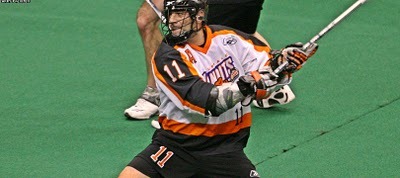
NLL mid-season report: East division

Each team has played roughly half their games, so it’s time for mid-season report cards. Just like last year, I’ve assigned letter grades to each team’s offense and defense (which includes goaltending). The letter grades are purely subjective based partially on the stats but partially on my own impressions of the team. The letters compare roughly thus:

A 2012 Knighthawks (Champions)
B 2012  Roughnecks (Excellent regular season, faded in the playoffs)
C 2012 Wings (Just made the playoffs)
D 2012 Stealth (did not make the playoffs)
F SyracuseSmash

We’ll start with the NLL East and get to the West in a couple of days. All of the stats were as of the end of week 9.

BanditsBuffalo Bandits

Offense: C-

6th in goals scored per game. The top scorer (Shawn Williams) is 11th overall. The next-highest scorer (Aaron Wilson) is 34th. If you look at points per game (to factor out the number of games played), Williams is 12th and Tavares is 29th. Tavares missed three games which did not help though he’s back now.

Defense: C+

6th in goals allowed per game. They’ve given up 12 or more goals in seven of their nine games. When Cosmo is on, he’s still one of the best in the league, and he was certainly on in their 10-6 win against the Knighthawks. He just has to be on a little more often.

Overall: B-

How is their overall rating better than either of their offensive or defensive ratings? Well, they’ve managed to turn a below-average offense and a below-average defense into a 5-4 record.
 

WingsPhiladelphia Wings

Offense: F

Dead last in goals per game, averaging less than 11. They have one player in the top 20 in scoring, Crowley at #15. Only 7 players have 10 or more points after 8 games. The Kevins are doing fine, Drew Westervelt is fine, and Jordan Hall isn’t quite up to his New York Titans numbers, but is on pace to blow away his Rochester numbers. Paul Rabil has been disappointing from a scoring standpoint, especially since he’s been on offense more than transition. Brodie Merrill is about where he was last year, and nobody else is scoring at all. They’ll be happy to get Brendan Mundorf back.

Defense: B-

5th in goals allowed per game. Brandon Miller had three pretty crappy games where he allowed 14, 16, and 20 goals, but has been good or really good in the five wins.

Overall: B-

The Wings have impressed me more than I thought they would this year. I predicted them to be the one team out of the playoffs, but it’s looking less and less like that’s the case. They’re still not a Championship team in my opinion, but they’re closer than I expected.
 

KnighthawksRochester Knighthawks

Offense: D-

Tied for seventh in goals per game. How bad is the Knighthawks offense? Dan Dawson is on pace for his worst season since 2003, about 15 points worse than any season since 2004 – and he’s second on the team. (That’s not really a fair statement though, since a crappy Dan Dawson season is still better than most.) Jamieson is top 10 in both points and points per game, so no problem there. Dawson is tied for 18th in points per game. Casey Powell is in 35th and has missed two games. Johnny Powless is on pace for 35 points, after scoring 50 last year. Stephen Keogh is on pace for 38, after 59 last year. The only reason this isn’t an F is because they put up 35 goals in two games (in two days) in early February, so they can score. They’re just not.

Defense: A

The defense has been as good as the offense has been bad. The Knighthawks are first in goals allowed per game, allowing a measly 10.2. They’ve given up more than 10 goals once in their last six games, and yet they’ve lost two of them. The Knighthawks may have 99 problems, but Matt Vinc ain’t one.

Overall: D

If they’re trying to channel the 2012 Stealth (first to last in one year), they’re doing a good job. But there are better teams to emulate – like the 2012 Knighthawks. It’s looking like adding Powell and Dawson did have an effect on team chemistry. Strangely, the person I expected it to affect most, Cody Jamieson, seems unaffected and is on pace for 80 points.

RockToronto Rock

Offense: B+

Third in goals scored per game, and they have scored less than 10 goals only once. Two of the top six scorers are Rock players. Colin Doyle is on pace for 84 points which would be his highest point total in three years. Billings is on pace for 105 points. Blaine Manning’s numbers are way down (he’s on pace for less than half of his worst non-injury season), but his role has changed. He’s not one of the top scorers anymore, he’s one of the guys that “bangs bodies” and makes space for Doyle and Billings and Josh. He even played one game coming out the back door.

Defense: A

Second in goals allowed per game. Have only allowed as many as 13 goals twice, and one of those was in OT. Nick Rose is third among starters in both GAA and save %. Jesse Gamble has become one of the best transition players in the league. Young goalie, young transition, veteran D – seems to be a good combination.

Overall: A-

Most consistent team so far this year. Great goaltending and defense, the best transition game the Rock have seen for years, and plenty of offense, though by only a few players. A little more scoring from Evans and Manning and maybe a couple more decisive wins (7 of their 9 games have been decided by 1 or 2 goals) and this would be an A+.

The NLL Pronunciation Guide v2.0

A couple of years ago, I wrote an article on the NLL Blog listing a bunch of NLL players with difficult-to-pronounce names and how to say them correctly. Apparently it is not yet required reading for NLL play-by-play guys, since I still frequently hear names being mispronounced. But there are a number of new players in the league now, so it’s time for an update. Some of these have been confirmed by the players themselves via twitter – thanks to Frankie Scigliano, Jaeden Gastaldo, Kurtis Wagar, and Neil Tyacke for responding and confirming how to say their names properly.

I’ve grouped them by team and alphabetically.

Buffalo

Chad Culp – CHAD CULP
John Harasym – HAIR-a-sim.
Mat Giles – JYLES
Alex Kedoh Hill – KEE-dough
Tracey Kelusky – kuh-LUH-skee. Not kuh-LOO-skee.
Steve Priolo – pree-O-lo
Jimmy Purves – PURR-vis
John Tavares – If you can’t say his last name, you are obviously not a lacrosse fan. Why are you reading this article? But for completeness, it’s tuh-VAR-ez.
Jay Thorimbert – I would have expected THOR-im-bear but I believe it’s THOR-im-bert.
Dhane Smith – DANE
Mark Steenhuis – STAIN-house
Kurtis Wagar – WAY-ger. Attention Buffalo announcers: not WAG-ner.

Philadelphia

Kevin Buchanan – byu-CAN-in
CJ Costabile – COST-a-bull
Pat Heim – HIGHm
Paul Rabil – RAY-bull
Brian Tueber – TOOB-er
Drew Westervelt – WEST-er-velt
Chad Wiedmaier – Could not get confirmation. I’d have said WEED-myer but the NLL Pronunciation Guide* says it’s weed-MAY-er.

* – Yes, the NLL Pronunciation Guide is a real thing, though there are a few mistakes in it. No idea if this is one of them.

Rochester

Mike Accursi – uh-CUR-see
Stephen Keogh – KEY-o
Ian Llord – la-LORD. No, I’m not serious. It’s just LORD.
Matt Vinc – Like VINCE, not VINK
Cory Vitarelli – VIT-a-RELL-ee

Toronto

Kasey Beirnes – BEERns
Stephan Leblanc – STEFF-in la-BLONK
Brendan Thenhaus – I had TEN-house originally but I believe it’s TAIN-house. Like Steenhuis without the first ‘S’.

Calgary

Dane Dobbie – DOUGH-bee. Not like Dobby.
Joe Resatarits – res-a-TARE-its
Frankie Scigliano – SHIL-ee-ANN-o
Geoff Snider – SNY-der. Not SHNY-der.
Kaleb Toth – KAY-leb TOE-th. My biggest pet peeve – he played 11 seasons in Calgary and I still hear people (even Calgary announcers!) talk about Kaleb TAW-th.

Colorado

Joey Cupido – cuh-PEE-dough
Ilija Gajic – ILL-ee-ya GUY-ch
John Gallant – gull-ANT
Jaeden Gastaldo – JAY-den guh-STALL-dough
Chet Koneczny – kon-EZ-nee
Eric Martin – Just like it looks, presumably. I asked a Colorado fan and he just lowered his head and whispered “We do not speak his name.”
Sean Pollock – SHAWN POLL-ick
Creighton Reid – CRAY-ton REED

Edmonton

Chris Corbeil – cor-BEEL
Brett Mydske – MID-skee

Minnesota

Mitch Belisle – buh-LYLE
Ryan Benesch – buh-NESH
Nic Bilic – Nick BIL-ich. Oddly, Jake Elliott (Swarm play-by-play guy) acknowledges that he knows this but says it “BIL-ik” anyway.
Callum Crawford – CAL-um. Attention Edmonton announcers: not CAY-lum
Alex Crepinsek – CREP-in-sek
Kiel Matisz – Just like it looks. (Sigh) OK, fine. It’s KYLE muh-TEEZ
Corbyn Tao – COR-bin TOW (last name rhymes with COW). Attention Washington announcer: not TAY-o.

Washington

Rhys Duch – REES DUTCH
Billy Hostrawser – HOS-trouser
Athan Iannucci – EYE-uh-NOOCH-ee
Justin Pychel – PITCH-el
Bob Snider – SNY-der. Remarkably similar to that of Geoff Snider.
Neil Tyacke – TY-ack. Rhymes with kayak.

Non-players

Steve Bermel – BURR-mull. Rhymes with “thermal”. Bandits writer for IL Indoor.
Jamie Dawick – DOW-ick. (DOW rhymes with COW like Corbyn Tao. Sounds like that sentence should be in a rap song somewhere) Owner of the Rock.
Marisa Ingemi – muh-RISS-uh in-JEM-ee. Runs the show over at InLacrosseWeTrust.com.
Darris Kilgour – DARRIS KILL-gore. Not DAR-ee-us. Buffalo head coach.
Johnny Mouradian – moor-RAD-ee-an. Philadelphia GM & head coach.
Graeme Perrow – GRAY-um PEAR-o. The most knowledgeable lacrosse mind of our generation whose first name is Graeme. Or at least in the top ten of Graeme’s.
Grant Spies – SPEEZ. NLL ref.
Tim Then – THEN. I dunno, some guy that tweeted me.

Game report: Buffalo 15 @ Toronto 13

I don’t know who the Rock played in Thursday night’s game, but it certainly wasn’t the Buffalo Bandits that I, as a Rock fan, know and love. You know, the undisciplined team that takes stupid penalties at key times, sometimes giving away leads and games? Yeah, those Bandits were nowhere to be seen. The ones that showed up didn’t play perfectly all night, but they played well enough to beat the top team in the league and that’s really all that counts.

I wouldn’t say the first half was “all Buffalo” but the Bandits were doing a really good job with their passing, while the Rock were a little messy with theirs. In the second quarter, the Bandits took two penalties within 11 seconds, giving the Rock a 5-on-3 for almost two full minutes. A 5-on-3 in lacrosse is almost a guaranteed goal (or more accurately, should be a guaranteed goal), but the Bandits D came up huge. The Rock couldn’t get many decent shots away and Cosmo handled the ones that managed to get through. The Bandits took a 6-5 lead into the half.

The Rock came out of halftime pretty flat, not looking like they were really in the game at all. But after one early Bandits goal, they really turned it on and went on a 5-goal run to take a 3-goal lead and seemed in control. Up by three, only fifteen minutes left – this one’s over, right? Surprisingly enough, no. The Bandits came back with 5 of their own in a little over 6 minutes to take back their two-goal lead. They traded goals after that but the the Rock just couldn’t get that one extra to tie it.

Scott Evans was a healthy scratch. Right, because we don’t need gritty tough guys when playing the Bandits. But maybe they sat him because he’s gritty and tough and therefore more likely to get involved in the physical stuff. Maybe they figured “that’s the way Buffalo plays but we want to play our game”. Turned out that’s not the way Buffalo played anyway. At one point late in the fourth (after Buffalo had their 2-goal lead back), there was some pushing and shoving after a play and I thought “Oh good! The Bandits are going to do their normal thing and lose their minds and start taking dumb penalties. Man I wish Scott Evans was out there!” But to their credit, the Bandits kept it together and continued playing disciplined, smart lacrosse.

Goaltending wasn’t really part of the story here. I didn’t think Cosmo was outstanding but was very good in the first half, particularly during that 5-on-3. Nick Rose wasn’t terrible but it certainly wasn’t one of his better games and there were a few softies which we don’t see him allow often. I think I said this last year, but if there’s one thing that I don’t like about Rose’s game it’s that he gives up too many rebounds. Far too many times during this game he’d make a great save only to give up a huge rebound and have the Bandits recover the ball for either a second shot or a fresh 30. Here’s some goaltending advice for ya Rosey: stop doing that.

Jay Thorimbert was great on the faceoffs, winning a Snider-esque 80.6%, and even scored twice on breakaways. Speaking of breakaways, the Rock had a few, actually more than a few, but I don’t think they scored on any of them.

Long story short, the Bandits played very well while the Rock played OK, except in the third when it was reversed. I don’t buy into this “they wanted it more” crap, but the Bandits just played better and deserved the win.

Other game notes:

  • My friend Mike noticed that there were no moving pick calls the entire game. My other friend Steve said that this was likely because they were all moving, so if you call one, you have to call them all. Otherwise, the officiating would be inconsistent, and we can’t have that, can we?
  • Jimmy Purves: dude, what’s with the thigh-high socks? Looked like he was wearing leggings.
  • I don’t know if the decision to have a Thursday night game was intentional or whether that’s the only date that was left, but I think it’s safe to call that experiment a failure. The announced attendance was 8213, the lowest in Rock history.
  • Fearless Fred from Edge 102 was one of the in-game hosts. I’ve never heard him on the radio, but he was less animated than I expected an afternoon radio guy to be. He didn’t add much to the experience.
  • Dear Rock music guy: “Brick House” is the song they play in Buffalo for Mark Steenhuis. We should probably not play it in Toronto when playing the Bandits.
  • Overheard: “There’s a lot of money in pro lacrosse. A LOT of money.” Boy, would I like to have heard more of that conversation, mainly to find out where the hell it is.

Week 9 picks

OK, so that sucked. I went 0-5 last week as Edmonton and Minnesota each won in the other’s barn, the Wings pulled off a couple of wins, and the Stealth grabbed a first-place tie in the West. Every team is in action this weekend (and this week, since Toronto and Buffalo play a rare Thursday night game), and the Bandits play twice.

Record: 14-22 (.389)

Game

Comments

Pick

BUF @ TOR Buffalo has a winning record in Toronto, but the Rock are the top team in the league right now. If Cosmo plays like he did two weeks ago this could be a tough one for the Rock. Nick Rose has allowed 12, 13, and 12 goals in their last three games so he might have to take it up a notch, especially with John Tavares returning. Rock
PHI @ BUF Both teams are 4-3, both 2-2 at home. Buffalo has scored two more goals and allowed one more than Philly. Couldn’t really get more even. I’ll give this one to Buffalo because they’re at home. Bandits
EDM @ CAL The Roughnecks have lost two of their last three but this is their first home game in a few weeks. I think Calgary is still the team to beat in the West. Roughnecks
ROC @ COL The loser of this game will have the worst record in the league. The Knighthawks have gone from the Championship game to the basement in one year. Where have we heard that before? And this is after adding Casey Powell and Dan Dawson to their lineup. And yet, I still can’t bet against them… Knighthawks
MIN @ WAS Speaking of Championship game to the basement in one year, now the Stealth are trying to go the other direction in one year. I’m not sure they can get all the way there, but in a one-and-done playoff format, anything’s possible. Meanwhile, the Swarm have lost their captain for the rest of the season. How will this young team handle the loss of their leader? Stealth

Rocking the Rez

The Toronto Rock announced this past week that they had signed former Buffalo Bandit Roger Vyse to the practice roster. Vyse was released by the Bandits during the pre-season and has been lighting up the CLax arenas ever since. Vyse is a Native from Six Nations, and continues the proud Toronto tradition of signing Native players, like Kim Squire and… um… hang on, let me think…

Considering how many Native players come from southern Ontario, it’s surprising to me that if Vyse plays a game for the Rock, he will only be the fifth Native player ever to do so. Here’s the list:

Kim Squire

Name Seasons Games Points
Kim Squire (pictured) 6 52 168
Rodd Squire 4 34 39
Tom Montour 1 6 8
Jason Henhawk 1 1 0

Think of all the Native players that have played for the Bandits or more recently the Knighthawks – far too many to list. I’m sure there have been plenty of times where each of them has had five Natives on the floor at the same time, let alone five over fourteen years. So why the difference?

Is there some kind of an anti-Native policy on the Rock? I seriously doubt it. First off, they wouldn’t have signed Vyse. Secondly, this has been the case for the entire history of the Rock, through a number of coaches, GMs, and even owners. And thirdly, only an idiot GM would make player decisions based on race over ability and nobody would call Les Bartley or Terry Sanderson (the GMs of the Rock for most of its existence) idiots.

This is a pure guess on my part, but I suspect it has little to do with the Rock and more to do with the Bandits and Knighthawks. Natives see a lot of other Natives, many of whom they grew up playing with or against, playing for those teams and want to go play with those players. It then becomes self-fulfilling – the more Natives play there, the more Natives want to play there. If you’re a GM from Six Nations (as both Darris Kilgour and Curt Styres are), you’re more familiar with players from Six Nations, again because they live near you and you have watched them play for years. As a result, you’re going to be more likely to draft them – same reason Terry Sanderson picks so many Orangeville guys.

Coincidentally, every one of these five players played for the Bandits either before or after playing for the Rock, and Kim Squire and Jason Henhawk also played for the Knighthawks.

Week 8 picks

2-3 last week. Not bad, but continually having weeks under .500 will not help me make it to .500 overall. I called Edmonton’s win over Colorado and Calgary’s over Minnesota, but said that Calgary scared me in the Toronto game (they weren’t that scary) and that Buffalo would struggle without JT against the awesome firepower of the Knighthawks. Turns out the Bandits didn’t need much firepower themselves, and Rochester didn’t bring theirs anyway.

Some tough ones this week – will Edmonton continue their hot streak in back-to-back games against the Swarm? Will Philadelphia get some payback for the beating they took from Rochester a couple of weeks ago? What will happen when the worst and second-worst teams face off in Philly?

Record: 14-17 (.452)

Game

Comments

Pick

MIN @ EDM Two underperforming teams face off twice this weekend. Edmonton broke out last weekend with two wins, but Minnesota has yet to do that. This could be the weekend they do, but I think Edmonton will ride their winning streak into their home arena and take the first game. Rush
PHI @ ROC Making picks for the Knighthawks is difficult because there seem to be two Knighthawks teams – the reigning champs from last year who demolished the Wings a couple of weeks ago, and the other team that only scored 6 against Buffalo last weekend and lost their first three. I remember saying this about the Knighthawks last year too. That said, Casey Powell should be back this weekend and the Hawks not going to be happy with last week’s game. Knighthawks
CAL @ WAS Despite their loss in Toronto last weekend, the Roughnecks are still a scary good team. But they know that the Stealth are right behind them in the standings and cannot be taken for granted. If I had to choose my least confident pick this week, this would be it. Roughnecks
EDM @ MIN Minnesota’s home field advantage is pretty significant – they were 6-2 last year at home and are 2-1 this year (while 0-3 away), so I have to give this one to the Swarm. Swarm
COL @ PHI Colorado’s been one of the biggest surprises this year. Sure they’ve had goaltending issues, but that’s not the extent of their problems. Only one team has scored fewer goals/game than the Mammoth (11) and that’s the Wings (10.4). Last year, nobody scored more than the Mammoth. They gotta start scoring sometime, don’t they? Mammoth

Faceoff dominance: Does it help you win?

Over the last decade or so, a few players have stood out as excellent face-off men. Washington’s Bob Snider and his brother, Calgary’s Geoff Snider, are the cream of the crop right now, and in recent years Peter Jacobs, Jamie Hanford, and Jamison Koesterer have also made names for themselves in the circle. But does it really matter?

Logic says yes. When you win a face-off, you gain possession and in lacrosse, possession is everything. If you win 75-80% of your face-offs, as the Snider boys do with regularity, that’s 10-15 extra possessions per game for your team, and at least a few of those have to translate into goals, right? But do the stats bear that out? As we frequently do on this blog, let’s look at the numbers and see if they support something that “everybody knows”.

tl;dr

For those of you who don’t care to look at the actual numbers, here’s the “too long; didn’t read” version: Yes, but not by very much. Feel free to skip to the conclusion now.

The numbers

I only have sufficient stats for the 2012 season, so we’ll have to restrict the numbers to that season. There were 72 games played during the regular season, and therefore 72 winners. Three of the 72 games finished with a tie in faceoffs, so we won’t count those three. Of the 69 remaining games, the winning team led in faceoffs 39 times (56.5%). This means that in 30 of the games (43.5%), the winning team won fewer faceoffs than the losing team.

So it looks like winning the faceoff battle does give you a slight edge. But let’s look even further. If we look at games where one team really dominated the faceoffs, say winning 70% or more, we find the opposite. There were 28 such games last year, and the team that won the faceoff battle only won 13 (46%) of them. Of the 15 games where the losing team won 70% or more of the faceoffs, the teams break down like this: Washington 8, Philadelphia 3, Calgary 3, and Minnesota 1. The Stealth lost eight games (and won three) while winning 70+% of the faceoffs.

Of course, this is a strange case – the team with the best face-off man in the league and the worst record. This is also the record of one team over only 16 games. Calgary, for example, went 5-3 in games where they won 70+% of faceoffs. Even if we look at the season as a whole, that one team dominates so much that the numbers are too skewed to be meaningful. Not surprisingly, we can’t honestly say that winning 70% of the faceoffs means you’re less likely to win the game.

Conclusion

The conclusion to all of this is that during the 2012 season, teams won 56.5% of games in which they won more faceoffs than their opponents. I’ve done the calculations for the 2013 season as well (less than half over), and through 31 games (one game tied), everything is exactly 50-50 – winning teams have also led in faceoffs 50% of the time.

This tells me that winning the battle of the faceoffs does give your team a greater chance to win, but not by as much as you might think.

Game report: Calgary 12 @ Toronto 17

I mentioned in my Week 7 picks article that Calgary scares me. They have arguably the best offense in the league, one of the best face-off men in the league, quick transition, a strong defense, and lots of toughness up and down the lineup. Oh yeah, and the reigning goaltender of the year. They’ve won four in a row, two of those by 7+ goals. There’s no question that the Roughnecks are one of the toughest teams to beat in the league, and that’s the team we saw tonight.

For the first quarter.

For the rest of the game they looked like just another pretty good lacrosse team. They certainly had flashes of brilliance – Poulin made a few great stops, the Roughnecks defense was pretty stifling all night long, and they scored a couple of goals that I, a Rock fan, even applauded. Shawn Evans didn’t score but dished out some pretty nice feeds. Dane Dobbie was on fire, and Shattler, Dickson, and Ranger had some pretty nice goals as well. But penalty trouble was the name of the game for the Roughnecks, as they gave the Rock 12 power play opportunities, 9 of which were converted.

The Rock started the game with the yips – shots going everywhere, dropped balls, fancy behind-the-back passes to nobody. It looked like the first game of the season out there – assuming nobody had picked up a lacrosse stick during the off-season. But things gradually came together and after being down 5-2 and 6-3, the Rock went on a 11-1 run including five straight power play goals in the third. Early in the second quarter, Garrett Billings scored an unbelievable behind-the-back no-look short-side goal and I mentioned on twitter that it “may be the most beautiful lacrosse goal ever scored in the history of the world” and was only partially kidding. But later in the same quarter, Billings scored another from almost the same place but this one was far side. I swear it looked like the ball curved after he shot it, since the space between Poulin’s arm and the post was almost nonexistent.

As I said, penalties caused the Roughnecks trouble all night, none more than Geoff Snider’s ejection early in the third. He was having his usual ho hum 78% face-off night, when he seemed to lose his mind and go after Scott Evans. Evans decided that fighting Snider was a bad idea (can’t blame him) and tried to walk away. Snider, who had hold of his jersey, pulled him back and started pummeling him. Refs quickly broke it up, but Snider was given 2 for instigating, 5 for fighting, and a game misconduct. The 2 and the 5 I get, but I honestly don’t know what earned him the misconduct. Evans, who never threw a punch, was given no penalties at all and the Rock went on a seven-minute power play, scoring three goals.

The Rock had a seven-goal lead at one point, but it dwindled to four with almost eight minutes left, so this was no blowout until the very end. Still, the Roughnecks seemed to get more and more frustrated (possibly with hitting the number of posts and crossbars that they did – they were banging more iron than a blacksmith), and both Andrew McBride and Shawn Evans got unsportsmanlike conduct penalties within the last five minutes of the game.

So with this win, did the Rock cement themselves as the best team in the league? Arguably yes, and they do have the best record, but given the parity in the league it’s hard to say they’re far and away the best. They’ve also played two more games than Rochester and Buffalo, and three more than Philadelphia so we’ll have to let them catch up in games played before we can make a meaningful comparison.

Only a couple of game notes, neither of which has anything to do with the game itself:

  • It took me over two hours to get to the ACC from my house. With no traffic, I can make it in 45 minutes easy. I was a little frustrated by the time I arrived, especially since I’ve now missed the first five minutes of two games (out of three) this season due to horrible traffic on Lakeshore Boulevard. I know that nobody but me cares about that, but hey, it’s my blog and I’ll whine if I want to.
  • Because of this, I missed the pre-game event where a couple of members of the Grey Cup-winning Toronto Argonauts brought the Cup onto the field. The two captains Colin Doyle and Andrew McBride met the players, but after McBride declined to drink some beer from the Cup, the Argo player (Adriano Belli) poured beer over McBride’s head. There are a number of tweets from Roughnecks players and at least a couple from Rock players expressing their “disgust” over this. I can’t say I’m outraged but I agree this was a classless move. I don’t follow the CFL at all (and had never heard of Belli before this), but I’m pretty disappointed that a pro athlete would choose to disrespect a fellow pro athlete like this. I think an apology should be forthcoming from Belli and the Argos.

Week 7 picks

After starting the season 2-8, I’ve gone 10-6 since. Just enough to give me confidence that I might actually know what I’m doing. Therefore, look for a 1-4 week.

Last week I said this about the Philadelphia-Rochester game: “I have a weird feeling about this one” and then picked Philadelphia. Shoulda just taken a Rolaids for that weird feeling. I also got the Toronto/Minnesota game wrong, though in fairness (Warning: cheap excuse ahead) I did say that if Crawford returned I was less sure about my pick, and Crawford did play.

Record: 12-14 (.462)

Game

Comments

Pick

WAS @ EDM Looks like the 2012 Stealth are gone, and the 2010/2011 Stealth are back. They are second in the west, tied for most goals scored. The Rush are what they were last year – struggling to score goals but doing very well in the defense department. No brainer, right? No such thing in this league, buddy. But I’m still betting on Washington. Stealth
CAL @ TOR This will be a fun one. Both teams are stacked offensively and have great goaltenders so I don’t know if this will be a blowout one way or the other, a defensive battle, or a 18-17 slugfest. Could be any of them. Toronto is 5-7 at home in 2012 and so far in 2013, and I’ve heard everyone from owner Jamie Dawick to GM Terry Sanderson to a handful of players talking about how they have to play better at home. I can think of no better challenge than having the Roughnecks come in on a four-game winning streak. The Rock did beat the Roughnecks earlier this year, but they were Dobbie-less and hadn’t clicked yet. I hate to pick against my Rock, but Calgary scares me. Roughnecks
EDM @ COL This is kind of backwards to the Washington/Edmonton pick above: Edmonton’s defense is doing well and the Mammoth are struggling. The Mammoth is one of only two teams who have scored fewer goals than the Rush. Can they break out and score 15? With Junior on your team, definitely. But they only scored 6 against the Stealth and they’ve been more focused on their goaltending than their offense recently. Rush in a close one. Rush
CAL @ MIN Minnesota played very well in their game against Toronto last week, though they did give up the lead in the fourth quarter. But they didn’t give up entirely, scoring  twice in overtime. One of those goals even counted! And this against the top team in the league. This time they’re facing the Roughnecks, the #2 team in the league (and if they beat the Rock on Friday, they’ll be the #1 team). Not sure the Swarm can pull that off two weeks in a row. Roughnecks
BUF @ ROC Toughest game of the week to call other than CAL@TOR. The Knighthawks have been too strong over the last week or two while Buffalo has been consistently inconsistent and is still without JT. Knighthawks

Veterans and goal reviews and Dave Pym is a smart guy

There have been a few things I’ve wanted to write about but they weren’t really enough for a whole post. So I came up with the completely original idea of combining them all into one post. I know, right? Brilliant!


What is a veteran?

I recently got into a conversation over Twitter with @IKnowLax (and he does know lax) after a blog posting he made where he referenced Rock forward Garrett Billings as a veteran. I said that Billings hadn’t been in the league long enough yet to qualify as a veteran, and he disagreed. So I asked my twitter followers what they thought – how do you define “veteran” in the context of the NLL? Is it strictly time played in the league, and how long? Does the player’s impact on the league change things? I used an example: Cody Jamieson is in his third season but has already led his team to a Championship – is he a veteran? I got a few varied responses:

  • IKnowLax – “a person who has had a long experience in a particular field” I’d say 2 years. You’re not considered new at a job after that. …a guy like Cody Jamieson I would consider a vet.
  • TimNThen – I’d say it’s more based on playing time and impact combined
  • HindaCozaCulp – time in the league
  • banditfan11 – I don’t think he [Billings] should be called a veteran just yet
  • StealthDragon – I think years. If you make it to your 3rd year you’re a veteran [He clarified later to say that he meant once you’ve finished 3 years, so you’re a vet in your fourth]
  • apmckay – To me a veteran is someone who’s been through enough he can guide others through it too.

I also asked on the IL Indoor forums and got a few more responses there:

  • Wings-4-Life – My cutoff is 5 full years. I do not consider Jammer or Billings to be veterans.
  • Laxwizz – I’d say 50+ games in the league. If you’ve been able to stick with the league that long you deserve to be called a vet. [50 games is a little over 3 seasons.]
  • Hollywood42 – 5 or more years IMO
  • @podcasterryan – For me it’s 3 full seasons. In your fourth year you are a vet.
  • poskid – I like four years. Might be because the Swarm are so young and lasting four years here means something.
  • swami24 broke it down even further: You are a veteran at the start of your third full year. You are a seasoned veteran in your 6th season and a grizzled veteran in your 10th.

So we don’t have a real consensus, but it looks like most people would consider a player a veteran after they had finished 3-4 years. Personally, I’d give it a couple more years – after five full years I’d probably use the term veteran. I might drop it to four if the player had had a significant impact, so I might give Jamieson that honour next year.


The magic number

Former Roughnecks coach and current Toronto Rock scout Dave Pym tweeted recently:

Unlike Spinal Tap the magic number is not 11. It is 12. If you can pop 12 then your winning % will be 75% and better. Probably a lot higher.

Of course, that made me curious, and I jumped into action. It’s not that I was trying to prove Pym right or wrong, I was just curious as to how true that was. It shouldn’t really be that surprising that Pym’s impressions after all of his years in lacrosse were pretty accurate.

Over the history of the NLL (not including any games from the 2013 season), the the average losing score was 10.6 (the average winning score was 14.4 in case you’re wondering). The median losing score is 10, so if you want to give yourself a >50% chance of winning, scoring 11 would do it, but just barely. Scoring 11 goals would have won you 51.6% of all NLL games. Scoring 12 would give you a much higher 64.6% winning percentage, and if you wanted to hit the 75% mark, you’d need to score 13 (which would actually give you 76%).


Automatic goal reviews

While watching the Calgary / Edmonton game a couple of weeks ago (not last week’s 9-8 nailbiter, but the 18-15 goal-o-rama game the week before), I thought I was watching a basketball game: there was lots of scoring and the last few minutes of the game took forever. I wasn’t the only one either; lots of people on twitter felt the same way. The reason for the frustration was the fact that there were three goals scored within the last two minutes of the fourth quarter, the time during which no goal challenges are allowed. Instead, the referees will automatically review every goal during those two minutes. This apparently includes included empty-net goals.

I get the idea of this rule. If a coach challenges a goal and the challenge is overturned, his team loses a timeout. If they don’t have a timeout remaining, they get a bench minor penalty. But if there aren’t two minutes left in the 4th quarter, the team can’t serve the whole two minutes, so there’s less of a risk to calling for a challenge. To avoid frivolous “nothing to lose” challenges near the end of a game, they simply take away that possibility and review every goal, negating the need for a challenge. But I expected that the rule was written to say that all goals in the last two minutes of the 4th were reviewed if necessary. If there is no question that the shooter was outside the crease, none of his teammates are near the crease, and the ball went in before the whistle, shot clock expiry or final buzzer, there’s no need to review it, right? Apparently not. Even worse, both of the empty-net goals were reviewed.

The fact that these goals were reviewed at all is frustrating enough. But when the reviews take two minutes or more, we start to get into “ridiculous” territory. They showed the replay from a couple of different angles during the telecast, and there was no question that the goals were good. There’s no reason those reviews should have taken more than about fifteen seconds. I have no idea why they took so long. The fans watching on twitter, those in the stands at the game, and even the announcers calling the game were similarly stumped.

Some of the suggestions I saw on twitter were to limit the time that a review could take (i.e. if the ref can’t figure it out within 30 or 60 seconds, the call on the floor stands), or allowing the coach of the team who was scored on to waive the review. The problem with the second option is that if the losing team is gaining momentum in the last two minutes, the scored-on coach would not waive the review because he wants to kill any momentum the scoring team might have had. But momentum is being killed anyway, so they need to do something.

Thankfully the NLL announced a couple of days later that empty-net goals in the final two minutes of the fourth (or OT) are no longer required to be reviewed. While this is a great addition, I would have preferred the rule be changed to give the referees the ability to decide for themselves whether a review is necessary. A lot of people complain about the refs in the NLL, but the league has to show enough confidence in them to allow them to see a goal and make a judgment call as to whether it needs reviewing. Maybe they can err on the side of caution and say “If it’s close at all, review it”.

Either way though, kudos to the NLL for addressing this issue quickly.


Colorado’s goalies

Last year, I seem to remember some trepidation about Chris Levis being the Mammoth’s starting goalie. Was he up to the task? By the end of the year, however, there were no doubts, and Levis placed third in IL Indoor’s Goaltender of the Year race (even getting one first-place vote). It seemed that many people forgot about this over the summer, though, since I saw a lot of people remarking at the beginning of this season that Colorado’s biggest question mark was goaltending. Now maybe Levis had a bad summer in the MSL or WLA, or got injured while windsurfing or something, and I didn’t hear about it. But it seemed to me that if Levis was one of the best goaltenders in 2012, there shouldn’t be much of a question about him in 2013 before any games have been played.

Sure enough though, Levis didn’t have a great start to the season and was released. Matt Roik, who had been brought in during the off-season as Levis’ backup, was given the starting job. But when the Mammoth signed Dan Lewis to back up Roik, I saw tweets from people talking about how the Mammoth had solved their goaltending problems. Really? Dan Lewis is the answer? Nothing against Lewis, about whom I know very little, but his entire NLL career consists of nine minutes during which he allowed 4 goals and made 10 saves. That’s not much to go on.

That said, as of now Lewis has played 8 minutes. He’s got a 9.25 GAA and 87.5% save percentage. Not bad at all.