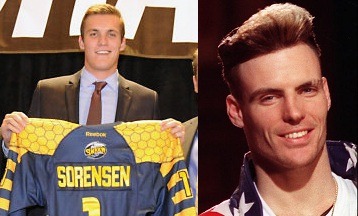
Guest blogger Jack Goods at Bandits open practice

We have a special guest blogger today: Jack Goods, who has written for both IL Indoor and In Lax We Trust. Jack was at the Buffalo Bandits’ open practice this morning, and filed this report which I am happy to provide here on NLL Chatter.


Bandits Open Practice Recap
By Jack Goods

The Bandits held their annual open practice today at the First Niagara Center and used the occasion to help unveil their new uniforms. The first primary uniform change in over ten years from the team, this year’s jerseys have a more modern feel. Many design aspects are similar to the All Star Jerseys worn in Buffalo last season. A few players, including John Tavares, Mark Steenhuis, Shawn Williams, Jay Thorimbert, and Scott Self were wearing the full uniforms which including name plates and numbers.

Of course the main event for fans was the actual practice and the chance to see many of the new Bandit players in action. After undergoing a pretty big overhaul this offseason many of the names on the roster handed out to fans were different than they names they saw last year. That added even more excitement to a day that usually gets the diehard fans in Banditland pumped up. A few players were notable in my eyes.

Derek Hopcroft showed off his skills quite nicely in both the drills and the scrimmage. One goal in particular stood out, a behind the net goal with his off hand. He showed lacrosse intelligence that many players just seem to lack. A young player who scored 15 goals last season for Colorado, Hopcroft could end up being a solid player on this year’s roster.

Nick Cotter, another new name, seemed to be on his game today as well. Although he sat out last season he doesn’t seem to have lost a step. He appeared to be one of the fastest and most in shape players out there, maybe due to playing with the Charlotte Copperheads of the PLL this fall.

This was the first chance for fans to see this year’s draft picks in their Bandits gear, and one thing jumped right out at me. Guys like Dhane Smith and Carter Bender are huge. The Bandits had issues with size recently but seem to have answered them. Dhane Smith made a few moves today that caught my eye and I noticed he is very fast for his size.

Marty Hill, Joel Matthews, Jimmy Purves, Jamie Rooney, and Scott Stewart all did not practice due to injuries. Although both currently on the physically unable to perform list, both Steenhuis and Self participated in practice. Steenhuis did take a Dhane Smith shot to the head early on, but returned after a short time.

This is a very good team this year; Bandits fans should be very excited. I look at this roster and think there are probably 27 players who could easily be on this team. Deitrich has brought in solid competition, winners, and a good mix of experience and youth. Although the Knighthawks have to be thought of as the front runners (especially since the Dawson trade) the Bandits shouldn’t be a push over this season.

The Lou Marsh committee snubs John Grant – and lacrosse

Christine Sinclair, captain of Canada’s national women’s soccer team, was named the winner of the 2012 Lou Marsh award this past Monday. This award is given to Canada’s outstanding athlete of the year, as chosen by a group of sports reporters and broadcasters. Sinclair had an outstanding year, breaking her own record for goals (23), setting an Olympic record with 6 goals, and factoring in on over 65% of her team’s scoring. Without question, she is deserving of the award.

John Grant

Also deserving, in my opinion, is the Colorado Mammoth’s John Grant. Grant set a new NLL record for points in a season and was named league MVP. Then his Chesapeake Bayhawks won the MLL championship, and to cap it all off his Peterborough Lakers won the Mann Cup. Not a bad year for one of the best lacrosse players in history. But how much consideration was he given for the Lou Marsh? None, apparently, as National Post writer, Lou Marsh committee member, and twitter aficionado Bruce Arthur revealed to me in an exclusive interview. OK, I’ll put “interview” in quotes. In actual fact, we had a short twitter exchange:

@GraemePerrow: @bruce_arthur Were you on the Lou Marsh committee? Was John Grant (lacrosse player) given any consideration?

@bruce_arthur: @GraemePerrow he wasn’t, to be honest.

@GraemePerrow: @bruce_arthur Too bad. One of the best lacrosse players ever with one of his best seasons ever, 3* years after life-threatening surgery

@bruce_arthur: @GraemePerrow I’ll look him up. Thanks.

* – it was actually four years. I misspoke.

I’ll look him up.” Not only was Grant not given any consideration at the meetings, but Arthur has never heard of him.

I wish I could say that this reflects badly on Arthur or the Canadian sports media in general, but unfortunately for the lacrosse community, it’s par for the course. I’m sure this is frustrating for fans of a lot of sports – who was Canada’s best rugby player in 2012? Did he deserve to be mentioned? I have no idea, but rugby isn’t Canada’s national summer sport. Lacrosse is.

Should Grant have won the award over Sinclair? There’s certainly an argument to be made for it. More non-soccer fans heard about Sinclair this year than non-lacrosse fans heard about Grant, thanks to the Olympics. That said, it doesn’t seem fair to punish Grant for having an outstanding year in a “fringe” sport.

But I think it’s more than fair to say that Grant deserved to be in the conversation. Someone in that room should have said “Hey what about this John Grant guy? Won championships in two different leagues and was MVP of a third.” With a little research, they could have discovered that Grant had had knee surgery in 2008, which was not just career-threatening but life-threatening. There was talk of amputation, and Grant was told he’d never play again. Four years later, he’s the best player in the NLL. Again.

If someone in the room had brought that up and after some thought, it was decided to give Sinclair the award, I’d be fine with that and this article would never have been written. I might disagree with their decision, but they have their opinion and I have mine. But not to have Grant’s name even mentioned is a travesty.

Unbelievably, 2012 wasn’t even Grant’s best year. In 2007, he won the NLL Championship and the Mann Cup. He was named MVP of the NLL, the NLL Champions Cup game, the MLL, and the Mann Cup, and was also Offensive Player of the Year in the MLL. And since that wasn’t enough, he also won the World Indoor Lacrosse Championship as part of Team Canada. But did he get any consideration for the Lou Marsh award that year either? As far as I can tell, nope.

The Lou Marsh trophy was first awarded in 1936. Since then, 12 hockey players have won it along with 9 figure skaters. There have been runners, skiers, baseball players, golfers, swimmers, and now a soccer player. There have even been two wheelchair racers. But in 76 years, zero lacrosse players. Lacrosse has been one of Canada’s national sports since 1994 and was Canada’s only national sport for well over a hundred years before that, but the best lacrosse players in the world don’t seem to be considered for this award. This needs to change, but if John Grant can have the seasons he had in 2007 and 2012 and not even get mentioned, it doesn’t look like it will.

Pre-season game report: Edmonton 12 Toronto 8

The NLL is back! After seven months of NLL withdrawal, NLL fans were treated to three pre-season games on Saturday night as the teams get ready for the 2013 season. Only one of the three games actually took place in an NLL venue, as the Rochester Knighthawks held off the Minnesota Swarm 11-10 at the Blue Cross Arena in Rochester. The NLL returned to the Vancouver area for the second straight year as the Calgary Roughnecks beat the Colorado Mammoth 20-11 in a high-scoring affair, while the Toronto Rock hosted the Edmonton Rush at the new Toronto Rock Athletic Centre in Oakville. This was pretty convenient for me, as the TRAC is about halfway to the ACC from where I live.

Edmonton took an early 2-0 lead before the Rock got their first goal, but 2-1 was as close as the Rock would get as the Rush led the rest of the way, winning 12-8. Considering this was the first game of the pre-season, both teams played pretty well with a few missed or dropped passes but no obvious signs of rust. None of the goalies were spectacular but all played well. The Rush defense, unsurprisingly, was the star of the game, frustrating the Rock offense by not letting them get good looks. Blaine Manning looked really good, and Josh Sanderson got back on defense a couple of times, which surprisingly did not make me cringe. If there’s one thing that future Hall of Fame lock Sanderson is not known for, it’s his defense but he seemed to be playing with a new intensity – and even got a penalty while he and Leblanc were preventing an attempted incursion into Rock territory. Great to see.

This game was the NLL debut of Edmonton’s first-overall draft pick Mark Matthews, and he certainly did not disappoint. I don’t have any stats on the game, but Matthews picked up at least three goals and a few assists as well. Matthews looked comfortable on the floor, and seemed poised to take control of the Edmonton offense, similar to the way Cody Jamieson did with the Knighthawks a couple of years ago. The Rock were without many of their big offensive players, with Colin Doyle, Garrett Billings, Dan Carey, Kasey Biernes, and Phil Sanderson all sitting out. There were a bunch of new names (Belton, Andrews, Caravello, Ivey) as well, though a couple of notable absences were draft pick Bradley Kri and the newest Rock Scott Evans. As is frequently done in the pre-season, some of the Rock players only played the first half (Nick Inch, Cam Woods, Chris White) while others only played the second (Damon Edwards, Stephen Hoar), and both teams swapped goalies a couple of times.

Aaron Bold started against Nick Rose – at least I’m pretty sure it was Bold; Edmonton must have forgotten their Twitter handle jerseys at home and played with practice jerseys with no names. Edmonton brought out Brodie MacDonald (who didn’t even get a practice jersey – his was just plain gray with no number or logo or anything) to start the 3rd quarter while the Rock countered with rookie Zac Boychuk. Rose came back in the fourth, and another rookie, Dave Marrese, finished the game for the Rush.

Part of the reason for these pre-season games is to give the rookies time to show their skills, and both Kyle Belton and Dustin Caravello took full advantage of this. I wouldn’t be surprised if Caravello played more minutes than Leblanc. I was pretty impressed with both but especially Belton, who looked like a Josh Sanderson-type “floor general”, controlling the offense and setting up plays. Caravello, on the other hand, was more of a Kasey Biernes type, sneaking around (or through) the defense to get shots from in close. I’m pretty sure Stephan Leblanc did not score, though I think he had an assist or two. I wouldn’t say he looked lost, but I didn’t see the improvement in play that I was hoping for. He seemed to have a lack of confidence last year, and I saw that again here.

I would be remiss if I didn’t mention the venue itself. This was my first visit to the Toronto Rock Athletic Centre, and it was pretty impressive. There are two rinks, one with turf and one without. The turf one has bench seating for about 700 along one side, similar to your local hockey rink. There are also offices upstairs. Make no mistake though, this is not a hockey arena where you can play lacrosse once the ice is removed – I confirmed (with a security guard who seemed to know what he was talking about) that there is no ice-making equipment – this is a lacrosse facility.

Other game notes:

  • It was very cool to see Bob Watson at the game. I heard some guys a couple of rows behind me talking shortly after Whipper walked by, and one said “I will always have time for Bob Watson. As good a goalie as Watson was, he was a better person.” I have never met the man personally, but this is consistent with everything I’ve ever heard about him.
  • My son and I were sitting right next to the Edmonton dressing room – you can see us during Derek Keenan’s interview before the game. My son (green baseball cap) waves at the camera. I noticed Chris Corbeil standing around before the game while the rest of the team was practicing, but it wasn’t until much later that I noticed the cast on his right foot. No idea how serious his injury is.
  • Watching the Calgary-Colorado game, there were five or six “illegal equipment” calls because of loose chin straps. This is apparently something they’re going to be calling more this season, but obviously nobody told the refs at the Toronto-Edmonton game. Edmonton players lost their helmets at least three times.
  • They also did stick checks during the second quarter, and I believe Jeremy Thompson was caught. The ref handed his stick to a Rush trainer, and then signaled to either Thompson or Derek Keenan that there was a problem, though this was on the other side of the floor so I couldn’t tell what he was saying. Thompson immediately left the bench, ran to the dressing room, and returned a minute later with a new stick. There was no penalty assessed.
  • The first goal of the night was scored by Edmonton, but announced as “Jesse Gamble from Mike Hobbins and Brendan Thenhaus” all of whom are Rock players. Someone was looking at the wrong list. The rest of the goals were fine, but there was no correction on the first one.
  • Phil Sanderson, Garrett Billings, and Colin Doyle were up in the “owner’s box” with Jamie Dawick, except for halftime when Billings and Sanderson were on the floor taking shots. Terry Sanderson, usually behind the bench, was also up in the box.
  • Overheard: “The Rock goalie, what’s his name? Pete Rose?”
  • While Brodie MacDonald was in net, someone near me was yelling “five hole!” every time the Rock had the ball in the offensive zone. Sure enough, MacDonald’s five hole was half the net. But I guess that’s what happens when you’re 6’7″.
  • One lesson I learned from this game is not to tweet updates constantly on my phone. More than once I was tweeting about one goal only to miss the next one. If I had had my laptop with me it would have been easier, but I feel that I missed half the game because I was tweeting about the other half.

Upcoming NLL milestones

Here are some statistical milestones that may or may not be reached during the 2013 NLL season. Of course, all of these numbers are completely arbitrary – does anyone discount Tom Marechek’s achievements because he “only” scored 399 goals in his career and didn’t get the elusive 400th? Of course not, but people seem to like nice round numbers, so here are a few that we may see this coming season.

Players

John Tavares (photo: Larry Palumbo)A few players are close to some significant targets this season. Nobody will hit 1000 points unless a new single-season points record is set – Gavin Prout needs 119 points to reach 1000, and Dan Dawson needs 129. The closest points milestone would be 800, which only ten NLL players have ever reached, and which Mike Accursi will reach with only 15 more points.

John Tavares has reached more than his share of milestones over the years, and 2013 may feature yet another height to which nobody else has climbed. JT is already the only player in NLL history with 700 goals, and with 35 this season, he would reach 800. Tavares had 41 in 2012 so this is not out of the realm of possibility. To put this milestone in perspective, John Grant is the only other active player with over 500 goals, and Junior would need six more 50-goal seasons to reach 800.

Colin Doyle could join Tavares and Grant in the 500-goal club by scoring 42. Doyle has only reached 42 goals in one season three times and not since 2006 so this is a bit of a long shot.

Potential candidates for the 400-goal club include Lewis Ratcliff (needs 20), and Josh Sanderson and Mike Accursi, each of whom needs 32. Tracey Kelusky needs 43, but seeing as he’s only scored 32 in the past two seasons combined, this is even more of a long shot than Doyle.

A few almost-sure things are the three likely new members of the 300-goal club: Aaron Wilson needs 3, Blaine Manning needs 4, and Gavin Prout needs 7.

Just as John Tavares is the only player to reach 700 goals, he is also the only player to have reached 800 assists, and Tavares needs just 38 more to reach 900. Colin Doyle would need an 80-assist season (which has only been done once, right Mr. Billings?) just to reach 800. But only four players have ever reached 600 assists, and both Gavin Prout and John Grant are likely to join that club this season. Prout only needs 12 to get there, while Grant needs 26.

In terms of loose balls, no previously unobtained milestones will be reached this season. Or the next. Or even the one after that. Jim Veltman’s record of 2417 is safe for quite some time – John Tavares is the only player within eight hundred of Veltman, and Tavares would have to play for 3 1/2 more seasons (at his career average of 97 LB) to get there. But if anyone can reach Veltman’s astronomical total, Brodie Merrill and Geoff Snider are the most likely candidates, and each of them could reach the 1500 loose ball total this season. Merrill only needs 129 (he’s never had fewer than 157), and Snider needs 208, a figure he’s only failed to reach twice in six seasons. But assuming Merrill and Snider keep up their current paces (12.4 per game for Merrill, 14.5 for Snider) and play 16 games a year, Geoff Snider will become the new all-time leader 13 games into the 2017 season. I wrote about this once before and stated it wouldn’t be until 2018, but Snider’s 232 LB in only 14 games last year increased his average.

The 1000 loose ball mark is reachable by a few players: Gavin Prout only needs 27, Josh Sanderson 57, and Bill Greer 76.

Teams

The Colorado Mammoth have three upcoming team milestones, two of which are very obtainable while the third will be close. The easy ones first: the Mammoth are 43 goals away from 2000 regular season goals, and they are 80111 people away from a total of 1.5 million in attendance, including both regular season and playoff games. An average of just 10013 per game in their 8 home games will attain that mark – and the Mammoth’s smallest crowd ever was 12537. The slightly more difficult milestone: 10 regular season wins will give them 100.

The Philadelphia Wings’ first loss of the 2013 season will be their 150th regular season loss in their history. This is far and away the most losses for any NLL team, and nobody else is even close. Of course, they’ve played at least five more seasons than anyone else. But consider this: in the last ten seasons, the Wings have only reached .500 three times (and only exceeded it once). The fact that they are still above .500 all-time is a testament to how good they were in the 1990’s. There were only 8-12 games per season, but the Wings had seven straight seasons over .700. In fact, regardless of how they finish this season, they will still end up above .500. Even going 0-16 this season will put them at 169-165.

The Calgary Roughnecks’ first home game will be their 100th, and the Riggers could reach one million in regular season attendance this season as well. They are 66896 away from that mark, an average of 8362 per game. The ‘Necks averaged 8313 per game in 2012, so just an extra 50 people per game will do it.

The Edmonton Rush should have a much easier time reaching their attendance milestone than the Roughnecks. The Rush only need 19201 to reach the half-million mark. Other than a slight bump from their first season (2006) to their second, the Rush’s average attendance has dropped every season. But unless it drops by over 30% from 2012 to 2013, they should hit the half-million target in game 3.

League

This is a fact that I first pointed out on my personal blog back in 2008, and then reposted on The NLL Blog in 2010 (and have since seen mentioned elsewhere as well): The last time the NLL began a season with the same teams in the same cities as the previous season was 1993. Barring last-minute foldings like the Ravens in 2005, 2013 will end the 19-year streak. If you’re looking for stability in a league that’s shown anything but for almost two decades, this might be the biggest milestone of all.

IL Indoor article on NLL star and diabetic Scott Ranger

I recently saw a tweet by Calgary Roughnecks forward Scott Ranger in which he said something about being a diabetic. This struck a nerve with me, since both my wife and father-in-law are diabetic. Also, back in 2010 I spent two months in the hospital (and three more months at home) recovering from pancreatitis, a condition which could have left me diabetic myself. In fact, I was told by a nurse during my hospital stay that I was diabetic, since a blood glucose test came back with some astronomically high value. A subsequent test showed that the first test was messed up and I was fine.

Anyway, I asked Scott if he would be interested in talking to me about his diabetes and how he deals with it as a pro athlete, and he eagerly agreed. We talked over email a few times and Scott was very forthcoming with his answers. He gave me lots of great information and I did a fair bit of research on my own as well.

Because diabetes is a topic that is meaningful to me, I wanted to get the message out to as many people as possible and quite honestly, my lacrosse blog is not the way to do that. So I made use of (you could argue “exploited”) the fact that I write for IL Indoor during the NLL season and contacted my editor, Bob Chavez. He was happy to oblige and agreed to publish my article on IL Indoor, where it will likely reach far more people than on my little blog. In fact, Bob made it sound like I was doing him a favour by giving him something to publish during what is lacrosse-wise the quiet part of the year.

Here is a link to the article, called Challenges of Type 1 diabetes can’t keep Calgary’s Scott Ranger from thriving. Many thanks to Bob for agreeing to publish it and of course to Scott for talking to me.

Harry Potter and the Shop of Photos

Photoshop expert aficionado wizard (ha!) Dan Shirley created this awesome picture of the gang from my Harry Potter article from last season:

HarryPotterCrew

From the left we have Geoff Snider (Sirius Black), Connor Martin (Ron Weasley), Kevin Crowley (Harry Potter), Troy Cordingley (Mad-Eye Moody), and John Tavares (Professor Dumbledore).

Goals per game in the NLL

When hearing someone describe the NLL to a non-lacrosse person, you tend to hear the same things over and over:

  • played in a hockey rink with the ice covered with artificial turf
  • similar rules to hockey, but with the shot clock and over-and-back rules of basketball
  • high-scoring, average of about 25 goals per game

But how accurate is that “25 goals per game” number? On the surface, it seems about right – games like 14-10 or 13-12 are pretty typical, 18-15 is a little on the high side, and 11-7 is a little low. But if we actually crunch the numbers, what do we find?

Amazingly, we find that this number is almost exactly correct. Taking into account the 1,633 games (regular season and playoffs) from 1987 up to and including the 2012 season, the average number of goals scored per game is 24.99. But the breakdown by season is surprising:

AvgGoals

The first ten years or so were pretty unpredictable, ranging from 22.6 in 1990 to 29.1 only two years later. The extremes: the highest scoring season was 1992, when 29.1 goals were scored per game. 2011 was the lowest scoring season, with an average of only 21.7 goals per game. The first six seasons were interesting – two seasons in the mid 27’s, two low-scoring seasons of 24 and 22, then the two highest ever, 28.2 and 29.1.

The obvious trend is that from 2000 until 2011, the number of goals scored dropped pretty steadily, from 28.2 in 2000 to a low of 21.7 in 2011. The NLL increased the width of the nets from 4’6″ to 4’9″ in 2002, and one of the first games of the 2002 season featured the Montreal Express defeating the Calgary Roughnecks 32-17. Fans wondered if that would be the norm with the new nets, but in the end it made little difference; the average actually dropped about half a goal from 2001 to 2002, and then down over a full goal the next year as goalies adapted. However in 2012, a number of rule changes were made in an attempt to speed up the game, and seemed to have the (possibly unintentional) effect of increasing scoring as well. After the lowest-scoring season ever in 2011, scoring rebounded in 2012, jumping 2½ goals per game to 24.2.

Why did the rule changes increase goal scoring? Here’s why:

  • The 8 second rule (instead of 10), the “immediately drop the ball on possession changes” rule, and the fast starts all meant that there were more transition chances, and many of those were converted.
  • In addition, the faster the transition, the more likely that an offensive player will get stuck on the floor playing D, and some offensive players are just not the two-way players of old. They’re not all as skilled at their own end of the floor as at they are the other end, and so playing five top offensive players against four defenders and one O guy playing D gives the offense a bit of an advantage.
  • Defenders were also forced to give up their longer 46″ sticks for 42″ sticks, obviously making it harder for them to stop the John Grants and Dan Dawsons of the league.
  • Finally, on a five-minute power play, three goals are now required to allow the penalized player out of the box instead of two. I don’t think this rule came into effect all that often, but it did mean that some 5-on-4’s lasted longer in 2012 than they would have in 2011.

The 2012 NLL Entry Draft, from a fan’s point of view

Other than the eligible players and their families, it’s probably safe to say that the majority of people who attended this week’s NLL Entry Draft had been to previous drafts. Most of the GMs, coaches, scouts, and executives have likely been to many of them. Some are former players and were drafted themselves. But as a lacrosse outsider, this was my first time. Some of the event went as I expected, and there were a few surprises as well. For others out there who have never been to a draft, here are some of my observations. These are all serious, unlike the goofy thing I posted yesterday.

The draft took place at the Westin Harbour Castle in downtown Toronto, one of the most well-known and swankiest hotels in the city. Coincidentally, this was where my high school prom was held, back in (OMG) 1987 when it was the Harbour Castle Hilton. I arrived around 6:40pm, and the draft was scheduled to begin at 7:00. There was a stage at the front with a big “NLL DRAFT” banner behind it, as well as banners on each side with all of the team logos. To the left of that was a table where the commentators Andy McNamara, Stephen Stamp, and Randy Mearns sat, and directly in front of the stage were a number of long tables, one per team. I couldn’t see all of them, but the Rochester and Calgary tables were at the back. Edmonton was in front of Rochester, and Buffalo in front of them. Minnesota was in front of Calgary.

I sat in the front row, off to the left behind the Rochester table.  Looking around the front of the room, I saw a who’s who of NLL people – at one point without even moving my head I could see Curt Malawsky, Bob McMahon, Jamie Dawick, Terry Sanderson, Darris Kilgour, Steve Dietrich, Curt Styres, Bob Hamley, and George Daniel. A number of people from the Rochester scouting staff, including NLL legends Chris Driscoll and Paul Gait, were sitting in the row just down from me.

2012 NLL Draft

In this picture (click to enlarge), you see the Rochester table right in front of me. Owner Curt Styres is the guy with the braid. Andy McNamara and Stephen Stamp are sitting at the table on the far left. At the right edge is the left half of Calgary assistant coach Bob McMahon, and Curt Malawsky was sitting next to him (just out of the picture). You can also see Minnesota play-by-play man and scout (and last year’s Tom Borrelli award winner) Jake Elliott on the right – the big bald dude who’s seemingly looking right at me. Hi Jake!

The public seating was mostly empty when I got there, but there were a number of people milling about outside the room. Just before the proceedings began, I looked around again, and it had mostly filled up. There were a lot of young nervous-looking faces out there with girlfriends and parents. By the end of the night, many of those faces were smiling above brand new NLL jerseys.

Around 7:00, the event got underway. Andy McNamara, play-by-play voice of the Toronto Rock, was the MC for the evening, and introduced Stamp and Mearns as well. After a few words about what we can expect (including the exciting reveal of who the first player was going to be… not that we hadn’t known for weeks already), Andy turned things over to commissioner George Daniel and VP of Lacrosse Operations Brian Lemon, who explained a few of the rules. Basically, the teams were free to choose whoever they wanted, but if a player turned out to be ineligible or a pick was otherwise illegal, the pick would simply be retroactively cancelled. Each team had five minutes to make their selection in the first round, and two minutes in subsequent rounds, and each team had two five-minute extensions that can be used anytime. I believe the Bandits were the only team to use an extension.

Before long, Daniel announced that the Edmonton Rush were now “on the clock”, and the Rush brass panicked, since they only had five minutes to come up with… well, no, of course they didn’t. The Rush announced a while ago that Mark Matthews was going to be their pick, so less than a minute later, Daniel was up on the stage again making the least surprising announcement of the night. Matthews came down to the front, was given his new jersey (complete with his name on the back), and had the obligatory picture taken. He then went back to the table with the the Rush people and sat there the rest of the night, presumably providing input about players he knew for future rounds.

Minnesota had the next three picks, and I expected them to make all three at the same time, but they treated them as three separate picks. Brock Sorensen, here’s your jersey, take a picture. A couple of minutes later, Kiel Matisz, here’s your jersey, take a picture. A couple more minutes, Shayne Jackson, here’s your jersey, take a picture. This made total sense though; getting drafted is a big deal for these players, especially so high in the first round, so I’m glad that they didn’t water it down for these players by combining the picks and jersey presentations.

After the jersey presentation and pictures, each player was interviewed briefly by TSN’s Claude Feig, and most players ended up giving the same stock answers. It’s a dream come true, I’m excited to join the team, I’ve heard great things about them, looking forward to training camp, that kind of stuff. Not that any of them weren’t being genuine, and I imagine most of them are pretty new to giving interviews, but you did tend to hear the same responses over and over. It was amusing at the beginning when Feig talked to the first three picks and mentioned their height. They were all 6’4″ or 6’5″ – as tall as Feig himself who said later that it was “nice to have someone eye level to talk to.” Earlier in the evening, I saw Stephen Stamp walking up to the front, and he looked even taller than Feig.

In between picks, Stamp, McNamara, and Mearns offered analysis of the picks and players, and what each player could bring to their new team. Offensive star, defensive specialist, big and strong, small and wiry, hard shot, great passer, even one guy they described as something like “a really annoying guy to play against”, they knew something about everyone.

Despite the lower time limits, I didn’t notice the second and subsequent rounds going any faster than the first. Actually, the whole thing moved along pretty quickly. Once we got into the third and fourth rounds, some of the people chosen were not present as we got into the “what the hell, let’s take a chance on this guy” picks. At one point, I’m sure Chris Driscoll said “who?” as a name was read. There were only two trades on the night, both involving Minnesota and both picks for picks, no actual players involved. I was hoping for some obvious signs of talks going on, like seeing Terry Sanderson leaning over the Minnesota Swarm table saying things like “Sure, we can take Jordan MacIntosh off your hands”, but first off there were too many people wandering around, and secondly I didn’t recognize everyone up there, since there were GMs and assistant GMs and coaches and assistant coaches and scouts and owners and players (John Tavares was at the Bandits table) and possibly other people as well.

The only thing that was really different from what I expected was that George Daniel read out all the names of the players. For whatever reason, I expected each GM to come up and announce their pick, which is the reason I wrote the “behind the scenes” article as I did.

I enjoyed the draft and I’m glad I went, though I kind of wish I’d stuck around a little longer afterwards and introduced myself to some of the people I’ve talked to on Twitter a bunch of times but have never met in person. I know that some people had issues with the internet feed at the beginning, but as far as I could tell, the night went without a hitch. For a league that doesn’t have anywhere near the resources of the NHL or NBA, I thought they did an excellent job – it certainly didn’t look like a shoestring-budget kind of event. For those of us that are not lacrosse insiders, it was fascinating to see the inner workings of the league in action.

Behind the scenes at the NLL Entry Draft

The NLL entry draft took place this past Monday in Toronto, and was broadcast live on NLL.com. But the broadcast was just NLL commissioner George Daniel repeating the picks that the GMs gave him. The actual drafting process was a little different. I managed to record it, and I’m posting a transcription of the first round here so that other fans can see the real behind-the-scenes action that wasn’t shown on the broadcast.


George Daniel: Welcome everyone to the 2012 NLL Entry Draft. Many thanks to the Toronto Rock for hosting this year’s draft and yesterday’s combine, and good luck to the eligible players. Without further ado, let’s get right to it! The first pick goes to the Edmonton Rush. Derek?

Derek Keenan: Thank you Commissioner Daniel, and thank you also to the beautiful city of Toronto and the Toronto Rock for hosting this year’s entry draft. The management and coaching staff of the Edmonton Rush have been considering our first overall choice for some time now…

Daniel: Yeah, yeah, the Rush pick Mark Matthews. We’ve all known for months. Moving on – the Minnesota Swarm have the number 2, 3, and 4 picks. John?

John Arlotta: The Swarm pick Brock Sorenson, Kiel Matisz, Shayne Jackson, Dhane Smith, Joe Resetarits, Curtis Knight, …

Daniel: John, you only get three choices right now.

Arlotta: Oh right, sorry. Got carried away there.

Keenan: …carefully examining our offensive and defensive positions,…

Daniel: Thanks John. Next we have the Buffalo Bandits. Steve?

Steve Dietrich: (talking quietly) Um, hi everyone. It’s me, Steve. (whispering) Wow, that was a dumb thing to say. C’mon Steve, pull it together.

Daniel: Don’t worry Steve, we know it’s your first draft as a GM. No need to be nervous.

Dietrich: OK, thank you Mr. Daniel sir. Um, has Mark Matthews been taken yet?

Daniel: Yes, Mr. Matthews has been taken.

Dietrich: Well, then, I guess our pick here is, um, Dhane Smith? That’s OK, right Darris?

Darris Kilgour: (headphones on, singing) Hey, I just met you, and this is crazy…

Keenan: …judging the talent of the players available…

Daniel: Thanks Steve. Next we have Calgary. Mike, you have two picks.

Mike Board: How about Mark Matthews?

Daniel: Um, Matthews is gone.

Board: Yeah, figured as much. Thought I’d give it a shot just in case Derek forgot or something. Anyway, Calgary takes Joe Resetarits and Matthew Dinsdale.

Daniel: Thank Mike. Derek, we’re back to the Rush for number eight.

Keenan: …and so with the first pick in this year’s National Lacrosse League entry draft, the Edmonton Rush choose, from the University of Denver and the Denver Outlaws, Mark Matthews.

Daniel: We got that one already, like twenty minutes ago. Who’s your pick at number 8?

Keenan: Oh. Curtis Knight.

Daniel: Thanks. Oh by the way, the University of Denver teams are called the Pioneers, not the Outlaws.

Keenan: Yeah I know, I meant the MLL team.

Daniel: (blank look)

Keenan: The MLL? You know, Major League Lacrosse? The field lacrosse league?

Daniel: (blank look)

Keenan: Never mind.

Daniel: Moving on, Steve, I believe it’s your turn.

Steve Govett: Mark Matthews is gone, right?

Daniel: (rubs forehead) Yes. Matthews is gone.

Govett: OK then. I like this Colton Clark guy. Colton. That’s a strong name. Sounds like a cowboy or something. Good Colorado name. Hope he’s a decent player.

Daniel: All right, for the last pick of the first round, we go back to the Minnesota Swarm.

Arlotta: The Swarm pick Alex Cresinpuck… Crepsnick… Crespo… Crensipick…

Daniel: Yeah, I was hoping he and that Matisz guy wouldn’t get picked so I wouldn’t have to say their names. I already spent half an hour getting Resetarits right. Anyway, that ends the first round. If someone can go wake up Doug Locker and Terry Sanderson, they are picking soon. And just let Styres and Mouradian sleep, they’ve got another round or two to wait.

Curt Styres: Hey, we’re with ya, we’re paying attention, aren’t we Johnny?

Johnny Mouradian: (asleep, mumbling) Sure Kevin, you can have a sweater just like Brodie and Dan.

Styres: Oh….kay.

Mouradian: (still mumbling) The Wings choose Mark Matth–

Daniel: Don’t even go there.

First round draft choices

The annual entry draft is one of the biggest days in the NLL off-season. Obviously each team is trying to improve by drafting players who they hope will contribute to their team for many years, but the fact that all the GMs get together in one place increases the possibility of trades and makes the day that much more interesting.

Drafted players in the NLL can make an immediate and significant contribution to the team that drafts them, much more so than in hockey where drafted players frequently need another year or two of seasoning before they’re ready for the NHL, and especially in baseball where a drafted player may not make the majors for five years or more, if ever. In lacrosse, it’s not unusual for a drafted player to be familiar with many of his teammates and opponents thanks to playing in the summer leagues. I imagine this helps the NLL GMs significantly, since they don’t have to wonder how the player will do against NLL-calibre opponents – they can see first-hand.

Every year, someone is given the honour and/or the curse of being drafted first overall. In this article, I list the last ten first-overall draft picks and with the advantage of hindsight, who the first overall pick should have been. Keep in mind that if the “hindsight pick” isn’t the same as the guy actually chosen first, that doesn’t necessarily mean that the GM screwed up and should have taken someone else. Players don’t always work out as well as was expected. Sometimes the player just didn’t make the transition to the NLL as smoothly as others, sometimes there were work commitments that meant the player had to miss significant time, sometimes there were injuries, and sometimes another player who wasn’t chosen first ended up exceeding the expectations of him.

2011

Kevin CrowleyFirst pick: Kevin Crowley, Philadelphia
Hindsight pick: Too early to say

It’s been said before that 2011 was the strongest draft in years, possibly ever, but here’s something that really drives the point home. Everyone drafted in the top two rounds of the 2011 draft saw playing time in the NLL in 2012. You have to go to the fourth pick of the third round – number 22 overall – before you get to a drafted player who did not play in 2012, that being Washington’s Adam McGourty.

Obviously with only a year behind them, it’s hard to say who’s the best of this amazing bunch. Adam Jones won Rookie of the Year, but Crowley, Jordan MacIntosh, or Evan Kirk easily could have.

Cody Jamieson2010

First pick: Cody Jamieson, Rochester
Hindsight pick: Jamieson or Kyle Rubisch (2nd)

Kyle Rubisch is widely regarded as the best defender in the league, having been chosen as such in 2012 by both the league and IL Indoor. But Cody Jamieson is a legitimate offensive star, and given that he led the Knighthawks to the Champions Cup (and was named Championship Game MVP) in only his second season, you can’t say that the Knighthawks made a mistake drafting him.

2009

Sid SmithFirst pick: Sid Smith, Rochester
Hindsight pick: Garrett Billings (6th), Stephen Leblanc (11th)

Sid Smith is a big, solid defender and like Jamieson, was instrumental in helping the Knighthawks to the 2012 Championship so again it’s kind of hard to say the Knighthawks made a big mistake here. But as good as Smith is, it’s tough to argue with Leblanc, the 2010 Rookie of the Year, and Billings, the current single-season assists holder and 2012 MVP runner-up, as being better choices.

2008

Daryl VeltmanFirst pick: Daryl Veltman, Boston
Hindsight pick: Rhys Duch (3rd)

Veltman had an excellent rookie season, scoring 77 points for the Blazers in 2009, and followed it up with 65 points in his sophomore season. He was then traded to the Roughnecks in the Josh Sanderson deal, but his 2011 season was not was the Roughnecks expected. Having picked up 43 and 42 assists in his first two seasons, the Roughnecks (and Veltman himself) were a little disappointed with the 42 points Veltman tallied in 2011. He rebounded a little in 2012 with another 42 assists and 62 points, so Veltman isn’t a bust by any definition. But IL Indoor named Rhys Duch the #1 player in the league at the beginning of the 2012 season, and the only reason he was below 85 points this past season (his first such season) was because he missed a couple of games. He ended up with a paltry 79 points in 14 games, which extrapolates to 90 over 16.

2007

Jordan HallFirst pick: Jordan Hall, New York
Hindsight pick: Hall or Dane Dobbie (4th)

Hall has been one of the game’s better transition players since his debut with the New York Titans in 2008, and was given the NLL Sportsmanship Award in 2011. He’s played more of a defensive role in Rochester than he did in New York or Orlando, but was still an important part of the Knighthawks 2012 Championship season – or at least the first 2/3 of that season, before he tore a knee ligament and missed the last 6 games and the playoffs. Was he the best player in that draft year? Probably, though an argument could be made for Calgary’s Dane Dobbie, who only scored 7 points in his 5 games in 2008, but exploded for 75+ points in each of the next three years. He only scored 50 last season, but missed three games due to injury.

2006

Ryan BeneschFirst pick: Ryan Benesch, San Jose
Hindsight pick: Benesch

This year had a great draft class – you could argue for Geoff Snider (4th) over Benesch, and this group also included Kyle Sorensen (2nd), Ian Llord (5th), Paul Dawson (7th), Athan Iannucci (8th) and Brendan Mundorf (11th). Benesch was drafted by the Stealth but was immediately traded to the Rock in the deal that sent Colin Doyle out west. Benny had a great rookie year (58 points and a Rookie of the Year award) but then dropped off a little in his second season, which concluded with his being inexplicably benched for the last two games of the year. After being benched again for the first two games of the 2009 season, Benesch was traded to the Edmonton Rush along with Derek Suddons for draft picks* in one of the most stupidly lopsided trades in Rock history. Benny’s numbers dropped a little more in 2009 before he was traded to the Swarm where he flourished, turning into one of the most potent scorers in the league and winning the scoring title in 2011.

* – One interesting footnote here: The Rock sent Colin Doyle to the Stealth for Ryan Benesch. (There were others involve in the trade, but it was essentially Doyle for Benesch.) When Benesch was traded to Edmonton two years later, one of the draft picks sent from the Rush to the Rock was a first-rounder in 2009. With that pick, the Rock selected Joel Dalgarno, who was later traded to the Stealth along with Tyler Codron and Lewis Ratcliff for – guess who? – Colin Doyle.

2005

Brodie MerrillFirst pick: Brodie Merrill, Portland
Hindsight pick: Merrill

Another good group including Shawn Evans (2nd), Luke Wiles (4th), Matt Vinc (6th), and Jeff Zywicki (8th), but Merrill’s been Rookie of the Year, Defender of the Year, and Transition Player of the Year twice. He makes any team he’s on better, and has been considered one of the best players in the league since his first season.

2004

Delby PowlessFirst pick: Delby Powless, Buffalo
Hindsight pick: Rory Glaves (2nd), Ryan Boyle (3rd)

Powless entered the league with a lot of hype, mainly because he was the first overall pick. But part of the hype was the fact that he is part of the legendary Powless family. He played well, no question, racking up 40+ points in his first four seasons including 55 in 2008. But he never really lived up to what you might expect from the first overall pick, and after a substandard 2009 and only a single game in 2010, Powless was released by the Bandits and hasn’t played in the NLL since.

2003

Mark MiyashitaFirst pick: Mark Miyashita, Vancouver
Hindsight pick: Ryan Ward (3rd), Scott Evans (5th), Scott Ranger (7th)

Miyashita was a defenseman and faceoff guy who played a single season with the Ravens, one season with the Mammoth, and then parts of three seasons with the Swarm before calling it quits due to multiple injuries. Ward, Evans, and Ranger are still legitimate scoring threats and have luckily avoided the injury bug.

2002

Patrick MerrillFirst pick: Patrick Merrill, Toronto
Hindsight pick: Mark Steenhuis (7th)

I like Patrick Merrill. I think he’s a hard worker, a good defender, and a pretty good fighter as well. But Mark Steenhuis is one of the best transition players of the last ten years. At one point I remember saying that there was nobody on the Rock that I wouldn’t trade for Steenhuis. Of course, this was when Doyle was in San Jose and the team was 6-10 while Steenhuis was lighting up the league, so that’s no longer true. But Steenhuis over Merrill is really a no-brainer.


I won’t go through all of the previous years, but a few names stand out as obvious hindsight picks.

  • In 1996, Tim Langton was chosen first overall, while Cory Bomberry was taken third. Langton played three seasons with the New York Saints, while Bomberry played fourteen seasons with Rochester, Arizona, and Buffalo, winning a Championship with the Bandits in 2008.
  • In 1993, John Webster was the first overall pick, taken by the Philadelphia Wings. Webster never played a game in the NLL while the New York Saints’ fourth overall pick, Mark Millon, played 96 games over ten years, ironically finishing his career with the Wings.
  • Jim Buczek was the Pittsburgh Bulls’ first overall choice in 1992. Buczek’s pro career was limited to three games, while the Bandits had the sixth overall pick and drafted some guy named Tom Marechek. Obviously he never made much of an impression on the Bandits, since he was traded to Philadelphia before he ever played a game for Buffalo. He did OK in Philly though, where he won four championships over twelve seasons and is now in the NLL Hall of Fame.