Thinking inside the box Part II: Exodus

Last week I wrote about a number of significant MLL players who may be playing in the NLL this coming season. This is significant not just because NLL fans who don’t watch the MLL will be introduced to some great lacrosse players, but because this seems to reverse the trend over the last few years. But where did this trend come from, and why is it changing?

Aside: Jake Elliott and Brad Challoner talked about this a bit on the Oct 21 edition of the Stealth Classified radio show / podcast, a show that you really should be listening to if you’re a lacrosse fan – even if you’re not a Stealth fan.

Another aside: The list of MLL players signed this season has grown since that last article: New England signed both Myles Jones and Josh Hawkins to contracts. Again, it doesn’t mean they’re definitely playing but it does mean they’re interested.

The Wings and the Championships

Back in 2013, the Philadelphia Wings had a whole bunch of guys who also played in the MLL: Crowley, Westervelt, Crotty, Rabil, … actually it would be faster to list the guys who didn’t. Of the 27 non-goalies who wore a Wings jersey in a game that season, 18 of them (67%) also played in the MLL that year. In 2014, they had 25 no-goalies but only 13 of them, or 52%, were MLL players. Why the sudden drop?

In the summer of 2014, Colorado hosted the World Lacrosse Championship, the pinnacle of field lacrosse supremacy. The USA had taken home the gold medal at the event in Manchester in 2010. The World Championships hadn’t been held in the US since 1998, and Team USA wanted nothing more than to repeat their gold medal performance in front of their own fans. As a result, a number of players decided to take the winter off from the NLL to prepare for the Worlds. The Wings lost Paul Rabil, Ned Crotty, Kyle Hartzell, Pat Heim, Brendan Mundorf, and Jeff Reynolds – six players totaling 79 games, 86 points, about a third of their transition, and 71% of their face-offs.

I imagine the Wings brass were less than impressed with this exodus. The intentions of the players were honourable, I suppose – they wanted to represent their country to the best of their ability. But it didn’t help the Wings any, and they dropped from 7-9 in 2013 to 6-12. I can’t be sure about this but I remember hearing at the time that the players who left were not welcomed back by the Wings, meaning that they were not invited to camp for the 2015 season – and other than Heim, they were not released either. Right after training camp at the end of 2014, the Wings added Rabil to their protected player list, Mundorf to the PUP list, and buried Hartzell, Crotty, Reynolds, and Max Seibald (who played for them from 2010-12 and also played for Team USA) on the restricted free agent list. As far as I can tell, they’re all still there, and none of them has played in the NLL since (though it’s possible that none of them have been interested in returning). To add insult to injury, Team USA lost the gold medal match to Canada.
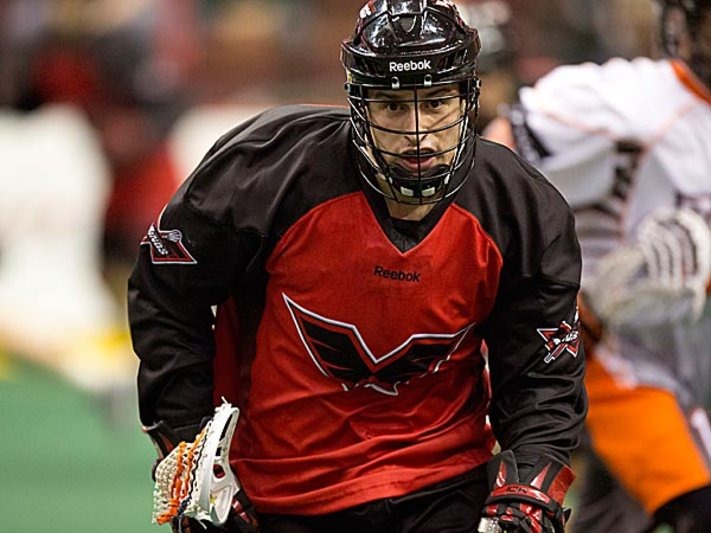
Kyle Hartzell with the WingsAlso interesting to note is the fact that both Kevin Buchanan and Garrett Thul found the time to play for both the Wings and Team USA in 2014. I don’t remember hearing of a single player on the Canadian or Iroquois teams who took the season off to prepare.

The number of MLL players in the NLL has continued to drop. In 2015, the Wings became the Black Wolves and only had six players who played in the MLL that same year. In 2016 it was only four. Of course it’s not just the Black Wolves that are involved; there were MLL players who played in the NLL for other teams, guys like Joe Walters and Mark Matthews, but the overlap seemed to keep declining. And overlap is one of the reasons why.

Us and them

As I said before, we know the NLL and MLL seasons overlap and players who want to play in both will miss games in one league or the other. It’s also true that just as the NLL is a “mostly-Canadians” league, the MLL is a “mostly-Americans” league. These guys grew up playing field lacrosse, not box, so the MLL is more important to them. Some of them think of the MLL as the “real” league and the NLL is a fun league to play in during the winter to keep in shape. I assume there are NLL players who think of the MLL the same way.

It’s also been said that some MLL players have publicly expressed interest in playing in the NLL purely as a bargaining strategy with their MLL team, i.e. “I’ll play with them and skip the beginning of the season if you don’t sign me to a long term contract / pay me more / whatever.” The person who stated this said he knows for a fact that this is happening, though he didn’t say who this was referring to nor was there any evidence given, so take that claim with a grain of salt.

NLL teams won’t be happy if players play the whole season and then leave when the playoffs arrive, while MLL teams won’t be happy if players don’t start playing for a month after the season starts. To my knowledge, the former has never happened while the latter definitely has. From that perspective, it certainly seems that the MLL is getting the worse of this situation. But are there MLL players who don’t play in the NLL at all because they don’t want to leave the team when the MLL starts? It’s likely that both leagues are losing out.

So there are a lot of reasons why a whole slew of MLL players suddenly signing with NLL teams is surprising. Maybe these guys want to stir up some controversy to get the leagues to talk and eventually co-operate. Based on the history of these two leagues, I will say with all the sarcasm I can muster: Good luck with that.

Then again, the NLL has a new commissioner who may not care about the history. If it makes sense for the league to have a partnership with the MLL, he may be more willing than previous commissioners to go to them and say “Hey, let’s forget all of that old animosity. If we start over and work together, we both benefit.” If that’s the case, I will say without a trace of sarcasm: Good luck with that.
Field players: Thinking inside the box

The winds of change might be sweeping over the lacrosse scene this winter, affecting not only the NLL but the MLL too. OK, that’s a little melodramatic, but there have been some significant signings over the past month or so. A few NLL teams have signed a number of MLL players to contracts and some of those players seem excited to join the NLL. This is not unprecedented, but it does seem to be reversing a trend.

There have been players who’ve played in both the MLL and NLL for many years. The roster of the inaugural Toronto Nationals back in 2009 looked like an NLL All-Star team. Some guys like Brodie Merrill, John Grant, and Kevin Crowley have played in both leagues every year, while others like Jesse Gamble, Kiel Matisz, and Chad Tutton were listed on MLL rosters this past year but did not play. There have also been players who were primarily MLL guys but played in the NLL too, guys like Paul Rabil, Ned Crotty, Max Seibald, Brendan Mundorf, and Connor Martin. Some were successful indoors, others weren’t. Rabil scored 161 points in 68 games over 5 seasons and won a Championship with the Stealth, while Connor Martin’s NLL career consisted of 6 games with the Mammoth, picking up 2 goals and no assists – though his backflip off the boards after his first was memorable. None of these guys has played in the NLL since 2013.

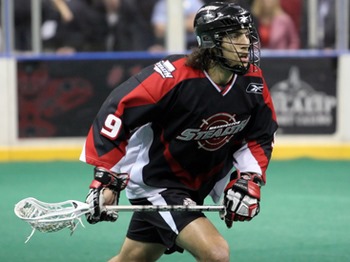
Paul Rabil with the Stealth

But the NLL and MLL seasons overlap, and to make matters worse for players who want to play in both leagues, the NLL season has become longer over the past few years. First they expanded the regular season from 16 to 18 games and then they also extended the playoffs. As a result, NLL players end up missing the beginning of the MLL season. In 2011, Kevin Crowley went to the NLL finals with the Toronto Rock and missed at least a month of MLL games.

So when it was announced in July that the Toronto Rock had traded a draft pick to the Black Wolves for the rights to Paul Rabil, it seemed like a weird move. Why bother trading for someone who’s already been in the league and has seemingly given up on it? But when Rabil acknowledged the trade and didn’t immediately say “yeah, not gonna happen”, a few eyebrows were raised. Could he actually report to camp and suit up for the Rock? Rabil is obviously a very skilled player but I don’t think that was even the main reason the Rock went after him. He’s probably the most famous lacrosse player in North America so what he brings to the team in attention off the floor may be worth just as much as what he brings on the floor.

Almost three months later, the New England Black Wolves drafted Myles Jones in the fourth round. Jones went first overall in the MLL draft earlier this year and is regarded as the steal of the (NLL) draft – if he plays. It sounds like this is unlikely (or he would have gone earlier) but it got people talking about MLL players in the NLL again.

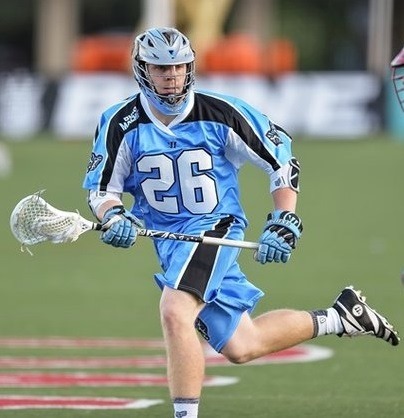
Tom SchreiberBut then the bigger news came down early in October. The Rock signed MLL stars Tom Schreiber and Kieran McArdle to one-year contracts and both have gone on the record as “looking forward to the challenge“. And these aren’t just MLL guys. These are really good MLL guys. McArdle was Rookie of the Year in 2014 and led the Florida Launch in scoring in 2016, finishing 6th in the league. Schreiber led the Ohio Machine in scoring, finished 3rd in the league, and was named league MVP. For comparison’s sake, Callum Crawford was 3rd in league scoring last year with 115 points and Mark Matthews was 6th with 109. This is not exactly the same since Schreiber and McArdle have no box experience but if you’re that good at field lacrosse, you’re unlikely to suck at box.

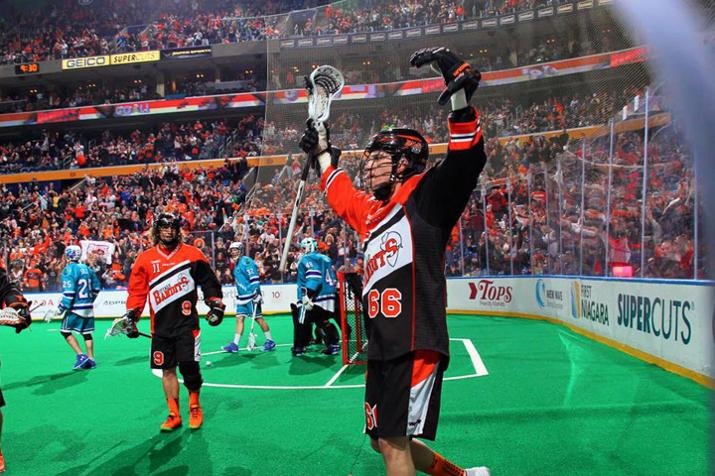
The same day, the Buffalo Bandits announced that they had signed Blaze Riorden, another MLL player. This one’s a little weird in that Riorden is a field goalie but was signed by the Bandits as a forward. Both Matt Vinc and Anthony Cosmo are goalies in box but not field, so there’s no reason Riorden couldn’t do things the other way around. And he’s familiar with the other end of the floor field too; here’s some (dizzying) video of Riorden the goalie scoring a goal.

Ten days after signing Schreiber and McArdle, the Rock signed McArdle’s Florida Launch teammate Connor Buczek. Buczek finished second in scoring on the Launch this past year and just like Schreiber and McArdle, he’s said that he’s looking forward to playing in the NLL.

For me, the big deal here isn’t that NLL teams are signing MLL stars. That’s happened before. But after the last three years where many MLL players have shied away from the NLL, the big deal is that now they’re not. Rabil hasn’t said whether or not he’ll report but hasn’t ruled out the possibility, at least not publicly. I haven’t heard anything from Riorden but the others have said that they are looking forward to it.

I have to think that if more MLL players are interested in playing in the NLL, this is good for both leagues. More players will start asking the two leagues to work together to make it easier, and eventually the leagues will have no choice but to work something out. But that possibility is a whole other kettle of fish – or can of worms. I’ll discuss that in a future article.

The NLL Draft is not about building for the future. It’s all about now.

While I was growing up as a hockey and baseball fan, drafts never interested me. I knew they happened but they were never televised and barely covered in the media at all, and there just wasn’t the hype about these young players that we have now. We all knew the names Sidney Crosby and John Tavares and Connor McDavid and Auston Matthews for months, sometimes years before they ever played an NHL game but a few decades ago, that’s not how it worked. I’d read about the draft results in the newspaper but it never meant anything to me because I don’t follow minor league baseball or hockey, so I’d never heard of any of the drafted players.

Most of the time, it didn’t really matter much anyway. Other than the very top draft picks, most players would sit in the farm system for a year or two (or five in baseball) before making the big club. If you remembered any names from the draft after the first round, you might never hear them again, or at least not for a long while.

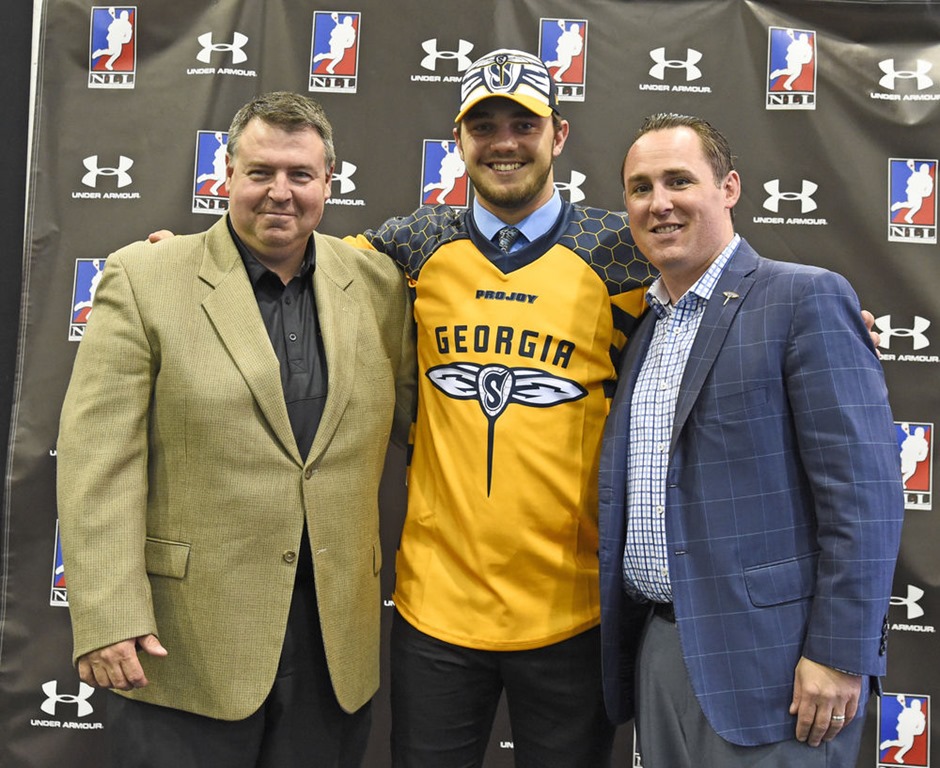
Connor Brown, Stealth drafteeFor the players and teams, it’s more of a big deal. Being drafted by a team means they thought highly enough of you that they want you in their system. And even if you can’t contribute right away, they’re willing to wait. It’s somewhat of a commitment. Sure, you can be cut at any time but a team has the option of playing you in the minor leagues for a year or two and see how you adjust to their playing system, get along with teammates and coaches, all that sort of thing. The draft is used to build the team for the future, not just next year.

The NLL is different

For most fans, the NLL draft is much the same – if you don’t follow the Canadian summer leagues or NCAA, you may not have heard of the players either. I was there last week and I certainly hadn’t heard of most of them. And there will be some whose name you never hear again after the draft.

But for the players and teams, it’s different from other sports. Teams aren’t drafting for the future, they’re drafting for now. And players aren’t hoping to get drafted and play for the big club sometime in the future, they’re hoping to play now. The reason for this is simple: there is no farm system. There are no minor leagues. Teams can’t draft a player and send him to the minors for a year or two before he’s ready. If you get drafted, there are three options:

  1. you make the roster for the upcoming season, or
  2. you make the practice roster for the upcoming season, or
  3. you are released.

That’s it. Players in the NLL aren’t drafted as much on their long-term potential, it’s all about next year. And this affects who gets drafted, by what team, and when.

Take the Toronto Rock for example: they have an older goalie in Brandon Miller and a younger one in Nick Rose. If they have a farm system, they might have drafted a young goalie like Doug Jamieson or Warren Hill and put him in the minors for a year or two for seasoning until Miller retires. Then they have Rose in his prime and a 22-year-old to back him up and everyone’s happy. Or if Miller plays well for a few more years and doesn’t retire, they have either Rose or a 22-year-old goalie as trade bait which nets them Curtis Dickson or Randy Staats or someone like that and still everyone’s happy. But there are no minors to put Jamieson or Hill in. They can’t pick them for the future. If there’s nowhere on the roster for one of them next season, they draft somebody else.

This is why the Rock’s choice of 18-year-old Latrell Harris at #12 is a little puzzling. I don’t know anything about the kid, but he’s only 18. Maybe he’ll be 19 when the season starts, and others like Shawn Evans and Rob Hellyer have excelled in the NLL at that age. And it’s certainly possible I’m underestimating how great a player he is; as I said, I know nothing about him. But if they decide during training camp that he’s too young or too raw, they either have to cut him or leave him out there, and trying to recover from a season where you missed the playoffs is not the best time to be using a roster spot on someone who’s not ready.

I only went to one or two CLax games in the few years it was around, and I feel kind of guilty about that now since it’s gone. But if they had partnered with the NLL, I think it could have been great. Imagine NLL teams drafting young players and sending them to CLax, or bringing up players when an injury hits, or using CLax for conditioning players returning from injury. There would have to be a western division of CLax, probably in Vancouver, and perhaps there are other factors that I don’t know about that would have made this impossible. But it seems like it would have been a good idea.

Except…

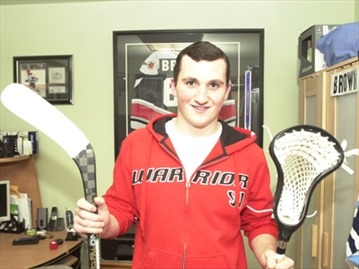
There is one exception to what I’ve said above. It is possible to draft someone and hold onto him for the future: a team can put a player on the holdout list. As long as he’s got a contract and doesn’t qualify as a free agent, he can stay there indefinitely. Teams don’t even have to pay players on that list. But the list is limited so you can’t just throw all of your draft picks that didn’t make the roster on the holdout list and keep them as long as you want. A team might use that strategy for one special player, as the Stealth have done with their 2015 draft pick Connor Brown (not the Toronto Maple Leaf). As long as he continues his hockey career, he’ll be unavailable to them but if he ever decides to play in the NLL, the Stealth will own his rights, even if that doesn’t happen for another few years.


Thanks a bunch to Teddy Jenner for consultation on the draft and holdout list rules.

NLL Entry Draft 2016

I was able to attend the NLL entry draft once again this year. It’s certainly fun to see all the players, coaches, GMs, media people, and the commissioner in one place, but it’s really cool to watch the players get drafted and see their excited parents, siblings, and girlfriends. I could watch it on the live stream, but it’s fun to be there in person. Unfortunately, I won’t be able to be at the TRAC tomorrow for the awards ceremony.

I have nothing much to say about the players drafted since I’ve never seen any of them play, with the possible exception of any Burrards or Chiefs from the couple of Mann Cup games I went to. This article is just about the draft itself.

NLL Draft

In previous years, Andy McNamara and Stephen Stamp gave their opinions and insight in between picks while Claude Feig briefly interviewed each player chosen. This year, it seemed that Stamper and Andy’s insight was reserved for the webcast and there were no interviews at all. In between picks, it was awfully quiet in the building. But it turned out that it wasn’t supposed to be that quiet – by the end of the first round, they had fixed the audio problems and we could hear Stamp and McNamara. Feig was not around, but Mia Gordon was interviewing many of the players (though we couldn’t hear her). I was sitting directly behind where she was doing the interviews, so I managed to get some screen time as well.

Have to give props to Stephen Stamp: it’s one thing to be critical of players in a blog or podcast or radio interview, but it really takes a pair to list a player’s shortcomings when he’s right there in front of you. “Ah, they just drafted Joe Laxalot and he’s walking to the podium now. Good offensive player, great outside shot, but not very fast and a little weak on the defensive end. I had him going lower in the draft, surprised they picked him.”

I took a couple of pictures with my phone but they didn’t turn out well at all so I stole the draft logo from the NLL site. I just noticed that the CN Tower is a lacrosse stick.

As usual, the TRAC was hopping, with a bunch of chairs on the floor itself and some people in the stands too. By the time the show got underway, most of the chairs were taken so I’m glad I got there early to grab one. And also as usual, Jamie Dawick and the TRAC people put on a professional show with a video board listing all the picks in the current round (though a bigger font might have been nice) and once the audio problems were fixed, the sound was good as well. I obviously didn’t see the web feed but I didn’t see anyone tweeting about problems with it. There were a bunch of wifi networks available, with names like “RochesterColorado” and “GeorgiaBuffalo” and such, as well as three TRAC ones and a couple of “NationalLacrosseLeague” ones. Alas, they were all password protected.

A bunch of Rush players were sitting right next to and in front of me – Matthews, Rubisch, Corbeil, Lafontaine, Knight, Sorichetti, and some other kid. I saw that other kid looking pretty nervous and taking a few deep breaths right before the first pick was made, and then once Ryan Keenan’s name was announced, he stood up and walked to the front. I don’t know if he was nervous because he didn’t know whether he’d be picked first or if he was nervous because he did know. He gave a little thank-you speech, which I think was also new. He’s now at least the second player to be drafted by his father, after Curt Styres picked Brandon a couple of years ago. Josh Sanderson was once taken by his father Terry in an expansion draft, which kind of counts.

OK, one actual lacrosse-related comment. There were a few trades on the night, only one of which included a player and not just picks. The Bandits sent a second round pick to the Knighthawks for Brad Self. Self is up for Transition Player of the Year at Tuesday’s awards, and all he’s worth is a second round pick? I’ve rarely disagreed with Curt Styres on lacrosse moves, but I wouldn’t have made this one. I know nothing about Dan Lomas, who the Knighthawks chose with the traded pick, but if the Knighthawks are lucky, he’ll turn out to be as good as Brad Self is now. Then again Self is 35, so perhaps they figured after a year or two of Lomas learning the ropes, he could be really good for ten years or more, so the long term gain will eventually offset the short term pain. But for a team that missed the playoffs last season and may be without Cody Jamieson for all of next season, adding more short term pain may not have been wise.

Other notes:

  • There was clearly no “what are we going to wear?” email going around the Rush camp. Chris Corbeil and Kyle Rubisch (and Lafontaine, I think) each wore a suit and tie, while Mark Matthews was wearing green denim jeans and a hoodie. Adrian Sorichetti and Curtis Knight split the difference – jackets but no tie.
  • I don’t always pick this up from watching on TV but some lacrosse players are BIG people. Mark Matthews is huge. Jim Veltman isn’t that big but he’s very tall. I was surprised at how big Glenn Clark is. I didn’t see Dan Dawson there this year but I saw him at last year’s draft and he’s massive. You can read “6-foot-5” in however many articles you want but until you’re standing next to someone that big, you don’t really realize just how big that is.
  • Almost didn’t recognize hipster Jimmy Quinlan with the bushy beard. It’s no Iannucci, but getting there.
  • This is going to make no sense to anyone but Steve, but thanks to Steve Bermel for the peanut butter.

Game report: Mann Cup game 3 – Maple Ridge 7 @ Six Nations 9

It seems a little silly to post my game 3 report after game 4 is finished, but damn that was a great game, so I need to post something about it.

The biggest surprise of this game was the announcement of the scratches for the Chiefs. Stephen Keogh? Really? Who the hell are they bringing in that’s so damn good they decided to sit Keogh?! Oh, Cody Jamieson? OK, well, I guess that’s acceptable. Still, there are a bunch of other people I’d have sat before Keogh.

After being pulled early in the third period of game 2, Dillon Ward looked sharp early in game 3, but Frankie Scigliano also looked good. The goals alternated almost all night – Six Nations scored, then Maple Ridge, then Six Nations, then Maple Ridge, … until the Burrards scored with less than four minutes left, giving them the lead. They held the lead for all of 2:11 before the Chiefs tied it. The game was tied at 1, 2, 3, 4, 5, 6, and 7.

The Chiefs took a lot of shots (they led the game 55-29 including outshooting the Burrards 20-9 in the second period and 19-9 in the third. But they didn’t really test Scigliano much in the first two periods; an awful lot of those shots hit him square in the chest. The Burrards did the opposite – they didn’t hit Dillon Ward much at all, they kept shooting high and wide and a lot of their shots hit the boards instead. Their shooting got better in the third quarter but so did Ward.

DillonWard

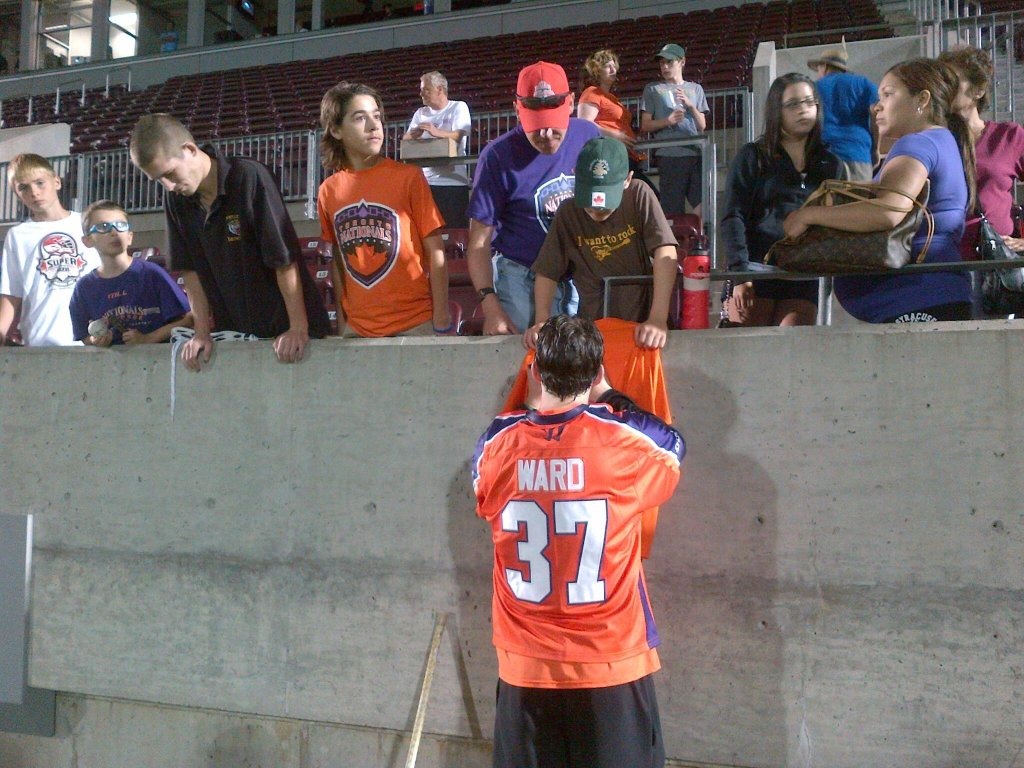
I didn’t take any pictures at this game, so this is a picture of Dillon Ward a couple of years ago as a Hamilton National, signing an autograph for my son (green hat). I’m wearing the red hat. I believe the woman in blue on the right is Mrs. Jeremy Thompson.

Like I said, this was just an excellent game. End-to-end action in both directions and not a lot of play stoppages. At one point in the second, I’m sure play went on for five minutes with not a single whistle. Part of this was due to a non-NLL rule I’m really starting to like – the shot clock does not run when a shorthanded team has possession. This means that if you’re good enough, you can grab the ball early in the penalty you’re trying to kill, and just run around for two minutes. Maple Ridge did this twice, and it was awesome.

In one case, the Burrards were killing a penalty and early in the penalty, the Chiefs got called for one, but the call was delayed because Maple Ridge had possession. Frankie Scigliano left the net and headed to the Burrards bench, but didn’t leave the floor. He stopped just short of the white line-change box, even pointing out to the ref that he was not in the box. The Burrards did not send an extra attacker out, presumably because the shot clock would have started. Instead, Frankie stood next to the bench for the full two minutes while the team killed the penalty (though he did grab a drink of water). With only a few seconds left in the penalty, the Burrards scored to negate the Chiefs delayed penalty. It seems weird that while killing a penalty, the Burrards seemed to have the advantage.

Game four just ended a short while ago, with the Chiefs winning by the same 9-7 score, though not in OT. That one was also tied five times. Clearly Maple Ridge is not the pushover many thought they’d be.

Other game notes:

  • I much preferred the Burrards white jerseys to the dark blue ones they wore in Game 2.
  • In overtime, Dan Dawson was being covered by two defenders when someone sent him a pass. It appeared that he didn’t even see the pass coming until it was halfway there, and then nonchalantly caught it with one hand on the stick.
  • Travis Irving took a tripping penalty in overtime which didn’t look like tripping to me. He and whoever he “tripped” just got their feet tangled up together and they both fell. Then Kevin Reid took a holding penalty that was pretty cheap as well. (“cheap” meaning it might have been technically holding since he grabbed Cody Jamieson’s jersey, but just for a second and it didn’t slow Jamieson down one iota.) IMHO, neither of these should have been called penalties, especially in overtime of a game where they weren’t calling much. Putting the Burrards on the PK for half of overtime for these kind of penalties was kind of unfair.
  • I sat across from the Maple Ridge bench rather than down in the end like game 2, and actually had phone and internet service… at least sometimes. For most of the game, the internet didn’t work while the phone was in my hand but once I put it in my pocket, it updated.

Game report: Mann Cup game 2 – Maple Ridge 13 @ Six Nations 9

My mini game report (mini-report on a game, not a report on a mini-game) covers most of what I saw in game 2:

Perhaps I can expand on that a little.

I don’t follow the MSL or WLA all that closely, but close enough to know that (a) the Six Nations Chiefs were expected to challenge for the right to represent their league in the Mann Cup, and (b) the Maple Ridge Burrards were not. They even got into… um… penalty trouble earlier this year, but not only pulled through that but made everyone forget about it.

While watching the warmups before the game, I was once again floored at the number of familiar names on the Chiefs. The Dawsons. Dillon Ward. Stephen Keogh. Ryan Benesch. Dhane Smith. Jeremy Thompson. Sid Smith. Brodie Merrill. Randy Staats. David Brock. Dan Coates. Ethan O’Connor (which is spelled wrong on his jersey). That’s a pretty impressive lineup of NLL stars right there – and that’s with Cody Jamieson, Billy Dee Smith, Jordan Durston, and Craig Point out of the lineup. Include a number of non-NLL players (including Randy Staats’s little brother Austin) and you have a pretty powerful team.

On the other hand, you have the Maple Ridge Burrards, who aren’t nearly the stacked team the Chiefs are. No disrespect to a guy like Ben McIntosh, who I’d take on my team in a heartbeat, or goalie Frankie Scigliano, or other solid NLL guys like Creighton Reid, Jarrett Davis, and Riley Loewen, but the Chiefs have five players who were the in the top 2 in scoring on their NLL team last year and Dillon Ward is up for Goalie of the Year and Jeremy Thompson is up for Transition Player of the Year. No Burrards were in the top 2 on any NLL teams last year and none are up for any NLL awards. In addition, the Chiefs seem to be the strong favourites to win the series. Some predicted that the Burrards wouldn’t win a single period, let alone a game.

But the Burrards don’t care about any of that. They won the WLA because they played well as a team, and they won game 2 for the same reason. They moved the ball around well and took well-timed and accurate shots, while it seemed that the Chiefs fired anything and everything at Frankie Scigliano.

Frankie!

From the buzz on Twitter, Frankie has been stellar for the Burrards over the playoffs and Saturday night was no exception. He allowed one goal on 19 shots in the first period and three on 22 shots in the second. Other than a five-minute lapse in the third, Frankie was in control all night. Dillon Ward wasn’t seeing the ball so well, though he was far from terrible. He was pulled a couple of minutes into the third for Doug Jamieson, who I assume is related to Cody. Jamieson played OK and along with the 4-goal run in the third, helped to give the Six Nations faithful some hope for a big comeback. But the Chiefs got into some penalty trouble of their own late in the third which allowed the Burrards to kill time and end the comeback bid.

It seemed to me that the Chiefs, other than Ryan Benesch, were all really big and the Burrards were not. Looking over the roster on the Burrards web site, most of their players are in the 5’11” – 6’2″ range, with a couple of 6’4″s and a 6’5″, so pretty much what you’d expect from a lacrosse team. There are a couple of guys named Porter who are Josh Sanderson-sized, but gritty and quick. It seemed that those guys were everywhere. On the other hand, the Chiefs seemed to have Beni and a bunch of guys 6’3″ and bigger. I’m sure most of that is seeing Dan Dawson, Paul Dawson, Brodie Merrill, and Dhane Smith together – those guys look like they belong on a basketball team, not a lacrosse team. I’m sure in reality it’s not as uneven as it seemed. Not that it mattered.

I’m heading back to the ILA for game three on Monday night, but I won’t be able to make games four, five, or six. I don’t have a particular rooting interest, so I’m rooting for a seven game series. If it goes to game seven, I’m there.

Other game notes:

  • I need a CLA rule book. It seemed that sometimes the team had to get the ball out of their end in 10 seconds, other times they didn’t. Over and back wasn’t called most of the time, but I think it was once or twice.
  • In the third, the Burrards got a tripping penalty, and then got a bench minor which was served by DJ Saari. The Chiefs scored on the 5-on-3, which ended the tripping penalty, but Saari came out of the box.
  • The ILA is weird. There are places that I’ve sat in the arena and had internet service on my phone, though kind of spotty. In other areas of the arena, I don’t even have phone service, let alone internet.
  • After his 2nd intermission interview, Dan Dawson left the floor and walked through a bunch of kids, then turned around and came back to give them all fist bumps. Classy.
  • The shot clock whistle is really loud.
  • All three media timeouts took place at 9:45 of the period.

The Ville

I went to a party recently hosted by my friends Doug & Ashley at their new house in Orangeville, a small town (population about 28,000) about an hour from my place. Other than stopping at Tim Horton’s a couple of times on my way to or from Collingwood, I had never been to Orangeville. But if you follow lacrosse at all, it’s hard not to know the significance of this town in lacrosse culture. At the party, I estimated that more NLL players come from Orangeville than any other single town, with the possible exception of Peterborough. It turns out that I was mostly right; from the 2016 rosters, Orangeville and Coquitlam BC each had 13 players in the NLL. Peterborough and St. Catharines had 12 each. But Coquitlam, Peterborough, and St. Catharines each have four times the population of Orangeville.

Even much bigger cities like Toronto or Hamilton don’t have the same numbers. Hamilton has almost twenty times the population of Orangeville but only had 7 NLL players in 2016, and that’s if you include Stoney Creek, Dundas, and Millgrove. But bigger cities certainly don’t have the same sense of community – two players may both have been brought up in Toronto but rarely played against each other, where that’s just not possible in smaller towns where everybody knows everybody.

Nick Rose with the NorthmenMany NLL fans know about the Sanderson family’s connection to Orangeville. Indeed, Sanderson’s Source for Sports (formerly owned by Terry Sanderson and now, presumably, by Josh) is right there on Broadway. Six different Sandersons have played in the NLL (Brandon, Josh, Nate, Phil, Ryan, and the late Chris; all but Nate played at the same time in 2002-2003) and two more (Terry and Lindsay) have coached.

But considering the size of the town, the number of lacrosse players that have come from the ‘Ville is astounding. Obviously we have the Sandersons. Pat Coyle. Brodie and Patrick Merrill (though Patrick was born in Montreal). Jon and Greg Harnett. Jason and Jeremy Noble. Glen Bryan. Andrew Suitor. Bruce Codd. Rusty Kruger. Brandon Miller and his late brother Kyle, who never played in the NLL but was a great field lacrosse goaltender. Dillon Ward. Evan and Mike Kirk. And one of Orangeville’s (and particularly the Orangeville Northmen’s) greatest promoters, Nick Rose. I’ve probably missed some.

It’s not just that there are a lot of players from Orangeville, there are a lot of great players. The list above contains three NLL Hall of Famers (Josh, T, and Coyle) and at least one future HoF’er in Brodie Merrill. The 2016 finalists for the NLL Goaltender of the Year award are Rose, Ward, and Evan Kirk who all played for the Northmen.

While driving into the town on my way to the party, I passed Sanderson’s and when I turned off of Broadway, I saw a sign pointing to the Tony Rose Memorial Sports Centre. This is where all the different Northmen teams play and was named for Nick’s father. It turned out that Doug and Ashley can see the “bunny barn” from their deck. I tried to impart on them the significance of this but they’re not huge lacrosse fans (or at least not as big as me) so its meaning was kind of lost. But even though they’ve only lived there for a matter of months, they’ve noticed people playing lacrosse everywhere. It’s a part of Orangeville culture.

Only two other towns in Canada even come close to Orangeville’s production in terms of great lacrosse players per capita. One would be Victoria BC. The population of Victoria is around 78,000, only double that of Orangeville. But Vic had seven NLL players in 2016, and many great players have come out of the BC capital, including the Gaits, Tom Marechek, Ryan Ward, Kevin Alexander, and last year’s Tom Borrelli award winner, Teddy Jenner.

The other is a different entity altogether. The Six Nations reserve in southern Ontario has a population of around 26,000, about the same as Orangeville. Nine players in 2016 called Six Nations home, and many other NLL players in the past have grown up there. The names Bomberry and Powless are all over the history of the NLL and lacrosse in general, and there’s a Bomberry and two Powlesses playing now. I’m guessing you’ll hear those names as well as names like Jamieson and Staats in the NLL many times in the coming years.

I called it a “different entity” because as much as lacrosse is a part of Orangeville culture, it’s even more ingrained in Native culture. It’s not just a fun game to play to pass the time or a game you play because everyone else plays it, it’s part of their belief system. But that’s an article for another day.

The 2016 NLL draft: the rich get richer

The draft order for the 2016 NLL entry draft was released on Friday. The defending champion Saskatchewan Rush have three first round picks, including two of the top three. Talk about the rich getting richer.

You might think the Vancouver Stealth or Toronto Rock might have the first overall pick since they finished last in their divisions. Normally, you’d be right but the Stealth traded that pick for Corey Small. The Rock do pick second overall and the Stealth pick first in the second round.

You might also think that so many first round picks would be a great thing for any team but there’s a bit of a problem. In order to have room for the new guys, the Rush will have to drop some players from the existing lineup. Given that they won the last two Championships, there isn’t a lot of deadwood around to get rid of. Make no mistake, this is a much better problem to have than, say, finishing last and having no first round picks at all. But it’s going to be a lot of work for Derek Keenan and his staff trying to figure out what to do with all of these great players. From a Rush perspective, it might be nice if they could defer those top picks to a future year. Of course, there’s no mechanism to do that.

So maybe they could try to trade this year’s first overall pick to someone else for next year’s first overall pick. But they can’t guarantee that; the best they could do is trade their pick for someone else’s first round pick, which can be quite different than the first overall pick. What they might be able to do is find a team who might want a first round pick now and offer them the 9th overall pick in exchange for that team’s first round pick in the 2017 or 2018 draft. Since this is the last pick in the first round, the Rush might have to throw in another, a second or third rounder maybe, to sweeten the deal a little. Obviously a team would have to have a first round pick for 2017 or 2018 available to trade, which immediately removes the Stealth from the picture.

Chad Tutton, drafted 5th overall in 2015, with Ed Comeau and Andy Arlotta

In Major League Baseball, the players drafted generally don’t even make it to the majors for several years. In the NHL and NBA, drafted players get to the big leagues much faster. Guys like LeBron James and John Tavares (no not that one, the other one) can have an immediate impact on their teams as rookies, but mostly it takes a year or two before the impacts are really felt.

And then there’s the NLL.

In the 2016 season, every player drafted in the first round of the previous draft not only played but had a significant impact on his team. Randy Staats led his team in scoring, Jesse King and Wesley Berg finished third on their teams, and Chad Tutton and Graeme Hossack are already considered among the top transition players and defenders in the league. Of the twelve players drafted in the second round, only two didn’t play in a game and some second rounders like Anthony Malcom, Mitch de Snoo, and Jordan Durston played almost every game.

But the 2015 draft was one of the deepest ever so it’s not surprising that 19 of the top 20 players made it to the show right away. If the 2016 draft isn’t quite as deep, Keenan may not have a problem drafting someone and trading him for a future first round pick.

We all know that Derek Keenan is one of the best GMs in the league so I’m anxiously awaiting his undoubtedly clever solution to this “problem”.

The home floor advantage

We all know that teams have an advantage when they play in their home arena. The fans are on your side, the home players don’t have to travel while the opposing players do, and the PA guys get excited about your goals and their penalties but not the other way around. The numbers back this up – in the 30-year history of the NLL (in all its forms), the home team is 973-796 (.550) in the regular season and 92-58 (.613) in the playoffs. Over 1769 games, the home team has won almost exactly 10% (actually 10.006%) more games than they’ve lost. The difference isn’t huge but it’s there, and it’s even more pronounced in the playoffs.

But there’s one home floor advantage that is, in my opinion, too much of an advantage and should be removed. But I’ll get to that.

Much of the advantage is the fans. I’ve heard a number of players say that they tune out the crowd while playing but if the fans are really loud, they do get heard. Having the fans on your side gives you a little mental boost, while having loud fans cheering against you can be deflating. Conversely, we’ve all heard visiting teams try to grab a lead early to “take the fans out of it” since playing in your home arena to silent fans is pretty deflating too.

Buffalo fans cheering Kedoh Hill

The travel thing I mentioned is not really an advantage in the NLL. The majority of NLL players come from either southern Ontario or southern BC so for most teams, playing in Toronto or Vancouver means the least amount of travel regardless of where the team is based. When Georgia visits Colorado, most of both teams have to travel but when they play in Toronto, it’s almost a home game for both.

But as I said above, there’s one difference that’s too much. It sometimes gets overlooked as an advantage but can really have a huge impact. When the visiting team scores a goal, the video replay guy shows the replay of the goal on the video screen as soon as he can, so that the home team’s coaching staff can watch for crease violations and such and know whether to throw the challenge flag. This also happens when the home team scores a goal that is waved off by the refs because of such violations. Depending on the arena’s camera placement and video system, you may get multiple angles and slow motion to make it easier for the coaches.

But the visiting team doesn’t get that courtesy. When their goals are waved off or the home team scores a goal that’s even remotely close to being questionable, you will not see a replay, or at least not until the time window for issuing a challenge has elapsed. The visiting coaches have to decide whether to throw the challenge flag from what they saw in real time, and this is much more difficult.

And it’s wrong.

The intention of the coach’s challenge is to make sure that the refs get the calls right. Clearly we want as many calls to be correct as possible, so that a team that legally scores ten goals is credited with scoring ten goals, not nine or eleven. But to get that right as often as possible means either the refs replay every single goal, or the coaches have as many challenges as they want. Coaches challenges can take a fair bit of time which disrupts any flow the game has and kills any momentum for either team. It’s also boring for fans, particularly those on TV who might leave to watch something else. We have to balance “getting all the calls right” with “don’t disrupt the flow of the game”, and so we limit the number of challenges.

Refs are human and so they’re going to make mistakes from time to time and we accept that. That’s why the challenges exist. But for a team to be able to handcuff the opposing coach and not their own is too much of an advantage, in my opinion. Suppose we said that the home team should get four challenges and the visiting team only two. Or that the visiting team is allowed one fewer coach on the bench. Nobody would accept those changes. But somehow it’s OK if the home team gets better insight through technology as to when to use their challenges?

The home team already gets a number of advantages, as I listed above, though most are “intangible”. But this one is not and in my opinion gives the home team too much of an advantage. The goal should be to get calls correct, as many as possible, so that the players decide the outcome, not honest mistakes made by the referees (who also have to make goal/no-goal calls in real time). To make this process more fair, replays for all goals should be put up on the video screen as soon as possible, and we should tweak the rules for challenges so that all coaches have a chance to see the replay before deciding whether or not to challenge.

Memories of Josh (Part II)

Yesterday I shared some of my memories of Josh Sanderson, but I had more to say so I broke it into two articles.

Sanderson was given the nickname “Shooter” and as has been noted many times, it’s a little misleading. Make no mistake, Josh can score with the best of them – only five players have scored more NLL goals. But he’s more associated with assists than goals. He’s set the record for assists in a season several times. Only John Tavares has more in his career, and only Garrett Billings has a higher assists/game average than Sanderson.

Josh SandersonSanderson was best known as a “playmaker”, the quarterback of the offense. He’d watch the floor and see where the defense was setting up, who was covering who, where the goalie and defenders (and his own teammates) were weak or strong, and come up with a game plan on how to score, adjusting the plan in real time as things developed. Sometimes he’d score himself, but even more often he’d pass to someone else who’d score. Sometimes he wouldn’t end up with credit on the goal at all but was nonetheless instrumental in making it happen. He wasn’t the biggest or the fastest guy on the floor – in fact at 5’7″, he was one of the smallest. But none of that mattered, because he might have been the smartest.

Josh had played for his father Terry in Albany, Calgary, and twice in Toronto but nobody accused Terry of nepotism for acquiring him. Josh was one of the best offensive players in the game his entire career, so any GM who traded for him was getting a great player, son or not.

Congratulations to Josh Sanderson on an outstanding playing career. He was a goal-scorer, an assist master, an expert playmaker, a captain and alternate captain, a two-time NLL champ, and a Championship game MVP. He’s also a no-doubt future Hall of Famer. In various seasons he led the Rock, Roughnecks, Attack, and Stealth in scoring, and had the best Movember moustache this side of Andrew McBride.

And given that he’s the GM of the MSL’s Oakville Rock, it may not be a big stretch to say we might see Josh Sanderson back in the NLL in a different capacity before too long.