My 2016 NLL wish list (Part II)

Yesterday I started my list of things I’d like to see in the NLL next season. Here are some more. Again, remember that this is a wish list, not a prediction list.

All games are available on YouTube – The NLL Live experiment was OK. I complained about it a lot and there were technical glitches, but if they do it again next year, I’ll complain and grumble some more but still get it. But it would be way better for existing fans and to try to pick up new fans if the league went back to YouTube for ALL games. Yes, maybe the league made a few bucks from NLL Live because people had to pay to watch the games, but I’m guessing the number of people who ended up watching games this year was far less than in previous years. Some die hards like me paid for it, but my A2L co-host Melissa, a similar die-hard (you might say she’s addicted to lacrosse), decided it wasn’t worth it. If she’s not going to pay for it, you’re not going to get any new fans that will.

I mocked up a potential logoA major TV deal – Duh. This has been on every NLL fan’s wish list for two decades. It doesn’t have to be all the games on NBC, ESPN, or TSN, but at least one or two a week on one of those networks would be good (as long as the rest are on YouTube). And get actual lacrosse guys to do the play-by-play and commentary. Guys like Teddy Jenner, Jake Elliott, and Jason Gregor out west, and Brian Shanahan and Andy McNamara in the east. Not Chris Driscoll.

The Blue Cross Arena gets a new hi-def system installed – It’s good that Vancouver and Rochester are three time zones apart, since games in both the LEC and the BCA are rarely on at the same time. If you were able to switch back and forth between feeds from these two arenas, the difference would be night and day. And not just regular night and day – night and day in the Sahara Desert, where there are no lights with a thousand miles at night and blinding sunshine during the day. LEC feeds are almost always crisp, clear, and high definition while feeds from Rochester are generally terrible. Maybe Santa Styres will leave a new video setup under the Knighthawk tree this Christmas.

Expansion – I think the time is just about right for the NLL to expand. There are more than enough good players to put together another good team, maybe even two. But unlike the Jim Jennings era, the $3 million expansion fee should be step 1 of many, not the only entry criteria. We need committed owners who understand that this is an investment on which they may never make profits but are willing anyway – or NHL ownership, in which case they might actually make a profit. We need a ton of market research on the location. We need a good arena deal. We need a lot of marketing and pumping the new team & brand around the new city – preferably for months before the season starts. There’s a ton to consider. Ideally, all of that can get done in time for the 2016 season, which means they need to start pretty soon. But if not 2016, definitely 2017.

Better social media – The NLL needs to hire Paul Tutka now as Marketing VP or Special Consultant or something and just let him go wild. He’s been tweeting ideas for making the NLL better since last year and is up well over 100 now. Most of them have nothing to do with the product on the floor, but deal with how the league handles Twitter and Facebook, pictures and videos they post, how their web site is organized, things like that. I can’t say I agree with 100% of them, and some of them are vague “Do this better” sort of suggestions, but I do agree with most of them. But I believe social media is a big part of Tutka’s current job, so he’s the expert, not me. He obviously knows lacrosse and the league better than most, so I think his expertise would be invaluable.

A better relationship with other lacrosse leagues – This might be a pipe dream based on how things have always been, but a guy can dream, can’t he? The NLL, MLL, MSL, and WLA all adjusting their seasons to allow players to play in any combination of them (well, maybe not MSL and WLA). Each promoting the others, giving ticket discounts and such. Each talking positively about the others. Wouldn’t it have been cool at the first Rock home game to have the Rock congratulate Miller, Doyle, Gamble, etc. on their Mann Cup victory?

The way it is now is simple – we don’t talk about you, and you don’t talk about us. We’ll all just pretend we’re the only lacrosse league there is. I have even heard that NLL execs are not allowed to mention the MLL by name. I find this difficult to believe, but in a press release this past season (that might have been about Jeremy Noble, I don’t remember), the NLL referred to “the field league” without saying “MLL”. This is simply childish.

Toronto wins their second of four straight championships – I’ve been trying to figure out how I can spin this to be good for the league in general and not just here because I’m a Rock fan. But I can’t. It probably wouldn’t be good for the league as a whole, actually. But it’s my wish list so shut up.

What did I miss? What’s on your wish list?
My 2016 NLL wish list (Part I)

As we wind down the 2015 NLL season, we take some time to look back at the season and reward those who did well. There’s talk of Champions, MVPs, and a bunch of <whatever> of the Year awards, and I’ve done my share of that on this blog, on IL Indoor, and on Addicted to Lacrosse. But now I’m going to look ahead to the 2016 season, beginning just seven short months from now. Here’s my wish list of things I’d like to see in the NLL in 2016. Now remember, this is a wish list, not a prediction list.

There are in no particular order. I started out with 4 or 5 entries, but as I wrote about each one, I thought of another one. Now I’m up to so many I decided to split the list into two.

The Edmonton Rush – I said no particular order, but I think this is still number one. I really want to see the Rush stay in Edmonton. Whether that’s Bruce Urban figuring out a way to stay or the Oilers buying the team, I honestly don’t care though I think the second option would be the best long-term solution.

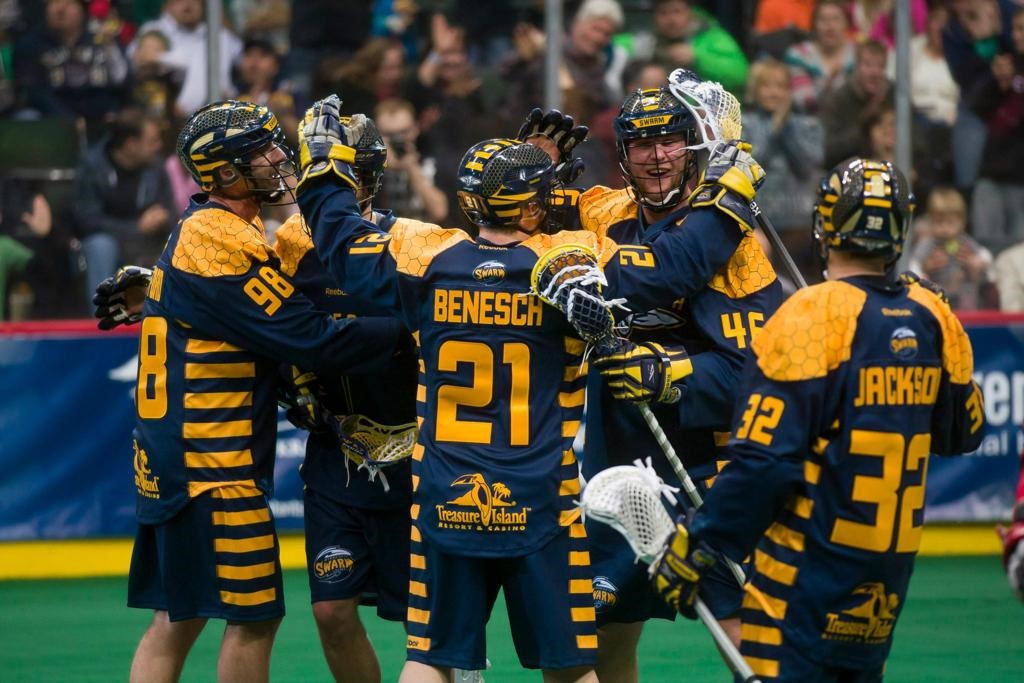
The Georgia Swarm are successful – I wrote last week about the Georgia Swarm and the challenges that face them. I was rather pessimistic about their chances for success, but I hope I’m wrong.

All players return healthy – Tons of players missed time during 2015, both regular season and playoffs, due to injuries. My wish is that all of them return healthy and 100% for 2016. This includes players who missed the whole season like Kyle Sorensen, Matt Beers, and Curtis Knight; players who missed the end of the season like Callum Crawford and Andrew Suitor; and Cody Jamieson who got hurt in the playoffs. Even Garrett Billings seemed mostly better when he returned but played 8 games and only scored 5 goals. He only had as many as 6 points once in those eight games. This is uncharacteristic for Billings.

We see better lacrosse when all these guys are healthy.

Kyle Sorensen (Photo: Larry Palumbo)

Earlier season – I haven’t decided whether I’d prefer a 16- or an 18-game regular season. I think I’m fine with both. But the season is ending too late – just two years ago, the finals ended on May 11. This year it will be at least June 5th and possibly June 13th. That’s just too long, particularly for players who play in the MLL, MSL, or WLA who’ll miss a good chunk of the season. The MLL season started on April 12, so Toronto and Edmonton players who are also in the MLL (Kevin Crowley, Zack Greer, possibly others) will miss two full months (over half of the season) before they’re available. It’s certainly not up to the NLL to make things easier for other leagues, but they could start their season in early December and get back to finishing up in early-mid May. Speaking of that…

Shorten playoffs – I’d like to see the first and second rounds as single-game elimination (though as a Rock fan, I’m glad that’s not how it is this year), and the finals as the best of 3. Ideally, two of those three would be in the same weekend, but I’m not sure how to do that without a brutal travel schedule in between or back-to-back games in the same city on the same weekend, which would likely result in terrible attendance for at least one of those games.

Reduce bye weeks if possible – Jamie Dawick talked about the this in a recent interview. Three teams from each division means a bye in the first round, and since the Rock had a bye in the last week of the season anyway, the semifinal with Rochester was their first game in over three weeks. And as we discussed on A2L, the Rock weren’t allowed to practice during the playoff bye week, which is silly. Dawick said the lack of games was a huge disadvantage, especially since they were playing the Knighthawks who had played twice in between the last two Rock games and had several practices. It would be nice if something could be done to even this out a bit, though I haven’t been able to come up with a solution.

John Tavares retires – This is not exactly something I want to happen, but something I think probably should happen. John Tavares is probably the best lacrosse player in the history of the NLL. He has an unbelievable 24 seasons in the league – Josh Sanderson and Colin Doyle would have to finish the 2021 season before they’re even tied, and John Grant could score 100 points four times (starting at age 41) and still not catch up. He has so many amazing numbers that I could do a full month of @NLLFactOfTheDay just on Tavares. But Father Time has finally caught up with JT and I think it’s time he hung ’em up. The Bandits are in good hands with Ryan Benesch and Dhane Smith leading the offense, so now’s the right time.

More coming tomorrow.

Game report: Edmonton 15 @ Toronto 9, NLL Finals Game 1

On the Addicted to Lacrosse show this week, I picked the Rock to win Saturday night’s game because of what I saw last weekend. When the Rock hosted the Knighthawks in the division finals, they came out fired up in game 2, slowed down a touch in the second half, but then came out fired up again in the tiebreaker. They got to Matt Vinc, one of the best goaltenders anywhere, scored a bunch against one of the best defenses in the league, and kept Dan Dawson off the scoreboard (i.e. 0 goals). Any team that can do that, and has the motivation that the Rock has, will be hard to beat in the finals, especially at home. So they should win game 1.

Great logic, except it didn’t happen.

I don’t know what was said in the Rock dressing room before the Rochester game that got them so fired up (presumably it was more than just “let’s win it for T!”), but it didn’t work on Saturday night. They did come out looking pretty strong, scoring the first two goals and keeping the Rush offense from getting many decent shots, but the first two goals were the only ones in the quarter for the Rock. After Mark Matthews scored on the power play, the Rush were kept off the board for another 5 minutes before scoring 3 in under two minutes to take the lead. A fifth with under a minute left gave them a 3 goal lead at the end of the first quarter. I tweeted that the Rush were leading 7-3 at the end of the first quarter last week, and they lost. But last week they stopped playing as well as they did in the first, and the Calgary D stepped up. Neither of those things happened in this one.

The Rock weren’t terrible, mostly, but certainly not as strong as we saw last week. Miller was OK but wasn’t seeing the ball well. Rose replaced him in the second and again in the fourth and was better. The Rock D in general was also OK but had some serious lapses in judgement here and there. The Rush D, on the other hand, was stifling, and Aaron Bold was great. He was stopping almost everything from way out (that didn’t get blocked by a defender), and the Rush D wouldn’t let the Rock forwards get in close, so there was basically no way to score on him.

The Rock offense had their moments, some crisp passing and nice goals, but for the most part they were shut down by the Edmonton D. Continuing the trend that Rochester started in the semifinals, the Rush blocked an awful lot of shots. Edmonton’s forwards were generally good but holy cow, Mark Matthews was outstanding. The guy was everywhere – plowing through defenders like they weren’t there, and firing bullets at Miller or Rose. Robert Church had a good night, but I thought Jarrett Davis was very good as well. Davis was the Kasey Beirnes of the Rush: getting into the middle, setting picks, and getting pounded pretty good so that the big O guys (Matthews, Church, Greer, McIntosh) could get better looks at the net.

But the difference in the game was the transition. I couldn’t count the number of times the Rock would get a transition chance that turned into a 5 second possession after a bad shot through two defenders. Basically the Rush defense got out there so fast that the “chance” wasn’t much of a chance once they got near the net. Similarly, Rock forwards got caught on defense a lot because the Rush transition was so fast that there wasn’t time to change. Crowley isn’t bad on defense for a forward, and Josh Sanderson is a better defender at 38 than he used to be, but he’s still not great. But one of the Rush goals in the second half was scored with Sanderson, Hellyer, and Leblanc as three of the defenders. That’s just not their thing.

Game 2 goes next Friday in Edmonton and if the Rock play then like they played on Saturday, this one’s over and congrats to the Rush. But if they play like they played last week, then we’ll have a series.

Other game notes:

  • Attendance was listed as 9257, or about a thousand less than last week. The difference looked and sounded like a lot more than a thousand.
  • The Rock seemed to be dropping the ball a lot on offense. Not missed passes, and not (always) Rush defenders knocking the ball out of their stick, just plain dropping the ball.
  • Kasey Beirnes’ first goal was nice but the pass was even better. Rob Hellyer was lining up to fire a shot until at the last possible moment he saw Beirnes open beside the net. He changed his shot into a pass to Beirnes who buried it. Nice unselfish play.
  • Similarly, Mark Matthews made a beautiful pass in the third to a streaking Zack Greer who put it behind Rose (or Miller, don’t remember who was in at the time). The timing of the pass had to be perfect or Greer, who was being covered by a Rock defender, wouldn’t have gotten it. But it was perfect.
  • Near the end of the game, when the comeback was still possible, the Rock kept losing their own possessions because of moving picks. C’mon guys, when every possession is that important, don’t waste them.

Georgia: The next big NLL success?

Georgia SwarmThe NLL has announced that it’s returning once again to the place where box lacrosse franchises go to die: the American south. The Swarm are moving from Minnesota to Georgia to become the Georgia Swarm. Presumably the name was not changed so that all the t-shirts and swag that just says “Swarm” or “Hive” doesn’t have to be thrown away.

There’s no way to know how successful this franchise will be until they actually start playing. And by “successful” here, I’m talking about the ability to keep a team in that city for more than a couple of years. Success on the floor will help, but there are two problems there: (1) the Swarm haven’t had much of that over the past few years, and (2) as I mentioned the other day, lots of other NLL teams have folded despite on-floor success.

Let’s take a look at the available data to see if we can make our estimate of success a little more educated.

The NLL has some history in the south, but most of it isn’t so good. There have been five NLL franchises over the years that are south of Denver, Colorado:

San Jose Stealth – The Stealth were in San Jose for 6 years after Albany and before Washington. Their average attendance was 4707 per game. This is only higher than 8 other NLL teams in history – but 3 of those 8 are the Albany Attack, Washington Stealth, and Vancouver Stealth. San Jose also has the honour of hosting the game with the lowest reported attendance in league history: 1437 people came out to watch the Stealth beat the Edmonton Rush 14-6 in 2008.

Arizona Sting – The Columbus Landsharks played 3 seasons before moving to Glendale, Arizona, where they played for 4 years as the Sting. Despite never finishing higher than 9-7, they went to the Championship game twice, losing to the Rock in 2005 and the Knighthawks in 2007 (in the infamous circus game). In attendance, the Sting averaged 6216 per game, right about in the middle of all NLL franchises. For the 2007 Championship game, their last ever game, they managed to pull in almost 10,000 people which is quite respectable.

Anaheim Storm – The Storm played 2 years in Anaheim after a couple of years in New Jersey. They were pretty darned awful though, going 1-15 in 2004, their first season, but improving to 5-11 in 2005. At 4790, their attendance was just higher than that of the San Jose Stealth, but as we know that’s not saying much.

Orlando Titans – The New York Titans spend 3 seasons in the Big Apple before moving to Orlando, where they only lasted one year. On the floor they had success, finishing 11-5 and making it to the Eastern Final where they lost to the Rock. Their attendance was higher than that of both the Sting and the New York Titans at 7035; in fact that puts them in the top half of NLL teams.

Charlotte Cobras – The Cobras spent a single season, 1996, in the league and finished 0-10, losing each game by an average of 10 goals. They had the lowest average home attendance of any team in NLL history, at 2760. Two of the ten lowest-attended games happened in Charlotte.

(Note that Philadelphia almost made this list too: Philly is north of Denver by approximately twelve miles.)

So the Titans and Sting did reasonably well attendance-wise, but the others really didn’t.

Now let’s look at the pros and cons of this situation.

Pros

  • Rent will be much cheaper at the Gwinnett Center than at the very expensive Xcel Energy Center. Expensive rent is what killed the Blazers, Wings, and New York Titans, and is a major factor in why the Swarm moved and why the Rush may also be moving. If the Swarm don’t have to get rid of players as soon as they become expensive, they might have a chance.
  • Atlanta is a major airline hub so travel may not be all that bad. Travel to Mohegan Sun is likely a nightmare and Saskatoon wouldn’t be much fun either.
  • The MLL held their Championship game in Atlanta in 2014, and pulled in over 8,000 people. They are also considering expansion to Atlanta. Of course, field lacrosse popularity in a region rarely seems related to box lacrosse popularity in that region. Right Baltimore? Syracuse? Albany? Charlotte?
  • The team has lots of young talented players and four first round picks in next year’s entry draft, rumoured to be one of the best ever.

Cons

  • Atlanta is not known as a great sports town. In 2014, Forbes Magazine listed Atlanta #1 on their list of “Most Miserable Sports Cities” – and it wasn’t their first time at the top of that list. I wrote recently about how NHL ownership of NLL teams seems to be a pretty good model. The NHL has failed in Atlanta twice and currently has no team anywhere near there.
  • Hopefully travel isn’t bad since every player will be a fly-in. They had a bunch of players move to Minnesota in the past, but that has dwindled in recent years. I suspect they’ll get fewer players willing to move to Georgia.
  • The team won’t be playing in Atlanta, they’ll be playing at the Gwinnett Center in Duluth, about a half-hour from downtown Atlanta. This is the same setup as the Chicago Shamrox, who played in Hoffman Estates, IL. The Shamrox lasted two seasons. Interestingly, the Shamrox owner’s main reason for folding the team was that it was too hard to run things in Chicago from his home in Atlanta. This kind of suburban setup also didn’t work for Anaheim (outside of Los Angeles) or the Washington Stealth, based in Everett rather than Seattle, and it’s also how the current Vancouver Stealth are set up. The Stealth were last or second-last in attendance for the last 2 seasons (though they apparently have a great deal on rent in the LEC so the low attendance isn’t a problem).
  • The Arlottas still own and run the team. These are the guys who traded Benesch, Watt, Suitor, and Bilic, among others. They’ve had twelve first-round draft picks in the past four years – almost half of them aren’t on the team anymore. (The Rock, heading to the finals this year, have had one first-round pick in those same four years.) But with that many first rounders, they’ve got to be good now, right? Well, they haven’t made the playoffs in two years. That type of mismanagement isn’t likely to change.

Is is possible the Georgia Swarm will thrive and be a successful franchise? Sure it is. Maybe the cheaper rent will be enough of a change that they don’t have to trade players once they get good and start asking for the money they deserve. Maybe Georgia will turn out to love box lacrosse. But it seems to me that the odds are against them. Call me pessimistic, but I give them two seasons in Georgia before they either move again or fold.

The NLL is a niche league. Get used to it. (Part II)

Yesterday, I talked about how I have given up on the idea that the NLL can be the next major North American sports league. There’s just too much team turnover and financial issues that are unrelated to the product on the floor that I’m no longer convinced this is a problem that can be fixed. But I had an idea…

A possible solution

What if the NLL looked to the NHL for ownership of all new franchises?

The top 3 teams in the NLL in terms of attendance are the Mammoth, Bandits, and Roughnecks – the only NLL teams owned by NHL teams. The advantages are much lower costs – all of the non-lacrosse-specific employees (ticket sales, marketing, HR) could be shared between the two teams – and cross-promotion. Buy Sabres tickets, get a deal on Bandits tickets and vice versa. They could have Bandits ads during more heavily-watched Sabres games on TV. Even NHL stars doing ads – “I played lacrosse growing up and it made me into a better hockey player. You should check these guys out”. With costs fairly low, the NHL teams can pump the NLL teams enough to boost attendance to the point that they’re making money, and in return, the NLL teams get to continue to exist. Win-win.

There has been talk of the Oilers offering to buy the Rush from Bruce Urban but he’s turned them down on a number of occasions, and now their relationship is bad enough that they may not make such an offer again. I don’t know if the Stealth and Canucks have ever had any discussions. I also have no idea what kind of relationship the Flyers and Wings had, but with the talk that the NLL may return to Philadelphia, maybe that’s something that could be explored. The rumours for the Swarm moving to Nashville include the possibility of Predators ownership which might end up being a good thing for the Swarm, even if it sucks hard for the fans in Minnesota.

If they do make a change like this, they’d have to add a grandfather clause since nobody wants to get rid of Styres or Dawick as owners (and I’m not sure I want MLSE running the Rock). The Black Wolves ownership is a little different – there’s no NHL team within 100 miles (Boston is just over 100 miles northeast), but it’s not clear they’re really out to make money directly from the lacrosse team. The Black Wolves owners also own the Mohegan Sun casino where they play, and their goal, first and foremost, is to bring people into the casino. They might be quite happy to lose a bit of money on the team in order to do that.

Mohegan Sun: Come for the game, stay for the GAMBLINGBut let’s face it: nobody is going to consider you a major sports league when you have teams in Langley, Uncasville, Saskatoon, and quite honestly, even Rochester. I know Rochester has been looked at as the Green Bay Packers of the NLL, since both of them fall into the “not even big enough to be a secondary market” category. But if you’re trying to get the president of the New York Rangers to take your call about expanding to the Big Apple (again), mentioning that one of your most successful teams is in Rochester may not help your case.

Don’t get me wrong, I love the Knighthawks (as much as a Rock fan can, anyway) and really want the team to stay there, which brings me to my final point.

Silver lining

Despite what might sound like despair above, I am not giving up on the NLL. I will still be tweeting, facebooking, blogging, and podcasting about it. That will not change. What does seem to have changed is my belief that someday lacrosse players will have one job and only one job – that of lacrosse player. As long as the NLL exists, we will still be talking about weekend warriors and how Joe Laxalot is a teacher / firefighter / stockbroker / whatever during the week. There will likely always be teams moving or folding because the owners don’t want to lose money for years before the team gets good or they still can’t get people into the arena despite success on the floor.

Could it be that this is the death knell of the league? I’ve seen lots of comments saying the league only has a couple of years left before it folds entirely. That could be, but given that not all NLL teams are having these attendance and financial troubles, I’m going to remain optimistic. The NHL option would be great for the NLL but how much incentive is there for the NHL owners to get involved? I imagine it would only be marginally interesting for some NHL teams and not interesting at all for most.

The silver lining here is that the NLL is still a great league full of great players and is still a lot of fun to watch and follow. Are they one of the big five leagues? No, but who cares? Other than issues like “Joe Laxalot can’t play this weekend / season because of work commitments”, it’s not a huge deal. With the Rush and Swarm we’re talking about relocating, not folding; as long as the league isn’t contracting, maybe it’s OK if it doesn’t grow. Yes, there will be team movement, but we’ll have to be content with the league in the places it’s in and not turn up our noses at options like Saskatoon. It’s a smaller market but the lacrosse played there will be just as good.

And I really do hope the league can still grow. But that hope is quickly turning into a wish – something I want to happen, but can do nothing about.

The NLL is a niche league. Get used to it. (Part I)

OK, that’s it. It’s over. Everybody out of the pool. With the Swarm announcing that they’re moving and the Rush announcing that they’re probably moving, I think I’m done with the whole idea of the NLL becoming the fifth major team sport in North America.

For years my hope has been that eventually, the NLL would be up there with the NHL and NBA as one of the major sports leagues in North America. Take hockey, mix in some basketball rules, take the ice away and what’s not to love, right? It’s bound to grow until the players are making millions and everybody knows about lacrosse!

But it never happened. The hope has always been there but reality is setting in, and I am now convinced that it’s not going to happen.

The problem

The bottom line: You can’t be a major sports league with this much team movement. But you can’t get rid of the team movement until you become a major sports league. Obviously there’s a problem there. The alternative is to have a bunch of committed owners who know they are likely to lose money but keep going anyway. The more Curt Styres’s and Jamie Dawicks the league has, the better. But even that isn’t enough. Bruce Urban is just as committed to his team, but look at where the Edmonton Rush are: top of the standings but near the bottom of the attendance list, and on the verge of relocating because they can’t draw enough people.

A few different solutions have been tried. You can’t be a big-time league without teams in the biggest cities, right? New York, Los Angeles (Anaheim), Chicago, Philadelphia, Boston – all failed. Maybe we should try the smaller but still big markets: Phoenix, Baltimore, San Jose, Pittsburgh – all failed. Even supposed lacrosse hotbeds like Syracuse, Vancouver, and Albany have tried and failed. Vancouver was given a second chance, but has come in last or second-last in attendance in each of the last two years. And now they’re talking about Saskatoon, Saskatchewan, a place that most Americans can’t say, let alone find on a map.

The good ol' daysThere are two categories here. Some of them folded because nobody wanted to see a losing team so attendance was low, and I guess ownership wasn’t willing to give it enough time to get better. Anaheim, New Jersey, Ottawa, and Charlotte (among others) all failed but their teams sucked so it’s at least somewhat understandable. But then there’s the second category, that of teams that failed despite success on the floor. Albany, New York, and Portland each went to the finals. Arizona did it twice. Washington did it three times and won one of them. Boston never got to the finals but were a very good team for three years. It’s frustrating because we can’t say to prospective owners “Yes, you’ll lose money for a couple of years but once your team gets good, you’ll be fine” because there are too many examples of where that hasn’t been true.

Now we have the same thing happening to both Minnesota in the first category (haven’t made the playoffs in 2 years, have only finished above .500 once since 2008) and Edmonton in the second (one of the best teams this year, arguably one of the best in NLL history last year).

The league can’t afford the bigger markets because rent at the big-name arenas is too high. This was a big part of the problems for New York, Philly, and Boston, and also the reason that the Chicago team was based in wherever-the-hell-it-was outside of the city. This is also a big concern for both the Swarm and Rush. Even the Toronto Rock have talked about moving because the rent would be cheaper. But they also know that attendance would plummet, so Jamie Dawick keeps coughing up the big coin to stay at the ACC. The Mammoth, Bandits, and Roughnecks get away with it because they are owned by the same people who own the arena.

Say, that gives me an idea…

Continued tomorrow

Game reports: Rochester 8 @ Toronto 11, Rochester 2 @ Toronto 8

I almost feel like I have to apologize to the Toronto Rock. I did pick them to win this series and head to the Champions Cup final, but not with much confidence, and I actually changed my pick since I originally had Rochester. (Note that the IL Indoor “NLL staff Picks: Division Finals Game 2 and 3” page has my picks listed incorrectly – I picked Toronto to win both game 2 and the mini-game. I also picked Calgary to win game 2 and Edmonton to win the mini-game. 4 for 4, baby.) But the way Toronto played on Saturday, there was almost no doubt from the opening whistle that Toronto was the better team.

The game started with something odd – rather than announcing each player one by one like they always do, they simply said “Here’s the Toronto Rock!” and the whole team ran out at once. Maybe they decided that they wanted to be viewed as a team rather than a collection of individuals and so they dispensed with the introductions.

The Rock came out on fire. They scored on their first two shots (both by Brett Hickey) and then Stephan Leblanc scored to make it 3-0 just over 3 minutes in. The Knighthawks got on the board then and the Rock calmed down a little, but the Rock had possession down in the Knighthawk end for the majority of the first quarter. In the second, Rochester seemed to get frustrated and got into a bit of penalty trouble, leading to two Rock power play goals. Stephen Keogh scored his second of the night with just a couple of seconds left in the half to cut the lead to 8-3, but it was clear the Rock was in control.

As much as I was enjoying the lead and the intensity with which the team was playing, I had to keep my enthusiasm in check. I have seen enough lacrosse to know that being up by 5 at the half is no guarantee of a win. Not to mention that even if they wiped the floor with the Knighthawks in game 2, there was still the mini-game to play. Momentum (and penalties) might carry over, but the score would not.

In the second half, the Rock seemed to let their foot off the gas. They still seemed in control for the most part, but Vinc played a lot better and the Knighthawks started to get back into the game. By a minute into the 4th, they were only down by two. I don’t know about other fans, but I started to get a little nervous. But then the D clamped down again and the Rock got a couple more by Vinc. I thought the Knighthawks were going to pull their top players to rest them up for the mini-game, but they didn’t; they seemed to continue playing for the comeback win, even when it got to the point of needing four goals in 3 minutes or so.

Photo credit: Jack Boland/Toronto SunBrandon Miller was playing very well but I thought the defense in front of him was outstanding. I also thought that Rochester wasn’t making the most of their possessions; they’d frequently shoot when there was more than 10 seconds left on the shot clock. Matt Vinc had an uncharacteristically bad game. He was better in the second half than the first, but he was giving up goals that he normally wouldn’t. It wasn’t that he wasn’t making the “holy crap” saves that he usually does, he wasn’t even making the “normal” saves that most goalies usually do.

Stephen Keogh came to play, scoring 6 of Rochester’s 8 goals and really looking good. He took a penalty right at the end of the game, which carried over into the mini-game, though I don’t think he knew that. He came out of the box after game 2 ended, and was told by the refs to go back. Some folks on twitter suggested the Knighthawks should have scored on their own net before game 2 ended to negate the penalty, but apparently there was a memo from the league before the playoffs saying that this would result in an unsportsmanlike conduct penalty, as it should.

I was a little worried about the mini-game, since (a) Toronto had only scored 3 goals in the second half, and (b) Matt Vinc was looking much more like the Matt Vinc we expected to see. But the mini-game looked more like the first quarter, as the Rock came out on fire once again. I did not vote for John Lovell as Coach of the Year (well, I put him on the ballot but at #3 or 4), but now I think he should have been higher. They scored 7 goals on 8 shots in less than 7 minutes and completely deflated the Knighthawks. Vinc was finally pulled in favour of Angus Goodleaf but the damage was done by then.

So there have been 5 mini-games in the league in the past 2 years, and I’ve seen two of them. Have to say they’re very exciting to watch, but are they a good idea in general? That I’m not so sure of, but I may get to that in a future article. We’re now down to 2 teams and the first best-of-3 series since 1998. The Rush will be visiting the ACC next weekend, and I am looking forward to it.

Other game notes:

  • Only 10,000 fans at the game, but it was certainly the loudest I’ve heard the ACC in a couple of years.
  • There were several busloads of Rochester fans at one end, cheering loudly for the ‘Hawks. Unfortunately for them, “Hawks” and “Rock” rhyme, and so their chants of “Let’s Go Hawks!” quickly turned into chants of “Let’s Go Rock!” by the hometown fans. I thought it was great to see such a large group from Rochester, just like I love seeing tons of Bandits fans when they play in Toronto. It was a little disappointing to see that about half of them had left before the tiebreaker game was even over. Where did they go? Were they afraid the buses were going to leave without them? Also nice to see the Knighthawks salute them before they left the floor.
  • Kevin Crowley is not just a great forward, he plays some pretty great defense too.
  • Just like last week, Rochester’s defense intercepted a whole bunch of passes, but they really only scored one transition goal all night.
  • A number of those intercepted passes came from Colin Doyle. I also noticed that Doyle took more shots through traffic than many others; he seemed to want to shoot even when it may not have been a good idea.
  • Patrick Merrill took a penalty shot in the mini-game because the Knighthawks took a too-many-men penalty with <2 minutes left. In that case, the Rock could have chosen anyone on the floor to take the shot, so I’m curious why they chose him.

Shawn Evans: MVP? Maybe not

Shawn Evans has had an excellent 2015 NLL season. That’s unquestionable. But is he the league’s MVP? Some would argue yes, others may disagree. The Roughnecks are certainly campaigning in that direction. But you can’t just look at the points and assists records, there are other things to take into consideration. Let’s examine the pros and cons:

Pro: Outstanding offensive numbers:

  • Set a new record for points in a season with 130
  • Tied record (set the day before) for assists in a season with 83
  • 6th in league in goals (48), 1st in shorthanded goals (5)

Con: Some numbers not so great:

  • Only 4 power play goals, second-lowest among Calgary forwards
  • Only one forward (Cody Jamieson) spent more time in the penalty box
  • 0 face-off wins
  • 0 saves

Pro: Team player: led his team from 0-6 start into the playoffs

Con: Is he really a team player? He played ZERO games as backup goalie. Corbyn Tao has him beat there.

Pro: Three cute daughters, including twins born last year

Con: That was last year. Nothing this season. Plus, his wife arguably did most of the work

Pro: Already has his name on the trophy so getting the engraving spelled correctly won’t be an issue

Con: Already has his name on the trophy. NLL doesn’t like to give the MVP award to the same player more than once

Pro: First in every category among Shawns in the league.

Con: Middle of the pack among current or former NLL players named “S. Evans”, when listed alphabetically

Pro: If the other team has quick transition, can play pretty good defense

Con: Steals valuable playing minutes from Roughneck defenders

Pro: Proved that you don’t need to be big to be a great offensive player

Con: Josh Sanderson proved that years before

Pro: Good lookin’ dude.

Con: No cool braid like the Thompson boys.


Hmmmm… looks like the jury’s still out.


How do you say no to that?

(Photo credit: 120 Sports)

Getting in sync

On Saturday night, we saw a goal scored by the Toronto Rock that shouldn’t have counted. Brett Hickey’s buzzer-beater at the end of the second quarter seemed to have gone in a split-second after the buzzer, but the referees who reviewed it couldn’t find definitive proof that the call was wrong, so they had to allow the goal. I don’t fault the refs for this call since they didn’t have sufficient information to call off the goal. But I have a proposed solution to that problem. Quite honestly, this seems like a fairly obvious solution, so there may be a perfectly good explanation for this that I am not aware of, or some huge drawback that I’m missing.

During the last 30 seconds of each quarter of an NLL game, any reset of the shot clock causes it to be disabled. Usually it’s set to 30 but does not run. I have heard countless broadcast announcers mention this: “With fifteen seconds left in the quarter, the shot clock is off.” But this has two significant drawbacks:

  1. Players cannot see the game clock as easily as the shot clock. In some arenas, they may be able to look up at the ribbon board or another display board above the net that’s showing the game clock, but it’s not as close to their field of vision as the shot clock. The “rule” for determining how much time you have left before you must shoot is given by: “Look at the shot clock unless there is less than 30 seconds left in the quarter and the shot clock has been turned off, in which case look at the game clock.” This inconsistency is confusing and unnecessary.
  2. In the case of a goal that’s scored near the end of the quarter and challenged, the referees are much more likely to have the shot clock available in the replay video than the game clock. We saw this with Hickey’s goal on Saturday. This goal was called a goal on the floor and even though it seemed that the ball went in after time ran out, there was no conclusive evidence and so the call on the floor stood. The shot clock was clearly visible in the video but it said 30 and was not moving, so it was of no value.

I propose that when a shot clock reset is signaled by the refs within the last 30 seconds of a quarter, the shot clock should become synchronized with the game clock. For example, if the referee signals that the shot clock should be reset when there are 17.3 seconds left in the quarter, the shot clock would start counting down from 17.3, exactly in time with the game clock. This eliminates both of the problems I described above:

  1. Players could then simply watch the shot clock like they always do and know how much time is left before they must shoot, regardless of how much time is left in the quarter. There’s no “watch this clock unless it’s off in which case watch this other clock that’s harder to see”, it’s always just “watch the shot clock”.
  2. The shot clock is much more likely to be in the frame when the officials are examining the replay to see if the ball went in on time.

This would require no extra work on the parts of the referees or the shot-clock operator. The software could be programmed so that when a shot-clock reset is indicated and less than 30 seconds remain in the quarter, the shot clock would be set to the current remaining time on the game clock.

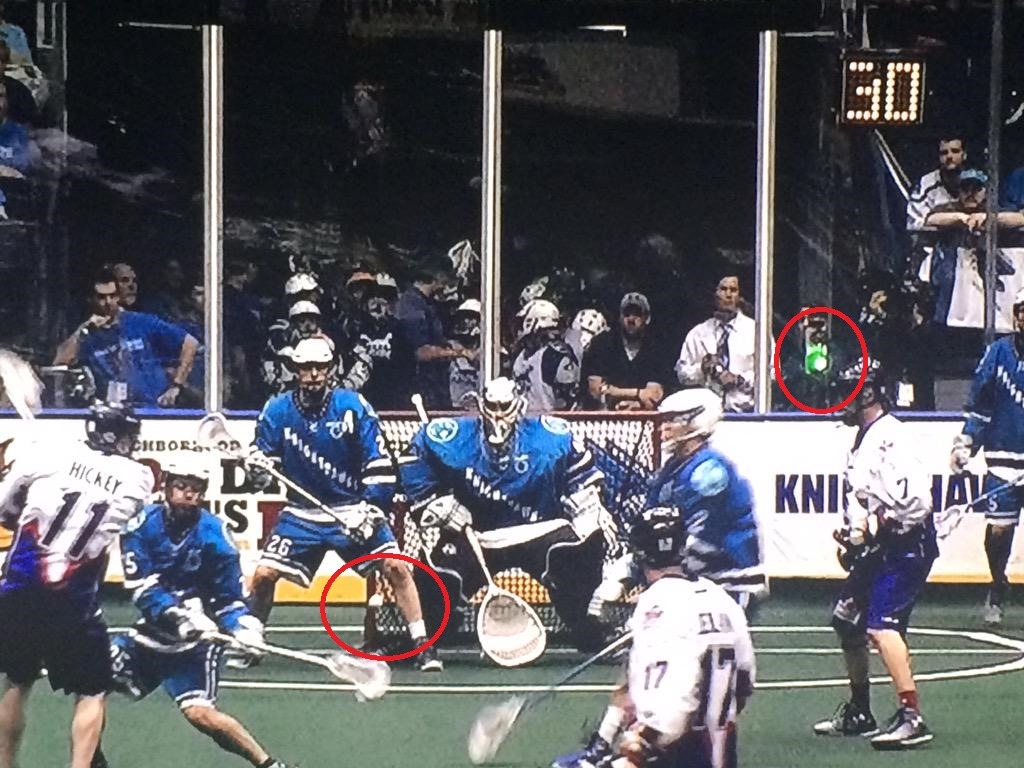
Alternatively, a light could be installed behind the net, next to the goal lights, that is set to come on as soon as the game clock reaches 0. If in the replay, that light is on before the ball goes in the net, the goal does not count. Oddly, there does appear to be a green light behind the net in Rochester that came on once the time reached 0. This light was either ignored or not seen by the officials, as it clearly came on before the ball entered the net. Note the picture below (tweeted shortly after the game by Brad MacArthur, though I added the red circles) showing the light on and the ball not yet in the net.

Buzzer-beaterFor the record, I am a fan of the Toronto Rock. This is not an angry Knighthawk fan saying Toronto’s goal shouldn’t have counted. (This is actually a Toronto fan saying that Toronto’s goal shouldn’t have counted.) I am making this proposal not as a Rock fan but as a lacrosse fan, in the hopes that we can make it easier to get the calls right as often as possible.

As I said, there may be a perfectly good reason why this is not possible. But as far as I can see, this is a fairly simple solution that solves two problems, makes things easier for players; officials; and fans, and has no drawbacks that I am aware of.

2015 Predictions revisited

As many sports bloggers do, I made predictions at the beginning of the season. But as many sports bloggers don’t do, I’m going to go back and see what they were and how I did. I covered some of these on last week’s Addicted to Lacrosse show. I recently had to submit my votes for the IL Indoor annual awards, so for each of the awards below, I’ve listed my pre-season prediction as well as my post-season votes.

Standings:

East

  1. Rochester
  2. Buffalo
  3. Toronto
  4. Minnesota
  5. New England

West

  1. Calgary
  2. Edmonton
  3. Colorado
  4. Vancouver

Three correct out of nine. I wasn’t nearly as optimistic with the Rock as I should have been. I was also far too optimistic with the Roughnecks, but so was everybody else.

Annual Awards

MVP

Prediction: Dan Dawson, Cody Jamieson, Ryan Benesch
Vote: Shawn Evans, Mark Matthews, Ryan Benesch

Jamieson and Dawson had very good years, but not MVP-worthy. Benesch was great, especially down the stretch. But Evans was outstanding.

Goaltender of the Year

Prediction: Aaron Bold, Matt Vinc, Mike Poulin
Vote: Matt Vinc, Aaron Bold, Frankie Scigliano

No surprises from the first two, and I really struggled to decide who got the top vote. And I got the wrong Calgary goalie.

Defensive Player of the Year

Prediction: Kyle Rubisch, Chris Corbeil, Brock Sorensen
Vote: Kyle Rubisch, Chris Corbeil, Sid Smith

I did vote Sorensen fourth.

Transition Player of the Year

Prediction: Jeremy Thompson, Geoff Snider, Karsen Leung, Jordan Hall
Vote: Joey Cupido, Karsen Leung, Jay Thorimbert

Hall didn’t play transition this year, and Thompson had another very good season but Cupido stole the show.

Ben McIntoshRookie of the Year

Prediction: Miles Thompson, Ben McIntosh, Chris Attwood
Vote: Ben McIntosh, Jeremy Noble, Miles Thompson

Attwood didn’t even make the Knighthawks, so that was totally wrong. Miles Thompson had a good rookie season but McIntosh was better. Didn’t have Noble on the list at the beginning since it seemed unlikely he’d play at all.

Les Bartley Award

Prediction: Curt Malawsky, Mike Hasen, Troy Cordingley, John Lovell
Vote: Derek Keenan, Mike Hasen, Curt Malawsky, John Lovell, Troy Cordingley

No idea how I missed Keenan at the beginning of the year.

GM of the Year

Prediction: Terry Sanderson, Curt Styres, Steve Govett, Chris Seinko
Vote: Terry Sanderson, Curt Styres, Steve Govett, Derek Keenan.

Nailed the top three on this one. I even voted Seinko fifth since I thought he did pretty well at the trade deadline. Getting Billings, one of the top two players in the league over the last few seasons, for Crowley was a good deal and grabbing Suitor from the Swarm was good too. It was just too late in the season to turn things around, and the fact that Suitor got hurt again didn’t help.

Team predictions – East

For each team, I made a “Look out for” prediction – a player who I thought would have a great season. Some of them I nailed, others I didn’t quite get right, and in one case, I couldn’t have been more wrong.

Dhane Smith (Photo: Larry Palumbo)Buffalo: Dhane Smith. Nailed this one. Smith went from 59 points in 18 games last year to 107 this year.

Minnesota: Miles Thompson. Not a bad choice, though Shayne Jackson might have been a better one.

New England: Kevin Buchanan. Again, not a bad season. Pat Saunders would have been the breakout player for the Black Wolves.

Rochester: Chris Attwood. Didn’t even make the team. We’ll call that a “miss”. I don’t know who I’d pick from the Knighthawks as having had a breakout season since everyone on the team played at or near what I expected. Maybe Craig Point, since he hadn’t played 15 games in a season since 2011.

Toronto: Brock Sorensen. I thought Sorensen had a very solid year with the Rock and even put him on my list for Defender of the Year. But you might be able to make an argument for Brett Hickey here.

Team predictions – West

Calgary: Karsen Leung. I thought Leung had another solid season and I voted for him as Transition player of the year. But for a breakout season, I’d have to go with Frankie Scigliano, who grabbed the starting goalie job from the struggling Mike Poulin a few weeks into the season and never gave it back.

Colorado: Dillon Ward. Ward didn’t have a great season, but good enough to grab second in the west. Breakout player on the Mammoth would be Jeremy Noble, Eli McLaughlin, or Alex Buque.

Edmonton: Corey Small. Mostly right, except for the team. Small only lasted 2 games with the Rush before being traded to the Stealth, where he had his best season ever. For the Rush, a better choice would have been Zack Greer, who beat his career best points/game average by almost a full point.

Vancouver: Joel McCready. Nailed it. I even said the Powless experiment wouldn’t be the huge success the Stealth were hoping for. We’ll call that a 2-for-1, which offsets the Rochester failure.