2017 NLL rule changes

The league has released its list of rule changes that will be in effect for the 2017 season. As usual, there are a few that might have a big impact, a bunch that will probably not affect things very often, and a few that may never come up at all but they wanted something specific in the rule book just in case. I’ve looked over the list of changes and compared them with the 2016 rule book, and here’s what you need to know.

The most obvious change is that there will be three refs on the floor this year rather than two. Strangely, this was listed on the NLL.com article on the changes, but I couldn’t find anything in the rule book that lists the number of referees. They did add a clause discussing challenges that says “In a three man on the floor mechanic, …” but that’s the only mention of having three refs.

The remaining rule changes are listed with a reference to the rule number.

Rule 11: GAME CLOCK OPERATION
11.2 TIME BETWEEN GOAL AND ENSUING FACE-OFF

Faceoffs should be held 25 seconds (up from 20) after a goal is scored. Similarly, if a goal is waved off, teams have 25 seconds (up from 20) to challenge.

Rule 17: REFEREES
17.81 CRITERIA OF CHALLENGE

Coach’s challenges can now be used for determining whether the ball was batted into the goal, whether the shooter’s stick head is behind the goal line when he shoots (how would that even work? I believe there’s already a rule that says the ball can’t bounce off the goalie’s back), or whether an attacking player went into the crease, left it, and was then the first to receive a pass or gain possession of the ball.

Rule 17: REFEREES
17.82 NUMBER OF CHALLENGES

Coaches get two challenges per game plus one more if they win the first two. That now only applies to regulation time. Coaches now get one challenge in OT.

There’s another clause that’s been added that makes no sense to me. Coaches are not allowed to use challenges during the last two minutes of the fourth quarter or the last two minutes of overtime – if they do, they will be charged with using a challenge even if no replay is actually done. But challenges can’t be called at that time anyway so what does it matter if you are charged with using one?

Rule 17: REFEREES
17.84 OFFICIALS’ MECHANICS

If two refs have a discrepancy in whether a goal was scored or not (i.e. one calls goal and the other waves it off), the crew chief will review the play. Neither team is charged with a challenge.

Rule 24: PLAYERS IN UNIFORM
24.1 ELIGIBLE PLAYER LIST

Each team can have up to 19 players eligible per game, up from 18. No more than 17 runners, up from 16, can be used. Adding only one extra player doesn’t sound like much, but this could have a big impact. Not only will it change up the lines and add more strategies for coaches, but it will give players just a little more rest during games so we don’t see quite as much fatigue (or worse, injuries) near the end of the game.

Note however that the roster sizes are not changing so this doesn’t mean there are more employed players. It simply means that there will be one fewer “healthy scratch” per team per game.

Rule 26: UNIFORM REQUIREMENTS
26.1 NUMBER AND NAME ON JERSEY

Jerseys are now required to have the player’s number on each shoulder or bicep.

Rule 38: DEFINITION OF MAJOR PENALTIES
38.1 MAJOR PENALTY

A player given a major penalty with less than 5 minutes remaining in regulation will be given a second major penalty “for accrual purposes only”. The rule specifically says this is “not a time served penalty”. The very next rule says that any player that gets two majors in a game will automatically get a game misconduct, but it’s not clear whether this second “accrual” major counts towards that. If it doesn’t, I don’t know what the point of this penalty is other than to pad one’s PIM numbers.

Rule 41: DEFINITION OF MATCH PENALTY
41.2 MATCH PENALTY AUTOMATIC SUSPENSION

The previous rule said that players given a match penalty would automatically receive a two game suspension. Now they are given a “one or two game” suspension. No word on how that is decided.

Rule 43: DEFINITION OF PENALTY SHOT

If there’s a delayed penalty and then game time expires, but the officials decide that the penalty warranted a penalty shot, the team gets to take the penalty shot.

Rule 43: DEFINITION OF PENALTY SHOT
43.4 CREASE VIOLATION

If a player (non-goalie) falls on the ball or closes his hand on the ball in his own crease in front of the goal line, the opposing team gets a penalty shot. The new rule is that if it happens behind the goal line it’s just a loss of possession.

Rule 44: FACING AT CENTER
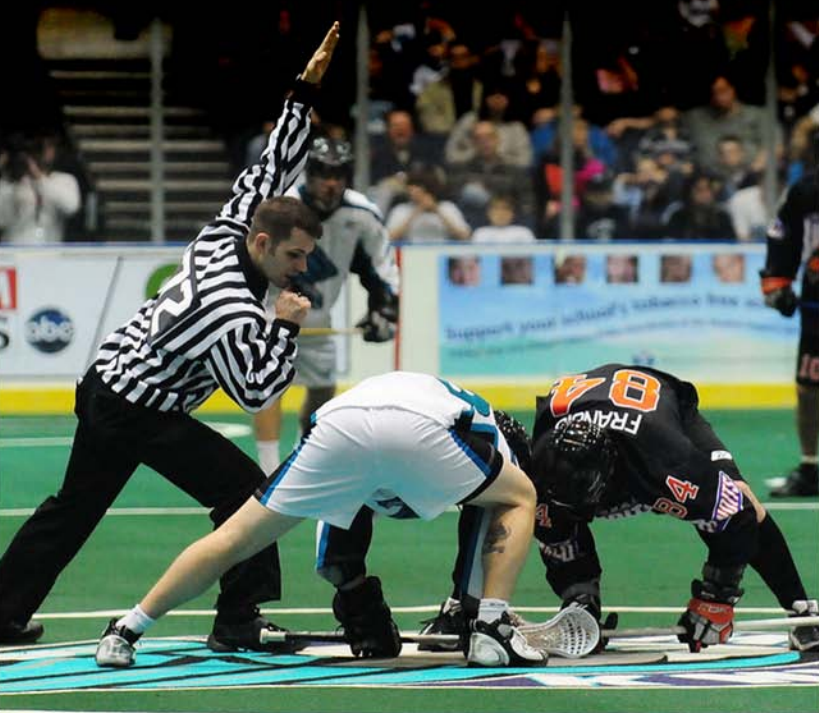
44.4 CONTESTING THE BALL ON THE FACE-OFF

This one seems too obvious to even write down. If a player doesn’t contest the ball during a faceoff, the other team gets possession. So if you don’t try to get the ball, you don’t get the ball.

Faceoff

Rule 51: BALL CAUGHT IN LACROSSE STICK OR EQUIPMENT
51.2 BALL CAUGHT IN GOALIES STICK OR EQUIPMENT

If the ball gets caught in the goalie’s equipment after a pass from a teammate, the whistle is blown, the ball dislodged, and play resumes (with the goalie having possession) but the shot clock doesn’t get reset. New rule: the 8-second clock doesn’t get reset either. This was probably always the case, but now it’s explicit.

Rule 57: CRITERIA FOR STOPPAGE OF PLAY ON A DELAYED PENALTY

If a delayed penalty is called, play continues until a goal is scored, the offending team gets possession, etc. Now play will also be stopped if the offending team takes a second penalty.

Rule 59: OFFENSIVE SCREENS/PICKS/BLOCKS

I’ll just quote this one since I can’t really summarize it any better: “An offensive player not in possession of the ball cannot exert significant unequal pressure on his defender as an attempt to gain space away from his defender“.

Rule 69: CONTACT WHILE SHOOTING ON NET
69.8 CONTACT INITIATED BY DEFENDER ON ATTACKER INTO THE CREASE

If an attacking player is legally checked into the crease and is then prevented from leaving the crease by a defender, a holding penalty is called. If a goal is scored, it counts (assuming no other violations). This is only slightly different from the existing rule, which talks about a player being illegally pushed into the crease.

Rule 70: ILLEGAL BODYCHECKING
70.1 CONTACT WHILE PURSUING A LOOSE BALL
70.4 CONTACT ON A FAST BREAKING OPPONENT
70.9 MATCH PENALTY

This change adds some vague wording to this rule about “officials shall consider the positioning of players when contact is initiated” and “an appropriate penalty for illegal body checking shall be assessed based on the severity of the illegal contact”. The idea is that if a player has his head down or is “unaware of an impending hit”, the ref has the discretion to increase the penalty.

Rule 80: FIGHTING
80.3 AGGRESSOR

The definition of “aggressor” no longer uses the word “aggressor”. It is now defines as a player someone who keeps fighting even after the ref has told him to stop and tried to pull him away.

Rule 81: HEAD-BUTTING
81.1 MINOR PENALTY
81.2 MAJOR PENALTY
81.3 GAME MISCONDUCT

Head-butting rules are slightly different. The old penalties were clear: a minor penalty is given if no contact is made, a major is given (possibly with a game misconduct) if contact is made with your helmet on, and a match penalty is given if contact is made with your helmet off. The new penalties are more vague and are probably designed to allow the refs more leeway in giving out such penalties.

Rule 88: EQUIPMENT INSPECTION
88.2 PREGAME INSPECTION PROCEDURE
88.6 DURING/AFTER GAME INSPECTION ILLEGAL GOALIE EQUIPMENT
88.7 GOALIE ADJUSTING EQUIPMENT BEFORE INSPECTION

When goalies are inspected before the game, their jerseys may be on or off (before it was off), though it doesn’t say if that’s the goalie’s choice or the ref’s. If a goalie is found using illegal equipment, he will get a major penalty (used to be minor). He won’t have to serve it himself but can’t return to the floor until the penalty expires. Also, if a ref is just about to do an inspection and the goalie adjusts his equipment to make it smaller, he gets a 5-minute penalty.

Rule 92: DELAYING THE GAME
92.2 THROWS, RETAINS OR ROLLS BALL AWAY

If a player is given the ball on a fast restart, the nearest defender must be 2 yards away or he gets a delay of game penalty. The change is that if the attacking player tries to move closer to draw a penalty on the defender, the attacking player gets a delay of game penalty. I wonder if this ever actually happened.

NLL Rule changes for 2016

The NLL has announced a number of rule changes going into effect for the 2016 season. The list is here and none of them is hugely significant (though I suppose by definition they are technically all game-changers) but I’ll go over what I think are the more interesting ones.

Rule 28.1: Injured goalie

If the trainer comes out to tend to the ‘tender and he stays more than 50 seconds, the goalie must be replaced. This was 45 seconds last year. The extra five seconds was worthy of a rule change?

nll-logo-750Rule 33.3: Helmet chin cup

Last year, if the chin cup was not properly worn and secured, the player would be removed from the floor. A second violation would get you a delay of game minor penalty. This year, you get the minor penalty right away. Interesting that this rule goes into effect right after the retirement of John Tavares, who was notorious for not wearing his chin cup or leaving it loose.

Rule 44.4: Contesting the ball on the face-off

If a player grabs the ball in the back of his stick during the face-off, he must immediately flip it to the front of this stick or get it to a teammate (“move, rake, or direct it”) before taking more than one step or the other team gets possession. You could call this the Geoff Snider rule but as of this writing, Snider is not on any NLL roster. Plus I believe there was a face-off change made a few years ago that was informally called the Geoff Snider rule though I don’t remember the details.

They tried something like this last year during the pre-season but that rule said that the player couldn’t leave the playoff circle without having the ball in the front of his stick. They dropped the rule before the season started.

Rule 57: Criteria for stoppage of play on a delayed penalty

The only change to this rule is the removal of a clause. In 2016, if the ref has called a delayed penalty and the offensive team pulls their goalie, a loose ball that crosses back over the centerline and rolls towards the open net will not cause a whistle, i.e. the resulting goal will count. I don’t know how often this happens but I suspect it ain’t much.

Rule 63: Illegal cross-checking

A player who cross-checks someone lying down on the turf will get a penalty, whether or not the guy on the floor has the ball.

Rule 67.6: Shooter in crease prior to ball crossing goal line

An oddly specific clause has been added which says that if an attacker shoots and the ball hits the goalie and then a defender and then goes into the net, this will count as a goal as long as the shooter is out of the crease by the time the ball completely crosses the goal line. It sounds like such a goal was waved off last year and someone got angry about it.

Rule 67.9: Contact by a defender

They’ve rewritten this rule entirely (all two sentences of it) to make it clearer. If an offensive player is checked legally into the crease before the ball goes in the net, the goal does not count. If an offensive player is checked illegally into the crease, the defender will get a delayed penalty and if the ball goes in, the goal counts (assuming no other rule violations).

Rule 67.12: No re-entry by ball

If a defender outside the crease gains possession of a ball that’s inside the crease, that defender can now step into the crease as long as the ball wasn’t directed or passed to him by a teammate.

Getting in sync

On Saturday night, we saw a goal scored by the Toronto Rock that shouldn’t have counted. Brett Hickey’s buzzer-beater at the end of the second quarter seemed to have gone in a split-second after the buzzer, but the referees who reviewed it couldn’t find definitive proof that the call was wrong, so they had to allow the goal. I don’t fault the refs for this call since they didn’t have sufficient information to call off the goal. But I have a proposed solution to that problem. Quite honestly, this seems like a fairly obvious solution, so there may be a perfectly good explanation for this that I am not aware of, or some huge drawback that I’m missing.

During the last 30 seconds of each quarter of an NLL game, any reset of the shot clock causes it to be disabled. Usually it’s set to 30 but does not run. I have heard countless broadcast announcers mention this: “With fifteen seconds left in the quarter, the shot clock is off.” But this has two significant drawbacks:

  1. Players cannot see the game clock as easily as the shot clock. In some arenas, they may be able to look up at the ribbon board or another display board above the net that’s showing the game clock, but it’s not as close to their field of vision as the shot clock. The “rule” for determining how much time you have left before you must shoot is given by: “Look at the shot clock unless there is less than 30 seconds left in the quarter and the shot clock has been turned off, in which case look at the game clock.” This inconsistency is confusing and unnecessary.
  2. In the case of a goal that’s scored near the end of the quarter and challenged, the referees are much more likely to have the shot clock available in the replay video than the game clock. We saw this with Hickey’s goal on Saturday. This goal was called a goal on the floor and even though it seemed that the ball went in after time ran out, there was no conclusive evidence and so the call on the floor stood. The shot clock was clearly visible in the video but it said 30 and was not moving, so it was of no value.

I propose that when a shot clock reset is signaled by the refs within the last 30 seconds of a quarter, the shot clock should become synchronized with the game clock. For example, if the referee signals that the shot clock should be reset when there are 17.3 seconds left in the quarter, the shot clock would start counting down from 17.3, exactly in time with the game clock. This eliminates both of the problems I described above:

  1. Players could then simply watch the shot clock like they always do and know how much time is left before they must shoot, regardless of how much time is left in the quarter. There’s no “watch this clock unless it’s off in which case watch this other clock that’s harder to see”, it’s always just “watch the shot clock”.
  2. The shot clock is much more likely to be in the frame when the officials are examining the replay to see if the ball went in on time.

This would require no extra work on the parts of the referees or the shot-clock operator. The software could be programmed so that when a shot-clock reset is indicated and less than 30 seconds remain in the quarter, the shot clock would be set to the current remaining time on the game clock.

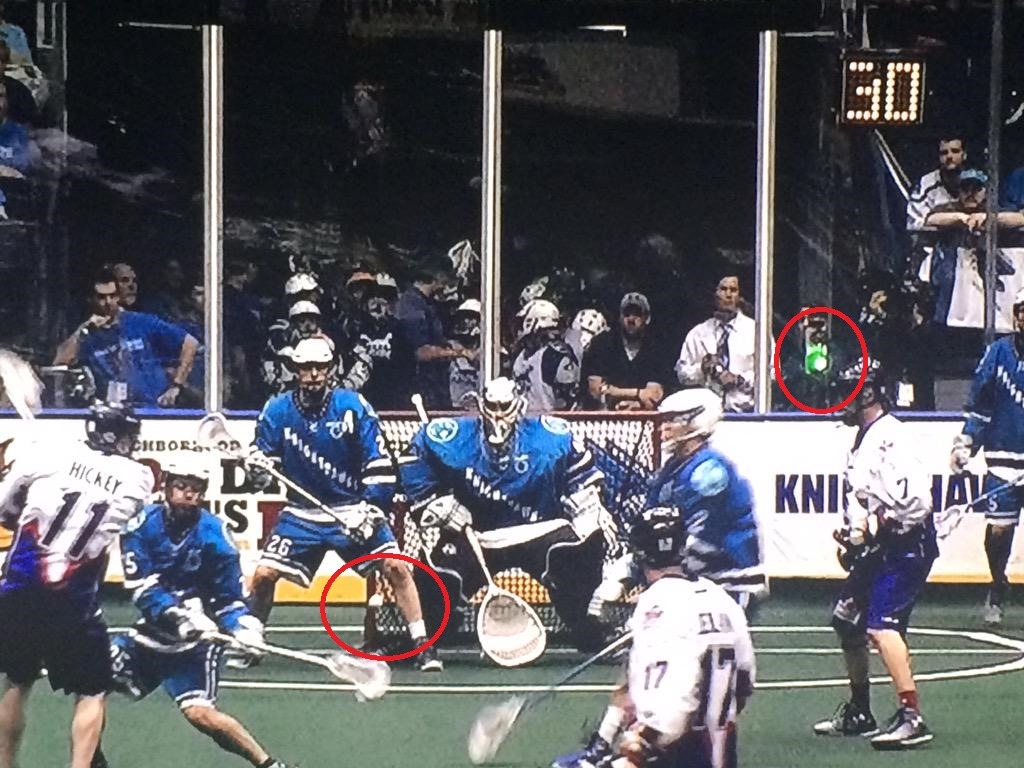
Alternatively, a light could be installed behind the net, next to the goal lights, that is set to come on as soon as the game clock reaches 0. If in the replay, that light is on before the ball goes in the net, the goal does not count. Oddly, there does appear to be a green light behind the net in Rochester that came on once the time reached 0. This light was either ignored or not seen by the officials, as it clearly came on before the ball entered the net. Note the picture below (tweeted shortly after the game by Brad MacArthur, though I added the red circles) showing the light on and the ball not yet in the net.

Buzzer-beaterFor the record, I am a fan of the Toronto Rock. This is not an angry Knighthawk fan saying Toronto’s goal shouldn’t have counted. (This is actually a Toronto fan saying that Toronto’s goal shouldn’t have counted.) I am making this proposal not as a Rock fan but as a lacrosse fan, in the hopes that we can make it easier to get the calls right as often as possible.

As I said, there may be a perfectly good reason why this is not possible. But as far as I can see, this is a fairly simple solution that solves two problems, makes things easier for players; officials; and fans, and has no drawbacks that I am aware of.

The NLL rules

(Thanks to my son Nicky for the title of this article. I asked him for a good title for an article about the NLL rule book and he said “The NLL rules. And it does.” Clever kid.)

The Official 2013 NLL Rule Book is available on the NLL’s web site, and it’s a bit of an interesting read. There are 127 pages of rules, including pictures of the ref signals for various penalties (apparently if a ref calls head butting or “spearing with head” he has to smack himself in the face), the 2013 schedule, and the official dimensions of the floor and crease area. Did you know that the crease is 18’6″ wide and the goal line is 12′ from the back boards, also called the “dasher boards”? I did not.

NLLRulesThere are exactly 100 rules in the book, broken up in to the following categories:

  • 8 rules on The Arena
  • 7 rules on Time Factors
  • 7 rules on The Officials
  • 6 rules on Composition of Teams
  • 7 rules on Equipment
  • 8 rules on Penalty Definitions
  • 14 rules on Flow of the Game
  • 43 rules on Infractions

Most of the rule book is spent describing things players shouldn’t do and what the refs should do if they happen. While looking up a couple of rules, I happened across a weird one and thought I should write about it. Then I found another, and another, and…

These are in no particular order. Any emphasis is mine.


Rule 21.3: SHOT ON GOAL – When a shot hits a part of the goal post, does not go in and the ball continues in play, a shot on goal is awarded and a save is credited.

Said another way, the goalie gets a save if you beat him with a shot but hit the post. The assumption here is obviously that the goalie sees the ball coming, knows that it will hit the post and not go in, and therefore doesn’t bother moving to stop it.


Rule 20.1: PUBLIC ADDRESS ANNOUNCER’S DUTIES FOR AWARDED GOALS – The name of the scorer and any player entitled to an assist will be announced by the public address announce system. Public address announcers shall not communicate derogatory or disparaging comments towards any individual players on the opposing team and towards the officials. Failure to do so will result in a fine to the announcer by the League.

The PA announcer in Colorado, a guy named Willie B, continually pronounces Rhys Duch’s surname like “douche”. So obviously, one of the following three things must be true:

  1. Calling someone “douche” is not considered by the league to be derogatory or disparaging.
  2. The league believes him when he says he keeps forgetting how to say it properly and it’s an honest mistake. In every game. For five years.
  3. He pays a lot of money in fines.

Rule 80.6: SWEATER REMOVAL DURING A FIGHT – Shall be [assessed to] a player who deliberately removes his sweater prior to participating in a fight. A player who engages in a fight and whose sweater is removed (completely off his torso), other than through the actions of his opponent in the fight or through the actions of the referee, shall be assessed a minor unsportsmanlike penalty.

So if your sweater is pulled up in front of your face during a fight and you pull it off so you can see, you get a penalty. That said, I’ve never seen this happen. I’ve seen players’ jerseys removed during fights, but I’ve never seen a player take his own jersey off.


Rule 80.7: EQUIPMENT REMOVAL PRIOR TO OR DURING A FIGHT PENALTY ASSESSMENT – A player who removes his equipment prior to or during a fight on his own accord shall be assessed a minor penalty for unsportsmanlike conduct. Any combination of the jersey removal and equipment removal will result in a minor penalty being assessed. This is in addition to other penalties to be assessed to the participants of a fight.

According to this, all fights should be done with full equipment on, including helmets and gloves. This is interesting, considering the next one:

Rule 80.8: INSTIGATOR WITH FACEMASK ON – Any player who instigates a fight with a face mask on against an opponent who already has his facemask off will be deemed an instigator.

So according to this rule, if you start a fight with your helmet on, you get a penalty. But according to the previous rule, if you remove your helmet before a fight, you get a penalty. Basically, every fight should result in seven minutes of penalties for one of the players involved – five for the fight, and two for either removing or not removing their helmet. There are plenty of fights where players drop gloves, helmets, sometimes even elbow pads. Never seen them get penalized for that.

But even ignoring the apparent contradiction here, this rule is irrelevant. Read the beginning: “Any player who instigates a fight…” Regardless of whether the helmets are on or off, if you “instigate” a fight, you’re an “instigator”.


Rule 91: HELMET LOST DURING PLAY – When a player in possession of the ball loses his helmet he must immediately release the ball by passing or shooting.

It’s happened a number of times in games I’ve seen – someone with the ball gets his helmet knocked off and immediately shoots and scores, and the fans around me start yelling that the goal shouldn’t count “because you’re not allowed to play without a helmet”. That is true, but as long as you shoot right away, the goal counts. A little knowledge is a dangerous thing.


Rule 25.3 (also 95.12): CAPTAIN COMMUNICATION WITH OFFICIALS – A complaint about a penalty is NOT a matter “relating to the interpretation of the rules” and a minor penalty shall be imposed against any Captain or other player making such a complaint.

So every time you see a penalized player look at the ref and hold their arms out in a “what did I do” gesture, that player should be given an extra penalty. This is related to the next one:

Rule 95.4: DISPUTES CALL BY BANGING THE BOARDS – A misconduct penalty shall be imposed on any player or players who bang the boards with their sticks or other objects at any time, showing disrespect for an Official’s decision.

Obviously, the refs never look in the penalty box once the player has arrived there. It’s not uncommon at all for the player to get in the penalty box, slam the door, and then pound on the glass or throw a water bottle.


Rule 47.1: 8-SECOND COUNT PROCEDURE – The 8 second time shall be kept by the trailing referee on the floor by a chopping wave of the hand for each second.

The ref manually counts 8 seconds starting from when he waves his hand to tell the shot clock operator to restart the shot clock. This makes total sense, since we don’t have any sort of computerized time-keeping device nearby that could possibly be used for this. And this is totally fair because all refs count at exactly the same speed every time.


Rule 55.11: DIRECTED INTO NET – If the ball is loose in the crease a player may not direct the ball into the goal.

I’m sure I’ve seen players dive at a loose ball in the crease trying to simply poke it past the goalie, though I cannot say for sure that such goals have counted. But why would a player bother trying to do this if the rule book says it wouldn’t count?


Rule 63: ILLEGAL CROSS-CHECKING – A defender who cross-checks a player, who is in a stationary position and not in possession of the ball shall be assessed a penalty.

Yup, you never see this in a lacrosse game.


Here’s a “rule” only notable by its absence: There is nothing in the rule book that says what happens if a penalty is called on the defensive team and then a goal is scored. In practice, the penalty is simply waved off as if it never happened, but in my opinion the penalty should still be recorded. They can skip putting the offender in the penalty box because of the goal, but I think a record of the penalty and the offender should still be made.

Top 10 surprises from the 2012 NLL season so far (pt. 1)

2012 has been a season full of surprises in the NLL, and it’s only half over. In true “top ten list” fashion, we’ll start at #10 and move up towards #1.


10. Steve Toll’s return

Steve TollHe hasn’t played yet, but Rush GM Derek Keenan has already announced his signing. I guess Toll’s retirement was never official, so he’s just a free agent. What I don’t know is whether his “iron man” streak will continue. He played all 16 games with the Mammoth last year, and wasn’t on a roster for the first part of this season, so does that count as breaking the streak? If not, he’ll only be one game behind the new leader Shawn Williams. Williams and Toll are good friends off the floor, so it stands to reason that Willy was involved in this transaction somehow, but I don’t know whether he convinced Steve to come back, or Steve asked him to put in a good word with the boss.

In case you are wondering, the other Toll on the Rush, Jarrett, is not related to Steve. At least he doesn’t think so.

9. Iannucci and Rabil

The biggest trade of last summer was unquestionably Brodie Merrill for Athan Iannucci. At the time, I thought Philly got robbed blind – not because Iannucci is so much better than Merrill, but because they gave the Rush three first round draft picks among everything else. Well, someone got robbed blind, but it wasn’t Philadelphia. Merrill is playing very well for the Wings, but Iannucci never reported to the Rush. Apparently he didn’t have problems with the team or the city, but the contract negotiations got heated and apparently things started to get personal, and Iannucci refused to play. Five games into the season, Nooch was finally traded to the Stealth, where he’s been OK, though nowhere near his level of play back in 2008. In return, the Rush got transition star Paul Rabil – who then refused to report to the Rush, and the whole thing started over again. This time it wasn’t about money; Rabil had been trying to get traded back east for years, but Washington couldn’t do it. I guess travelling to Edmonton would have been worse than to Washington since there are likely no direct flights from the Baltimore area (where Rabil lives) to Edmonton, so he’d likely end up having to fly to Seattle anyway and then to Edmonton so his travel schedule just got way worse. I guess you can’t blame him for that, but when you hear that someone like John Grant can up and move his entire family, including a young child, to Denver, you feel less sympathy for Rabil.

My impression of Rabil has always been that the MLL and field lacrosse in general is his thing, and the NLL is an interesting pastime and way to make a few bucks and keep up his skills during the winter. That’s not to say he doesn’t try hard; I’m sure he gives 110% when he’s on the floor, but if he had to give up the NLL or the MLL, the NLL would lose in a heartbeat. This is not a judgement or criticism of him, he just likes field lacrosse better. He’s happy to play in the NLL, but if it means lots of travel and major inconvenience, then he’s fine giving it up.

The trading deadline has just passed and Rabil was not dealt, so the deal now looks like Merrill, Mike McLellan, Dean Hill, a 5th round pick in 2011, and a 4th round pick in 2013 to the Wings for Alex Turner, Brodie McDonald, and first round picks in 2012, 2013, and 2014. Given the first rounders, it’s still not that terrible a deal for the Rush long term, but certainly isn’t helping them this year.

There are rumours that Derek Keenan will ask Rabil to report for the rest of the year, but that seems unlikely. I can’t imagine the reception he’d get from the Edmonton fans when his name was announced.

8. The rule change making the most difference

A number of rule changes were announced for 2012. A lot of people, myself included, thought the change from ten seconds to eight would be the most significant, or possibly the “two feet in the box” substitution rule. But when I’m watching the game, the two that make the most difference for me (and I’m putting them together because they’re related) are the delay of game on possession change, and the fast start rule. When the ref blows the whistle to signal a possession change (eg. a moving pick) or the shot clock expires, the attacking player must immediately put the ball down on the floor and give the other team some room. None of this rolling it away from the other team or running around for an extra second or two to give your team a chance to change. It’s been pushed to the limit a few times, where a player will put it down but not completely stop it, and it rolls a couple of feet and the player is given a penalty. That seems excessive, but assuming those kinds of calls disappear as the refs and players get more used to the rule, it really keeps the game moving.

The other one is related – say a player on team A shoots at the net and misses, and then the shot clock expires. If the ball bounces off the boards and all the way out to centre and a team B player picks it up there, the ref blows the whistle and play just continues. In previous years, play would be stopped, the ball would be brought back to the goal area, and team B would start again. Again, the new rule keeps the game going. It makes transition plays more likely and forces teams to either change faster (but the “two feet in the box” rule makes sure that they’re not too fast) or have the O guys play more D, which we’re seeing a lot this year.

7. The goalie situation in Minnesota

At the beginning of the season, it looked like Minnesota’s goalies might be Nick Patterson and Anthony Cosmo, which should have been an excellent tandem. In reality, Cosmo was unlikely to play, as he told the Swarm before they picked him in the Boston dispersal draft. So the Swarm decided to go with rookies Tyler Carlson and Evan Kirk backing up Patterson. After Patterson let in 20 goals in the Swarm’s first game, they gave Carlson a try. Carlson went 2-2 with a GAA around 11 in his first four games, and Evan Kirk and went 2-0 and an amazing 6.50 GAA in his first two games. Patterson was released, Cosmo was finally traded, and Minnesota has just as great a goalie tandem as expected, but not with the players that we expected. After ten games, the Swarm are 5-4 and third in the west, Carlson is 3-2 with a GAA of 11.14, and Kirk is 2-1 with a league-leading GAA of 8.33 and by far the best save percentage with 83.2%. Only one other goalie is over 80%, and that’s Calgary’s Frankie Scigliano (another rookie), who’s only played 51 minutes.

6. The goalie situation in Toronto

Bob Watson decided to retire following the 2010 season but after the Rock lost the Championship Game, owner Jamie Dawick (among others) managed to convince him to come back for one more year. It ended up as a storybook ending that couldn’t have been scripted any better, with a Championship for the Rock and well-earned Championship Game MVP honours for Watson. But as happy as Rock management and fans were with 2011, the question loomed: how do you replace Bob Watson?

Matt RoikThey answered that question in July, when they traded Kyle Ross to Washington for Matt Roik. Over and over, Rock management sung his praises. When Boston announced in September that they would “temporarily suspend operations” (NLL-speak for “vanish forever”), the rumours of Anthony Cosmo’s return to Toronto started almost immediately. The Minnesota Swarm traded three players to the Mammoth to get their first round pick, and they chose Cosmo. When I heard that Toronto and Minnesota had made a trade during the dispersal draft, I assumed it would be for Cosmo. Instead, it was Josh Sanderson coming to the Rock, and once again the Rock said that Matt Roik was their man and that they had no interest in Cosmo.

Five games into the season, it certainly looked like they’d made the right choice. The Rock were 3-2, and Roik had been solid in the two losses and great in the three wins. He was even named Defensive Player of the Week for week 5. Smooth sailing, right? Wrong. Four games later, the Rock are 4-5 and last in the East. So do they stick with the guy they’ve been talking about as “their man” since July? Nope. They release him outright and trade for Calgary backup Nick Rose. Then they talk about how it wasn’t Roik’s fault that they’ve played badly in the last few games, but Roik paid the price anyway with his job, possibly his season, and maybe even his career.

This whole situation is eerily similar to the 2004 Rock season. Legendary coach and GM Les Bartley had announced over the off-season that he was fighting cancer and would not be able to be behind the bench during the 2004 season. The Rock named Derek Keenan and Ed Comeau the interim GM and coach respectively in Les’ absence. But after only 6 games, both were fired and the Rock hired Terry Sanderson (who was an assistant coach with the Bandits at the time – the Rock would give up a draft pick the next year as punishment for “tampering”) as the new GM and coach. Considering that both Keenan and Comeau have gone on to great success in the NLL, both winning the GM and Coach of the Year awards, I have to wonder what might have been if they had been given a little more leeway and time. But Rock fans certainly can’t complain about how things worked out, considering the team went 8-2 over the rest of that season and then won the Championship the next year. (Les Bartley would lose his battle with cancer at the tragically young age of 51 the day after that 2005 Championship game.)

Rock fans may always wonder what might have been had Roik been given more time. But if Rose works out in Toronto as well as Sanderson did, the question may just never come up.


Coming soon: the top 5.

The return of the two-way player?

We all know about the rule changes that the NLL has put into effect this year, most notably the eight-second rule and the “two feet in the box on the change” rule. The idea of these rules, and others, was to speed up the game and the general consensus seems to be: mission accomplished. This means that we’re seeing more transition – after a turnover, the transition guys race up the floor trying to force odd-man rushes and breakaways, which seem to be happening with a little more regularity this season. With that will come more goals by transition players and defenders, and more assists by defenders and even goalies. After three games Mike Poulin has 4 assists, and Tyler Richards has 3 assists in 2 games. But whenever you create a rule like this, there are frequently unintended consequences. If these rule changes means that strong transition players get more floor time, someone has to get less. But who?

When transition players are heading up the floor on an odd-man rush, the players on the floor for the other team are going to be the attackers, not the defenders. They will likely not have time to get back to the bench to let the defensive specialists onto the floor, so you’re going to see more offensive players playing defense this year than in previous years. I’ve seen lots of people on the NLL Message Boards who talk about the good old days of the MILL, when just about every player played at both ends of the floor. If you were a great offensive player but sucked on defense, you better work on your D or you will find yourself on the bench. But in the last 10-15 years, that hasn’t been the case. Every now and then you’ll see a primarily offensive guy caught on the floor playing defense, and much of the time they keep looking towards the bench to see when they can get off.

There have certainly been players in the “modern era” who are/were comfortable at both ends of the floor – reigning MVP Jeff Shattler, Mark Steenhuis, Jim Veltman, and Chris Driscoll are great examples. Driscoll was primarily a (very good) transition and defensive guy for the last six or seven years of his career, but scored 49 points in 10 games with Rochester in ’97, and an amazing 76 points in 12 games (which extrapolates to 101 points over 16) with the Saints in 2003. Whatever era you’re in, two-way players like that are going to be exceptionally valuable, though I agree with Ty Pilson on the recent IL Indoor roundtable that we’re not likely to get back to having everyone play both ends. But what happens to the offensive stars who aren’t very good defensively?

I watched Josh Sanderson play for the Rock for several years, and after three years away in Calgary and Boston, now he’s back on the team. In the offensive zone, he’s the quarterback: setting up plays, making amazing passes, and scoring a ton himself. In this role, he’s one of the best ever and I have to say I’m a big fan of his. But at the other end of the floor, it’s a different story. Josh is simply not the greatest defender around. I have to wonder if the Rock will reduce his playing time slightly, depending on the speed of the opponent and the strength of the their transition game, to make sure he doesn’t get caught out there and have to play defense.

Josh is probably a bad example here – he’s so good in the offensive zone that any potential liabilities in his defense are more than offset, so his playing time will likely not be affected. But what about the good-but-not-superstar forwards who have weak defensive skills? I’m sure there are plenty of guys in the league who are decent offensively but can’t play D. (I tried to come up with some examples, (“What about the Kasey Beirneses, Zack Greers, and Daryl Veltmans of the league?”), but in the current NLL, these guys play defense so infrequently that I have no idea if they’re good on D or not.) They made the NLL and managed to stay there because of their offense, and since they didn’t need to play D anyway, their lack of defensive skill wasn’t a liability. Also, the fact that they never played on D means that their already-limited defensive skills have atrophied. With these new rules, these guys might find themselves warming the bench more often than in previous years.

Given the choice between a defender who prevents goals but can’t score and a forward who can score but is a defensive liability, I wouldn’t be surprised if coaches start to opt for the former more often than the latter.