I’m sure that by now you’ve heard about the controversial goal scored in overtime in the San Diego / Colorado game from this past weekend. A minute into the overtime period, Tre Leclaire took a shot, Ward stopped it, Wes Berg picked up the rebound, and passed it to Leclaire who scored. Or did he?
The goal went to automatic review, as all overtime goals do, and after a review that lasted three minutes and 31 seconds, the refs concluded that the goal was good and the game was over. But the next morning, there were some rumblings from a few people, including Colorado defensive coach Andrew McBride, that the goal was illegal and shouldn’t have counted. Later that evening, the NLL posted a message to social media admitting that the officials had gotten the call wrong and the goal should have been disallowed.
Before going any further, let me say Bravo to the league for admitting the mistake. As others have said, it would have been easy to just keep quiet. It takes guts to publicly admit something like this.
The reasoning behind the announcement was that after Leclaire took his first shot, he stepped in the crease (actually just on the line, but that’s the same thing). This means that he cannot be the first offensive player to receive a pass after leaving the crease, but he was. Rule 67.3 (which is the rule explicitly mentioned by the league) says this:
An attacking player who is not in possession of the ball and is in contact in the opposing crease and then exits the crease, and is the first to receive a pass after exiting the crease is in violation and possession shall be awarded to the non-offending team.
By this rule, the goal should never have been allowed. This is not a rule that your average NLL fan is even likely to know about. It’s not called in every game, but it’s not obscure or rare. It just doesn’t usually have the impact that it did here.
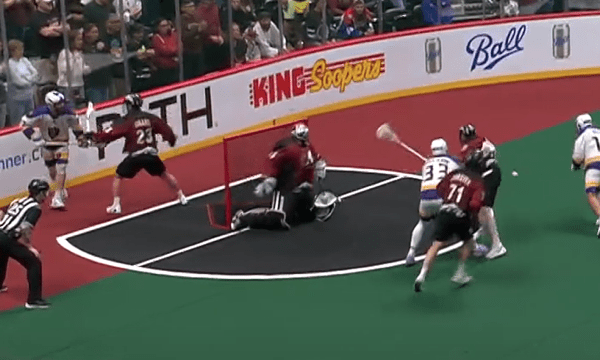
Leclaire steps on the line right after the shot
However
The rule immediately before this one in the rule book, 67.2, says this (emphasis mine):
If an attacking player who, after taking a shot on goal, or making a pass, steps by way of his momentum into the crease and then immediately out, is not in violation of the goal – crease area provided the attacking player is not the first to touch the ball (not including after a touch by the goalie) and or directly interferes with an opposing player who is attempting to pick up the ball.
To me, this sounds exactly like what happened here. If you watch Leclaire’s first shot (here’s the video, go to time index 2:29:31), he shoots and then his momentum carries him forward onto the line. (You can kinda see this in the image above, though it’s not clear that he is actually stepping on the line, and you can’t tell that it was his momentum that pushed him there.) He immediately steps back, and then receives the pass a second or two later. He is not the first to touch the ball (Berg is), and there is no interference with an opposing player. By this rule, the fact that he had touched the line should not be considered and the goal should count.
But the league did an extra review and determined that the official’s review was wrong, which means that either they didn’t consider rule 67.2 at all (seems unlikely) or they decided that it didn’t apply. I don’t know which it is.
So what do we do about it?
The league said that the officials involved in this game would not be officiating any other games in these playoffs. That’s fine in terms of accountability of the officials, but Colorado’s season is still done, and it shouldn’t be. Even if the Seals are beaten by the Rock in the semis or by Halifax/Georgia in the finals, the Mammoth might have won those series. If San Diego goes on to win the Championship, will we put an asterisk next to it in the NLL record books? It’s a horrible situation.
Like it or not, the only realistic “solution” is that we just accept that a mistake was made but keep going. It obviously sucks for Colorado. It sucks for the NLL because they will forever have this hanging over them. In a way, it also sucks for San Diego (though to a far lesser degree) if they do win because many will consider it an “invalid” or “stolen” Championship.
Someone mentioned the possibility of bringing both the Mammoth and the Seals to Toronto (Hamilton) for game one of the semi-finals next weekend. They would finish their overtime game and the winner would play the Rock in game one. I don’t hate that idea (partially because I’ll be there), but there’s more to it than just flying the players in. They’d need their entire staff – everyone who the team would normally bring to an away game – and all their equipment. And they’d need shootaround time earlier in the day. And they’d need practice time before the game. And a third dressing room. And the league would likely want to televise it, or at least broadcast it on NLL+, and there are logistics there. And the players and staff need to get paid for an extra day, and there may be CBA implications.
If after all that, they continue their overtime period and San Diego scores a completely legal goal 20 seconds in, that’s an awful lot of effort and expense to bring the Mammoth in for 20 seconds. Plus if Colorado wins, then as the higher seed, game one of the semis should be in Colorado.
As I said, it’s a horrible situation and there aren’t any great solutions. Even Coach McBride seemed to reluctantly accept that there was nothing more that could be done. I feel terrible for the Mammoth fans and players for getting so close to their ultimate goal and having it unfairly taken away.

