2016 NLL: Who’s in, who’s out

All of the roster changes in one article! That’s why you pay the big bucks to read this blog.

Note that these are the changes as of the final roster from last season, so a player might be listed as “In” even if he played for that team during last season.

Buffalo Bandits

In: Matthew Bennett, Tyler Ferreira, Brandon Goodwin, Anthony Malcolm, Daryl Veltman
Out: David Brock, Chad Culp, Derek Suddons, John Tavares, Kurtis Wagar, Andrew Watt
IR: Andrew Watt
PUP:
Holdout:
Practice Roster: David Brock, Tim Edwards, Craig England, Adam Will
Suspended: Chad Culp

The first ever Bandits roster with no Tavares. Culp is only out for one game.


Georgia Swarm

In: Reid Acton, Josh Gillam, Jesse King, Drew Petkoff, Randy Staats, Lyle Thompson, Chad Tutton
Out: Sam Bradman, Greg Downing, Jordan Houtby, Brodie MacDonald, Shane MacDonald, Patrick Miles, Corbyn Tao
IR:
PUP:
Brodie MacDonald, Michael Seidel
Holdout:
Practice Roster:
Thomas Hoggarth, Marcus Holman, Jordan Houtby, Sean Young

The Swarm only have one goalie on their roster for now, but Brodie MacDonald says he’s only out for a short while with a chest cold.


New England Black Wolves

In: Dan Ball, Sheldon Burns, Kevin Crowley, Shawn Evans, Mike MacDonald, Shane MacDonald, Brian Megill, Quinn Powless, John Ranagan, Derek Suddons
Out: Garrett Billings, Mark Cockerton, Matt Crough, Michael Diehl, Craig England, Josh Johnson, Jamie Lincoln, Mike Manley, Mike McNamara, Drew Petkoff
IR: Mike Manley, Mike McNamara, Andrew Suitor
PUP: 
Holdout:
Practice Roster: Phil Caputo, Wenster Green, Zac Reid, Pete Rennie

Wow, huge turnover from the Black Wolves / Wings organization! Who saw that coming?


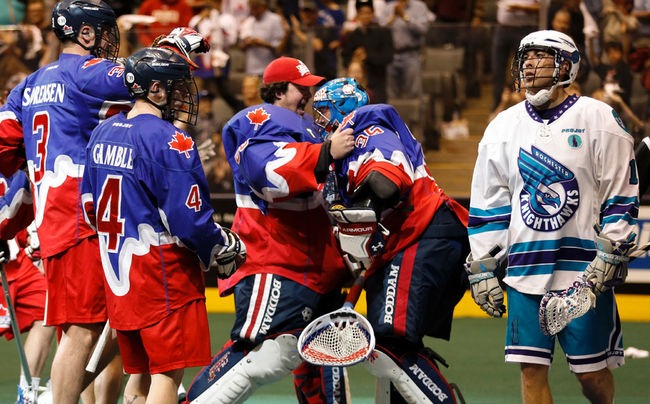
Rochester Knighthawks

In: Adam Bomberry, Graeme Hossack, Brandon Styres
Out: Colin Boucher, Angus Goodleaf, Zac Reid, Brad Self
IR:
PUP: Angus Goodleaf, Brad Self
Holdout:
Practice Roster: Brad Gillies, Joel Matthews, Derek Searle, Ty Thompson

Can you imagine? An NLL GM signs his own son! Crazy.


Toronto Rock

In: Glen Bryan, Turner Evans, Dan Lintner, Luc Magnan
Out: Kevin Crowley, Damon Edwards, Kevin Ross, Josh Sanderson
IR: Scott Johnston
PUP:  Damon Edwards, Kevin Ross, Josh Sanderson
Holdout:
Practice Roster: Kyle Acquin, Steve Fryer, Jordan Robertson
Protected: Mike Grimes

The loss of Josh Sanderson is huge for the Rock – with respect to JT, likely the biggest loss for any team.


Calgary Roughnecks

In: Tyson Bell, Wesley Berg, Mitch de Snoo, Christian Del Bianco, Tyler Digby, Kellen LeClair, Garrett McIntosh, Reilly O’Connor
Out: Shawn Evans, Andrew McBride, Pete McFetridge, Jeff Moleski, Sean Pollock, Geoff Snider, Daryl Veltman
IR: Pete McFetridge
PUP: 
Holdout:
Practice Roster: Patrick O’Meara

That’s a lotta big names replaced with Tyler Digby and a group of rookies.


Colorado Mammoth

In: Callum Crawford, Jackson Decker, Greg Downing, Ilija Gajic, Jordan Gilles, Josh Sullivan, Bryce Sweeting, Chris Wardle
Out: Dan Ball, Tyler Codron, Cam Flint, Ian Hawksbee, Colton Porter, Alex Turner, Drew Westervelt, Mike Woods
IR: Tyler Codron
PUP:  Cam Flint
Holdout:
Practice Roster: Conrad Chapman, Jamie Lincoln, Mike Woods

Lots of changes in Colorado as well but adding Crawford and Gajic strengthens an already-strong offense.


Saskatchewan Rush

In: Curtis Knight
Out: Matthew Dinsdale, Matt MacGrotty
IR:
PUP:  Matthew Dinsdale
Holdout:
Practice Roster: Doug Buchan, Jakob Doucet, Matt MacGrotty, Dan Taylor

Wow, very little turnover from the defending champs! Who saw that coming?


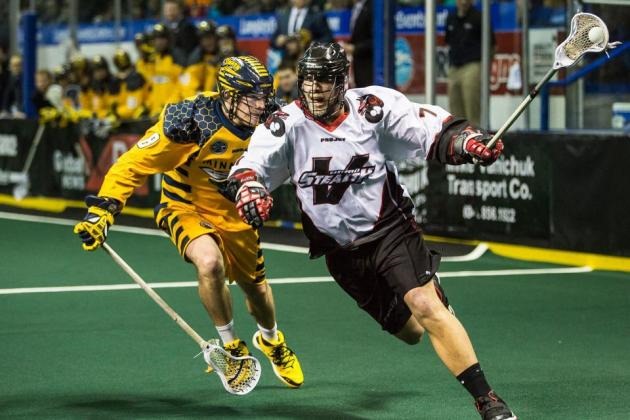
Vancouver Stealth

In: Matt Beers, Garrett Billings, Travis Cornwall, Jordan Durston, Ian Hawksbee, Brier Jonathan, Chris Levis, Jeff Moleski
Out: Tyler Burton, Tyler Digby, Ilija Gajic, Tyler Hass, Brad Kri, Tyler Richards, Rory Smith, Jarrett Toll
IR: Tyler Hass, Rory Smith
PUP: 
Holdout:
Practice Roster: Keegan Bal, Cody Hagedorn, Jarrett Toll, Ryan Wagner

Possibly the most improved team on paper, except at goaltender. No disrespect to Eric Penney and Chris Levis, but replacing Tyler Richards is a pretty tall order.
The NLL’s most successful franchise

It’s a cycle that almost every pro sports team goes through. If you look back over the history of most teams that have been around for a while, they’ve had periods where they’re really good, at or near the top of the league, and then other periods where they’re terrible. Think of any team that’s been successful over the last year or two: the Royals in baseball, the Clippers in basketball, the Islanders in hockey. It wasn’t that long ago that all three of those teams were terrible, near the bottom of their respective leagues.

Alternatively, think of any team that’s been terrible over the last few years: the Knicks, the Oilers, the Phillies. I can certainly remember times when those teams were at the top of their leagues.  Every team has times where they’re really great and times where they’re really bad. Even the Cubs won the NL Central three times from 2003-2008.

This has certainly happened in the NLL as well. The Edmonton Rush were arguably the best team of each of the last two years but were terrible for a decade before that. The Washington Stealth went to the Championship in three out of their four seasons, but were 4-12 and dead last in the fourth. The Wings won 6 Championships in their first 15 years, then only made the playoffs 3 times in their last 12. The Rock, Bandits, and Mammoth have each won championships and also sat near the bottom of the league during the last 10 years. The Minnesota Swarm may be a bit of an outlier here; they were never a really great team and never reached the finals, but they were a very good team for a few years, getting to the division finals twice. On the flipside, their last couple of years in Minnesota were pretty bad.

(Aside: The NLL is a little different because of the team turnover. I’m only looking at teams that have been around for ten years or more. There are a lot of teams who didn’t have a long enough existence to consider. The New Jersey / Anaheim Storm, Ottawa Rebel, and Montreal Express never stuck around long enough to get good. The Arizona Sting went to 2 Championships in 4 years but never finished above 9-7 or below 7-9.)

Knighthawks

But in the NLL, there are two oddball teams that have mostly defied the longevity rule.

The Calgary Roughnecks were terrible in their first season, when they finished 4-12. But in the 13 seasons since then, they  have only finished below .500 twice, have never missed the playoffs, and have finished with 10+ wins 7 times. Even last year when they started 0-6 and finished 7-11, they managed to get to the Western finals. Other than their debut season (when you kind of expect a team to suck) and for part of 2015, the Roughnecks have never really been terrible.

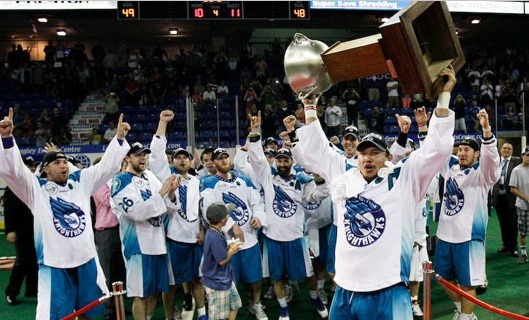
But take a look at the Rochester Knighthawks. In their twenty-one seasons, they have only finished below .500 three times, and all three times they were just below .500 at 7-9. What’s more: they won the Championship in one of those 7-9 seasons. Let me say that another way: they won the Championship in 2012 after finishing the regular season tied for the worst record in franchise history. They have only missed the playoffs twice in 21 years and as we all remember, are the only team ever to win three straight Championships. In their debut season, they went to the Championship (and lost it in OT).

If you had to pick the most successful NLL franchise during its existence, you could argue the Rock might be the best choice given the number of Championships in that time. But they had a four year stretch where they were 10 games under .500 and missed the playoffs twice. The Wings were one of the best choices for the first half of their lifetime, and one of the worst choices for the second half. The Roughnecks would also have been a very good option, but they’ve had strong regular season numbers and not so much in the playoffs.

For my money, the Rochester Knighthawks win the prize. They have never had a single terrible season, but have had some outstanding ones. I know it’s no 22 in a row, Bandits fans, but they won 16 straight games from 2007-2008. They have never finished last in their division. They have won five Championships and appeared in four more, and have seen some of the best players in the game on their benches including the Gaits, John Grant, Shawn Williams, Shawn Evans, Dan Dawson, Cody Jamieson, and Matt Vinc.

They say any NLL team can beat any other on any given night. This is mostly true for the non-Charlottes and non-Anaheims of the league. But let’s face it, there were years that this was not true for the Rock, Bandits, Mammoth, or Roughnecks. But there has never been a time when playing the Knighthawks that they didn’t have a good chance of beating you.

NLL Trades: one big, two bigger

After the huge trades we saw at the trade deadline last year involving names like Billings, Suitor, Powless, and Schuss, you’d think the NLL might be all blockbuster’ed out for a while. It lasted about half a year before we started seeing some more “holy crap” trades. But it all seems like one big trade involving almost half the teams in the league. I almost started to lose track of who went where, so I’ll break it down.

Billings went from Toronto to New England for Kevin Crowley but then Crowley was sent back to New England for Dan Lintner while Billings was sent to Vancouver for Tyler Digby who was then traded to Calgary for Shawn Evans. And a bunch of draft picks changed hands as well.

Got it?

OK. At the trade deadline last season, Garrett Billings was sent to New England for Kevin Crowley. As posited by me and totally unconfirmed and uncorroborated, this deal included a gentleman’s agreement that Crowley would be sent back to New England at the end of the season. This happened in early October, as Crowley was traded to the Black Wolves for draft pick Dan Lintner and a second round pick in 2016. This wasn’t quite a Holy Crap trade, but it was significant.

But the combination of Crowley and Billings on the same roster was not to be. Holy Crap Trade #1 happened two weeks later, sending Billings to Vancouver in exchange for Tyler Digby and a second round pick in 2017. This is where Billings’ part of the story ends. He’s now playing in his home town of Langley, and western goalies are very worried about the impact he’ll have on guys like Rhys Duch and Corey Small. But we weren’t done yet. A day later, Holy Crap Trade #2 happened.

Tyler Digby

Tyler Digby, it was said, wanted to be in the East because he recently moved to Pennsylvania. But the ink on his trade to New England was barely dry before he was traded again. Digby went to the Calgary Roughnecks for who else but the reigning league MVP, Shawn Freaking Evans, who wanted to play closer to his home in Peterborough. New England’s first round draft picks in 2018 and 2019 now also belong to Calgary, and Calgary’s third round pick in 2018 goes to New England. This marks only the second time in league history that the current MVP was traded, the first being Gary Gait who was sent from Philadelphia to Baltimore in 1998. But as surprising as the Evans trade was, the Gait trade blows it away. At that point, Gait had won three straight MVP awards and after the trade, he won the next two as well.

Did you sense the trend here? Billings is back home. Evans is closer to home. Crowley lives in Philadelphia, so he’s also closer to home. Digby wanted to be, but it didn’t work out. And the reason Gait was traded in 1998? To be closer to his home in Baltimore.

The trades themselves might have been surprising, but if the reasoning behind them surprises you, you’re obviously new here. Welcome to the NLL.

In a nutshell

I’ll break down my impressions of each team’s outlook once the rosters are announced in December, but here’s the end result for now:

Toronto is down Kevin Crowley and up Dan Lintner and a second.

New England is down Billings and two first rounders (in 3 years), and up Shawn Freaking Evans and a third.

Vancouver is down Tyler Digby and up Garrett Billings

Calgary is down Shawn Freaking Evans, and up Tyler Digby and two firsts.

The Crowley Trade Episode II: Attack of the Black Wolves

An odd trade occurred on Saturday that I suspect began back in March. The Toronto Rock sent Kevin Crowley back from whence he came, the New England Black Wolves, in exchange for Dan Lintner and New England’s second round pick next year. Crowley, of course, was acquired at the trade deadline last season in exchange for holdout Garrett Billings. Lintner was New England’s first round pick at the draft two weeks ago, 8th overall.

Jamie Dawick is quoted in the press release: “…we’re not far off with this deal from what was also on the table at the trade deadline in March.   We needed a player last year so the 2016 first round draft pick didn’t make sense at the time.” So they agreed in principle to trade Billings for a first and a second, but the Rock needed a player right away so they changed it to Crowley. Now they’ve basically reversed it to what they agreed on originally.

Pure speculation on my part, but it sounds to me like this was a two-stage trade from the start. Instead of the two draft picks, you give us Crowley for the rest of the season, then we’ll trade him back to you for the two draft picks once the season’s done. Perhaps the talking at the draft was that rather than the 2016 first, we’ll take Lintner since we wanted him anyway.

New England kind of won the trade last season, just based on numbers. By the time the deal was done the Rock only had four games left, while New England had eight. The Black Wolves got twice as many games from Billings than the Rock got from Crowley, and Billings averaged 4.5 points per game to Crowley’s 3.0. Then again, the Rock did have Crowley for five playoff games while New England missed the playoffs entirely, so that evens things out some.

Kevin CrowleySo the deal ends up being Billings to New England for a 1st round pick (Lintner), a 2nd round pick (in 2016), and the use of Kevin Crowley for half a season. Is this fair value for someone who averaged 105 points over the previous three seasons? On the surface, no. But if you factor in Billings’ surgery last year, it’s possible the Black Wolves are not getting  the same Garrett Billings who put up those big numbers. If he returns to his previous level of dominance and puts up the big numbers, then good for him and the Black Wolves win the trade. But it’s also possible that Lintner pulls a Brett Hickey and comes out of nowhere to score 50 goals. Honestly, that seems less likely, but who knows? He was picked in the first round because that is a possibility.

For now, I’d have to say that the Black Wolves are the winners here, but unless Billings returns to his pre-injury form and Lintner is a bust, I wouldn’t say the Rock got fleeced either. As with most trades, we won’t really know who won it until a long time after.

NLL musical selections

Many teams play music in the dressing room to get ready for games, and I imagine every team makes different choices.

Here are the favourite musical selections for each NLL team in 2015.

Buffalo Bandits

Tavares


Calgary Roughnecks

Superman


Colorado Mammoth

Mr. Jones


Edmonton Rush

We Are The Champions


Minnesota Swarm

Georgia On My Mind


New England Black Wolves

Casino


Rochester Knighthawks

Jammer


Toronto Rock

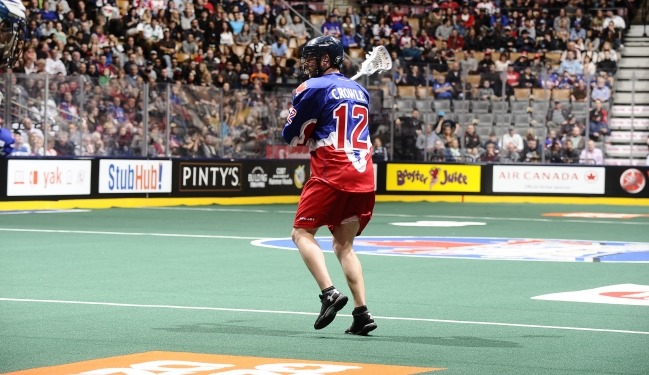
Mr. Crowley


Vancouver Stealth

Pass The Dutchie

My team lost the Championship. And I’m OK with that.

I’ve been a Toronto Rock fan since 2001, and have watched them win Championships live (2003, 2005, 2011) and on TV (2002), and have also watched them lose Championships live (2001) and on TV (2010 and now 2015). Obviously I’m disappointed in the outcome of the series, but part of me is glad the Rush won.

As much as I’d love to have seen the Rock win the Championship in memory of Terry Sanderson, I’m glad the Rush were able to win in memory of Wendy Keenan. The fact that both of these teams could have suffered such a devastating loss just before the season started and still make the finals speaks volumes to the feeling of family among them. And that Edmonton family was dealt another difficult blow when Aaron Bold’s girlfriend Michelle Fines was diagnosed with breast cancer. Instead of playing the season for Wendy, now they were playing for both Wendy and Michelle.

Aaron BoldThe team obviously has a ton of talented players and one of the best coaches in the league, so their success is not a big surprise. But doesn’t it seem that the Rush players were playing with just a little extra spark or something, particularly in Game 2 of the Finals? It’s probably the 20:20 hindsight talking, and if I knew nothing about their off-floor hardships I might not have noticed anything. But perhaps that extra motivation, plus the sound of 12,000+ Rush fans, was just enough to power the Rush to the Championship.

There’s also the fact that in sports, many teams have periods where they are strong contenders and periods where they’re not. The Oilers and Islanders were great in the 80’s and won several Cups each, but ended up near the bottom of the league later on. Even the Leafs went to the conference semifinals five out of six straight years (and the conference finals twice) in the early 2000’s, but have been terrible ever since. I remember the years when the Ottawa Senators were great and made it to the Stanley Cup finals once, but never won a Cup. Their window closed before they could achieve that goal. The Rush haven’t just been a very good team over the past two seasons, they have been amazing, having put together a 29-7 regular season record. But I’m sure the players will tell you that being the best team in the regular season means nothing if you don’t win the Championship. I’m glad they were able to achieve the ultimate success in the NLL before their window closed – not that that closure is imminent. This team could be very good for many years to come.

And I’m glad they were able to win it at home. Hopefully those 12,000+ fans can be an inspiration to Rush owner Bruce Urban. Urban said only a couple of weeks ago that it’s not unlikely that the Rush will be moving during the off-season because he couldn’t get a new arena deal in Edmonton. Maybe a bunch of the fans who showed up to that game will want to come back next year and watch this team defend its Championship. Maybe the turnout at Game 2 will be enough to prove to Urban and the city and the Oilers (who own Rexall Place) that pro lacrosse can work in Edmonton, and a deal can get worked out so the Rush don’t have to move.

Don’t get me wrong, I’m still sad that my team lost. And I don’t want to take anything away from the Rock, they played really well. Brandon Miller played a fantastic game, the Rock D wasn’t quite as strong as Game 2 against Rochester but still played very well, and the offense played well too. Colin Doyle looked like the Doyle of old, Rob Hellyer scored a couple of beauties, and I’m liking Kevin Crowley’s additions to the team more and more – he’s not going to pull in the points that Billings did, but he plays well off the ball as well as defensively.

But the Rush defense was as stifling as ever, and Aaron Bold was excellent, as always. Mark Matthews played like the guy the Rush hoped they’d get when they drafted him almost three years ago. Not that he’s been a disappointment up until now, far from it. But he really stepped up his game this season and went from one of the best offensive players on the team to one of the best in the league. I made the bold (pun intended) prediction on twitter that he’ll be in the top 3 of MVP voting for the next ten years.

So I’m glad the Rush won for Derek and Wendy. For Aaron and Michelle. For Bruce. And for the Rush faithful who turned out strong to watch their team achieve the goal they had been chasing for ten years. Who knows – Wendy, Michelle, the fans, and the Championship might even have saved the franchise.

My most sincere congratulations to the 2015 Edmonton Rush.

Game report: Edmonton 15 @ Toronto 9, NLL Finals Game 1

On the Addicted to Lacrosse show this week, I picked the Rock to win Saturday night’s game because of what I saw last weekend. When the Rock hosted the Knighthawks in the division finals, they came out fired up in game 2, slowed down a touch in the second half, but then came out fired up again in the tiebreaker. They got to Matt Vinc, one of the best goaltenders anywhere, scored a bunch against one of the best defenses in the league, and kept Dan Dawson off the scoreboard (i.e. 0 goals). Any team that can do that, and has the motivation that the Rock has, will be hard to beat in the finals, especially at home. So they should win game 1.

Great logic, except it didn’t happen.

I don’t know what was said in the Rock dressing room before the Rochester game that got them so fired up (presumably it was more than just “let’s win it for T!”), but it didn’t work on Saturday night. They did come out looking pretty strong, scoring the first two goals and keeping the Rush offense from getting many decent shots, but the first two goals were the only ones in the quarter for the Rock. After Mark Matthews scored on the power play, the Rush were kept off the board for another 5 minutes before scoring 3 in under two minutes to take the lead. A fifth with under a minute left gave them a 3 goal lead at the end of the first quarter. I tweeted that the Rush were leading 7-3 at the end of the first quarter last week, and they lost. But last week they stopped playing as well as they did in the first, and the Calgary D stepped up. Neither of those things happened in this one.

The Rock weren’t terrible, mostly, but certainly not as strong as we saw last week. Miller was OK but wasn’t seeing the ball well. Rose replaced him in the second and again in the fourth and was better. The Rock D in general was also OK but had some serious lapses in judgement here and there. The Rush D, on the other hand, was stifling, and Aaron Bold was great. He was stopping almost everything from way out (that didn’t get blocked by a defender), and the Rush D wouldn’t let the Rock forwards get in close, so there was basically no way to score on him.

The Rock offense had their moments, some crisp passing and nice goals, but for the most part they were shut down by the Edmonton D. Continuing the trend that Rochester started in the semifinals, the Rush blocked an awful lot of shots. Edmonton’s forwards were generally good but holy cow, Mark Matthews was outstanding. The guy was everywhere – plowing through defenders like they weren’t there, and firing bullets at Miller or Rose. Robert Church had a good night, but I thought Jarrett Davis was very good as well. Davis was the Kasey Beirnes of the Rush: getting into the middle, setting picks, and getting pounded pretty good so that the big O guys (Matthews, Church, Greer, McIntosh) could get better looks at the net.

But the difference in the game was the transition. I couldn’t count the number of times the Rock would get a transition chance that turned into a 5 second possession after a bad shot through two defenders. Basically the Rush defense got out there so fast that the “chance” wasn’t much of a chance once they got near the net. Similarly, Rock forwards got caught on defense a lot because the Rush transition was so fast that there wasn’t time to change. Crowley isn’t bad on defense for a forward, and Josh Sanderson is a better defender at 38 than he used to be, but he’s still not great. But one of the Rush goals in the second half was scored with Sanderson, Hellyer, and Leblanc as three of the defenders. That’s just not their thing.

Game 2 goes next Friday in Edmonton and if the Rock play then like they played on Saturday, this one’s over and congrats to the Rush. But if they play like they played last week, then we’ll have a series.

Other game notes:

  • Attendance was listed as 9257, or about a thousand less than last week. The difference looked and sounded like a lot more than a thousand.
  • The Rock seemed to be dropping the ball a lot on offense. Not missed passes, and not (always) Rush defenders knocking the ball out of their stick, just plain dropping the ball.
  • Kasey Beirnes’ first goal was nice but the pass was even better. Rob Hellyer was lining up to fire a shot until at the last possible moment he saw Beirnes open beside the net. He changed his shot into a pass to Beirnes who buried it. Nice unselfish play.
  • Similarly, Mark Matthews made a beautiful pass in the third to a streaking Zack Greer who put it behind Rose (or Miller, don’t remember who was in at the time). The timing of the pass had to be perfect or Greer, who was being covered by a Rock defender, wouldn’t have gotten it. But it was perfect.
  • Near the end of the game, when the comeback was still possible, the Rock kept losing their own possessions because of moving picks. C’mon guys, when every possession is that important, don’t waste them.

Game reports: Rochester 8 @ Toronto 11, Rochester 2 @ Toronto 8

I almost feel like I have to apologize to the Toronto Rock. I did pick them to win this series and head to the Champions Cup final, but not with much confidence, and I actually changed my pick since I originally had Rochester. (Note that the IL Indoor “NLL staff Picks: Division Finals Game 2 and 3” page has my picks listed incorrectly – I picked Toronto to win both game 2 and the mini-game. I also picked Calgary to win game 2 and Edmonton to win the mini-game. 4 for 4, baby.) But the way Toronto played on Saturday, there was almost no doubt from the opening whistle that Toronto was the better team.

The game started with something odd – rather than announcing each player one by one like they always do, they simply said “Here’s the Toronto Rock!” and the whole team ran out at once. Maybe they decided that they wanted to be viewed as a team rather than a collection of individuals and so they dispensed with the introductions.

The Rock came out on fire. They scored on their first two shots (both by Brett Hickey) and then Stephan Leblanc scored to make it 3-0 just over 3 minutes in. The Knighthawks got on the board then and the Rock calmed down a little, but the Rock had possession down in the Knighthawk end for the majority of the first quarter. In the second, Rochester seemed to get frustrated and got into a bit of penalty trouble, leading to two Rock power play goals. Stephen Keogh scored his second of the night with just a couple of seconds left in the half to cut the lead to 8-3, but it was clear the Rock was in control.

As much as I was enjoying the lead and the intensity with which the team was playing, I had to keep my enthusiasm in check. I have seen enough lacrosse to know that being up by 5 at the half is no guarantee of a win. Not to mention that even if they wiped the floor with the Knighthawks in game 2, there was still the mini-game to play. Momentum (and penalties) might carry over, but the score would not.

In the second half, the Rock seemed to let their foot off the gas. They still seemed in control for the most part, but Vinc played a lot better and the Knighthawks started to get back into the game. By a minute into the 4th, they were only down by two. I don’t know about other fans, but I started to get a little nervous. But then the D clamped down again and the Rock got a couple more by Vinc. I thought the Knighthawks were going to pull their top players to rest them up for the mini-game, but they didn’t; they seemed to continue playing for the comeback win, even when it got to the point of needing four goals in 3 minutes or so.

Photo credit: Jack Boland/Toronto SunBrandon Miller was playing very well but I thought the defense in front of him was outstanding. I also thought that Rochester wasn’t making the most of their possessions; they’d frequently shoot when there was more than 10 seconds left on the shot clock. Matt Vinc had an uncharacteristically bad game. He was better in the second half than the first, but he was giving up goals that he normally wouldn’t. It wasn’t that he wasn’t making the “holy crap” saves that he usually does, he wasn’t even making the “normal” saves that most goalies usually do.

Stephen Keogh came to play, scoring 6 of Rochester’s 8 goals and really looking good. He took a penalty right at the end of the game, which carried over into the mini-game, though I don’t think he knew that. He came out of the box after game 2 ended, and was told by the refs to go back. Some folks on twitter suggested the Knighthawks should have scored on their own net before game 2 ended to negate the penalty, but apparently there was a memo from the league before the playoffs saying that this would result in an unsportsmanlike conduct penalty, as it should.

I was a little worried about the mini-game, since (a) Toronto had only scored 3 goals in the second half, and (b) Matt Vinc was looking much more like the Matt Vinc we expected to see. But the mini-game looked more like the first quarter, as the Rock came out on fire once again. I did not vote for John Lovell as Coach of the Year (well, I put him on the ballot but at #3 or 4), but now I think he should have been higher. They scored 7 goals on 8 shots in less than 7 minutes and completely deflated the Knighthawks. Vinc was finally pulled in favour of Angus Goodleaf but the damage was done by then.

So there have been 5 mini-games in the league in the past 2 years, and I’ve seen two of them. Have to say they’re very exciting to watch, but are they a good idea in general? That I’m not so sure of, but I may get to that in a future article. We’re now down to 2 teams and the first best-of-3 series since 1998. The Rush will be visiting the ACC next weekend, and I am looking forward to it.

Other game notes:

  • Only 10,000 fans at the game, but it was certainly the loudest I’ve heard the ACC in a couple of years.
  • There were several busloads of Rochester fans at one end, cheering loudly for the ‘Hawks. Unfortunately for them, “Hawks” and “Rock” rhyme, and so their chants of “Let’s Go Hawks!” quickly turned into chants of “Let’s Go Rock!” by the hometown fans. I thought it was great to see such a large group from Rochester, just like I love seeing tons of Bandits fans when they play in Toronto. It was a little disappointing to see that about half of them had left before the tiebreaker game was even over. Where did they go? Were they afraid the buses were going to leave without them? Also nice to see the Knighthawks salute them before they left the floor.
  • Kevin Crowley is not just a great forward, he plays some pretty great defense too.
  • Just like last week, Rochester’s defense intercepted a whole bunch of passes, but they really only scored one transition goal all night.
  • A number of those intercepted passes came from Colin Doyle. I also noticed that Doyle took more shots through traffic than many others; he seemed to want to shoot even when it may not have been a good idea.
  • Patrick Merrill took a penalty shot in the mini-game because the Knighthawks took a too-many-men penalty with <2 minutes left. In that case, the Rock could have chosen anyone on the floor to take the shot, so I’m curious why they chose him.

Getting in sync

On Saturday night, we saw a goal scored by the Toronto Rock that shouldn’t have counted. Brett Hickey’s buzzer-beater at the end of the second quarter seemed to have gone in a split-second after the buzzer, but the referees who reviewed it couldn’t find definitive proof that the call was wrong, so they had to allow the goal. I don’t fault the refs for this call since they didn’t have sufficient information to call off the goal. But I have a proposed solution to that problem. Quite honestly, this seems like a fairly obvious solution, so there may be a perfectly good explanation for this that I am not aware of, or some huge drawback that I’m missing.

During the last 30 seconds of each quarter of an NLL game, any reset of the shot clock causes it to be disabled. Usually it’s set to 30 but does not run. I have heard countless broadcast announcers mention this: “With fifteen seconds left in the quarter, the shot clock is off.” But this has two significant drawbacks:

  1. Players cannot see the game clock as easily as the shot clock. In some arenas, they may be able to look up at the ribbon board or another display board above the net that’s showing the game clock, but it’s not as close to their field of vision as the shot clock. The “rule” for determining how much time you have left before you must shoot is given by: “Look at the shot clock unless there is less than 30 seconds left in the quarter and the shot clock has been turned off, in which case look at the game clock.” This inconsistency is confusing and unnecessary.
  2. In the case of a goal that’s scored near the end of the quarter and challenged, the referees are much more likely to have the shot clock available in the replay video than the game clock. We saw this with Hickey’s goal on Saturday. This goal was called a goal on the floor and even though it seemed that the ball went in after time ran out, there was no conclusive evidence and so the call on the floor stood. The shot clock was clearly visible in the video but it said 30 and was not moving, so it was of no value.

I propose that when a shot clock reset is signaled by the refs within the last 30 seconds of a quarter, the shot clock should become synchronized with the game clock. For example, if the referee signals that the shot clock should be reset when there are 17.3 seconds left in the quarter, the shot clock would start counting down from 17.3, exactly in time with the game clock. This eliminates both of the problems I described above:

  1. Players could then simply watch the shot clock like they always do and know how much time is left before they must shoot, regardless of how much time is left in the quarter. There’s no “watch this clock unless it’s off in which case watch this other clock that’s harder to see”, it’s always just “watch the shot clock”.
  2. The shot clock is much more likely to be in the frame when the officials are examining the replay to see if the ball went in on time.

This would require no extra work on the parts of the referees or the shot-clock operator. The software could be programmed so that when a shot-clock reset is indicated and less than 30 seconds remain in the quarter, the shot clock would be set to the current remaining time on the game clock.

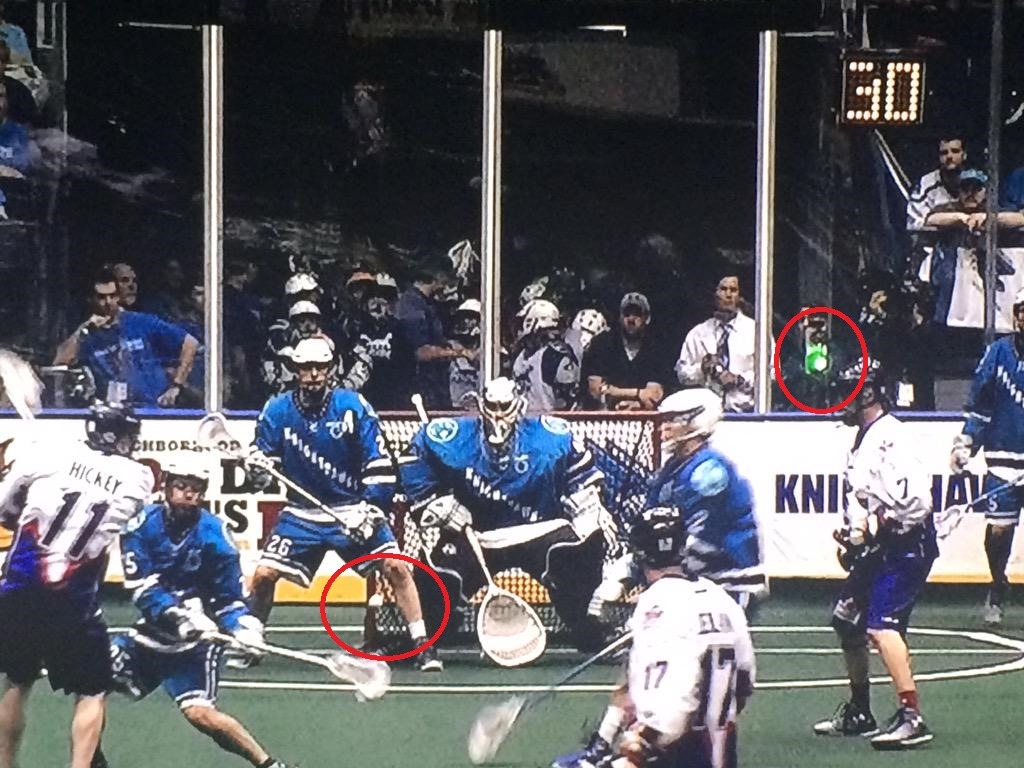
Alternatively, a light could be installed behind the net, next to the goal lights, that is set to come on as soon as the game clock reaches 0. If in the replay, that light is on before the ball goes in the net, the goal does not count. Oddly, there does appear to be a green light behind the net in Rochester that came on once the time reached 0. This light was either ignored or not seen by the officials, as it clearly came on before the ball entered the net. Note the picture below (tweeted shortly after the game by Brad MacArthur, though I added the red circles) showing the light on and the ball not yet in the net.

Buzzer-beaterFor the record, I am a fan of the Toronto Rock. This is not an angry Knighthawk fan saying Toronto’s goal shouldn’t have counted. (This is actually a Toronto fan saying that Toronto’s goal shouldn’t have counted.) I am making this proposal not as a Rock fan but as a lacrosse fan, in the hopes that we can make it easier to get the calls right as often as possible.

As I said, there may be a perfectly good reason why this is not possible. But as far as I can see, this is a fairly simple solution that solves two problems, makes things easier for players; officials; and fans, and has no drawbacks that I am aware of.

2015 Predictions revisited

As many sports bloggers do, I made predictions at the beginning of the season. But as many sports bloggers don’t do, I’m going to go back and see what they were and how I did. I covered some of these on last week’s Addicted to Lacrosse show. I recently had to submit my votes for the IL Indoor annual awards, so for each of the awards below, I’ve listed my pre-season prediction as well as my post-season votes.

Standings:

East

  1. Rochester
  2. Buffalo
  3. Toronto
  4. Minnesota
  5. New England

West

  1. Calgary
  2. Edmonton
  3. Colorado
  4. Vancouver

Three correct out of nine. I wasn’t nearly as optimistic with the Rock as I should have been. I was also far too optimistic with the Roughnecks, but so was everybody else.

Annual Awards

MVP

Prediction: Dan Dawson, Cody Jamieson, Ryan Benesch
Vote: Shawn Evans, Mark Matthews, Ryan Benesch

Jamieson and Dawson had very good years, but not MVP-worthy. Benesch was great, especially down the stretch. But Evans was outstanding.

Goaltender of the Year

Prediction: Aaron Bold, Matt Vinc, Mike Poulin
Vote: Matt Vinc, Aaron Bold, Frankie Scigliano

No surprises from the first two, and I really struggled to decide who got the top vote. And I got the wrong Calgary goalie.

Defensive Player of the Year

Prediction: Kyle Rubisch, Chris Corbeil, Brock Sorensen
Vote: Kyle Rubisch, Chris Corbeil, Sid Smith

I did vote Sorensen fourth.

Transition Player of the Year

Prediction: Jeremy Thompson, Geoff Snider, Karsen Leung, Jordan Hall
Vote: Joey Cupido, Karsen Leung, Jay Thorimbert

Hall didn’t play transition this year, and Thompson had another very good season but Cupido stole the show.

Ben McIntoshRookie of the Year

Prediction: Miles Thompson, Ben McIntosh, Chris Attwood
Vote: Ben McIntosh, Jeremy Noble, Miles Thompson

Attwood didn’t even make the Knighthawks, so that was totally wrong. Miles Thompson had a good rookie season but McIntosh was better. Didn’t have Noble on the list at the beginning since it seemed unlikely he’d play at all.

Les Bartley Award

Prediction: Curt Malawsky, Mike Hasen, Troy Cordingley, John Lovell
Vote: Derek Keenan, Mike Hasen, Curt Malawsky, John Lovell, Troy Cordingley

No idea how I missed Keenan at the beginning of the year.

GM of the Year

Prediction: Terry Sanderson, Curt Styres, Steve Govett, Chris Seinko
Vote: Terry Sanderson, Curt Styres, Steve Govett, Derek Keenan.

Nailed the top three on this one. I even voted Seinko fifth since I thought he did pretty well at the trade deadline. Getting Billings, one of the top two players in the league over the last few seasons, for Crowley was a good deal and grabbing Suitor from the Swarm was good too. It was just too late in the season to turn things around, and the fact that Suitor got hurt again didn’t help.

Team predictions – East

For each team, I made a “Look out for” prediction – a player who I thought would have a great season. Some of them I nailed, others I didn’t quite get right, and in one case, I couldn’t have been more wrong.

Dhane Smith (Photo: Larry Palumbo)Buffalo: Dhane Smith. Nailed this one. Smith went from 59 points in 18 games last year to 107 this year.

Minnesota: Miles Thompson. Not a bad choice, though Shayne Jackson might have been a better one.

New England: Kevin Buchanan. Again, not a bad season. Pat Saunders would have been the breakout player for the Black Wolves.

Rochester: Chris Attwood. Didn’t even make the team. We’ll call that a “miss”. I don’t know who I’d pick from the Knighthawks as having had a breakout season since everyone on the team played at or near what I expected. Maybe Craig Point, since he hadn’t played 15 games in a season since 2011.

Toronto: Brock Sorensen. I thought Sorensen had a very solid year with the Rock and even put him on my list for Defender of the Year. But you might be able to make an argument for Brett Hickey here.

Team predictions – West

Calgary: Karsen Leung. I thought Leung had another solid season and I voted for him as Transition player of the year. But for a breakout season, I’d have to go with Frankie Scigliano, who grabbed the starting goalie job from the struggling Mike Poulin a few weeks into the season and never gave it back.

Colorado: Dillon Ward. Ward didn’t have a great season, but good enough to grab second in the west. Breakout player on the Mammoth would be Jeremy Noble, Eli McLaughlin, or Alex Buque.

Edmonton: Corey Small. Mostly right, except for the team. Small only lasted 2 games with the Rush before being traded to the Stealth, where he had his best season ever. For the Rush, a better choice would have been Zack Greer, who beat his career best points/game average by almost a full point.

Vancouver: Joel McCready. Nailed it. I even said the Powless experiment wouldn’t be the huge success the Stealth were hoping for. We’ll call that a 2-for-1, which offsets the Rochester failure.